Slide Table Actuator Applications That Fit
When a pick-and-place unit starts missing position by a few thousandths, the root cause is often not the valve, controls, or air supply. It is the wrong motion package for the load. In many slide table actuator applications, the difference between stable repeatability and chronic misalignment comes down to one thing – how well the actuator handles guided linear motion under real side loads.
A slide table actuator is usually chosen when a standard rod-style cylinder is not enough. The load needs better support. The tooling overhang is creating a moment load. The cycle has to stay accurate over time, not just on day one. For engineers and maintenance teams working in automated assembly, material handling, or packaging, that distinction matters because guided motion errors tend to show up as scrap, nuisance downtime, and accelerated wear elsewhere in the machine.

Where slide table actuator applications make sense
The best slide table actuator applications are the ones where the actuator is doing more than extending and retracting. It is also carrying the load, maintaining alignment, and resisting off-center force.
In automated assembly cells, slide tables are commonly used to feed parts into nests, bring a subassembly into a pressing station, or move tooling between work positions. These jobs often involve short strokes, frequent cycling, and tight positional consistency. A guided slide table handles these conditions better than a basic cylinder paired with an improvised external guide, especially when space is limited and integration needs to stay compact.
Packaging equipment is another strong fit. Carton positioning, flap folding support, product diverting, and small transfer motions all benefit from a low-profile linear actuator that can tolerate repetitive side loading. In these machines, speed matters, but so does keeping the moving structure stiff enough to avoid vibration at the end of stroke.
Electronics and light-duty precision manufacturing also use slide tables for indexing, clamping support, and component transfer. The appeal here is controlled motion in a compact footprint. The actuator can be mounted close to the work zone without the extra length required by a projecting rod cylinder.
You also see slide tables in end-of-arm tooling and robotic support stations. When a robot places a part into a fixture and a secondary linear motion finishes the alignment or insertion, a guided slide table can provide the short, repeatable stroke needed without adding excessive mass or complexity.
Why engineers choose a slide table over a rod cylinder
The short answer is load control. A rod cylinder generates linear force, but it does not inherently manage side load well. Once the tooling extends away from the rod centerline, moment loads start working against bushing life, rod straightness, and overall repeatability.
A slide table actuator integrates guidance with the drive. That gives the moving platform better resistance to pitch, yaw, and roll. In practical terms, it means better support for offset loads, less need for external guide hardware, and more confidence that the workpiece arrives in the same position cycle after cycle.
This is not always a universal win. Slide tables are excellent for short to moderate stroke applications, but they are not automatically the best answer for long travel or high-thrust jobs. If the application needs substantial stroke length, very high force, or broad contamination tolerance, another actuator style may be a better fit. The right choice depends on stroke, load orientation, moment load, duty cycle, available space, and the quality of the air system feeding it.
Slide table actuator applications in demanding production lines
Assembly and fixture transfer
In assembly equipment, slide tables frequently move components into fixed tooling where alignment matters more than raw force. A common example is presenting a plastic housing, machined part, or stamped component to a joining process. The slide table keeps the part square to the fixture while resisting the side force created by tooling contact.
This matters when the tooling does not hit perfectly at the center of mass. Even a small offset can create instability if the actuator guidance is undersized. A properly selected slide table reduces that movement and protects downstream quality.
Sorting, diverting, and indexing
High-cycle sorting systems often need compact, fast strokes to shift parts from one lane to another. Here, the actuator has to move quickly, stop cleanly, and survive repeated impact loading from product contact or hard-stop conditions. Slide table designs work well because the guided platform helps maintain path accuracy under repetitive duty.
That said, if the payload changes often or the transferred item has inconsistent impact characteristics, cushioning and shock control become more important than the actuator catalog force rating alone. This is where many systems get into trouble. The actuator can produce enough force on paper, but the deceleration profile is still too aggressive for long service life.
Clamping support and secondary motion
Some slide table actuator applications are not about moving product from point A to point B. They are about positioning a clamp, sensor carriage, inspection head, or small tooling package. In these cases, the actuator is part of a process control sequence rather than the main transport axis.
This is often a smart use of a slide table because it avoids overbuilding the station. A compact guided actuator can handle the local motion with good repeatability while the larger machine frame or robot handles the primary movement.
What usually goes wrong in specification
The most common mistake is undersizing for moment load. Buyers often focus on bore size and stroke, then overlook how far the tooling center of gravity sits from the slide surface. That overhang creates leverage, and leverage changes everything. A small payload mounted far from the bearing center can be more damaging than a heavier load mounted close in.
The second mistake is ignoring the full duty cycle. If the actuator runs once per minute, a marginal setup might survive for a long time. If it runs every two seconds across multiple shifts, the same setup will expose every weakness in bearing capacity, shock absorption, and air quality.
Mounting quality is another issue that shows up later as mysterious wear or binding. Slide tables need a flat, rigid mounting surface. If the base twists during installation or the connected tooling induces side stress through poor alignment, the actuator loses the precision it was selected to provide.
Contamination also deserves more attention than it gets. Fine dust, washdown conditions, coolant mist, and abrasive debris can shorten service life fast. In those environments, seal choice, material compatibility, and the surrounding machine design matter just as much as the actuator itself.
How to evaluate slide table actuator applications correctly
Start with the real load, not just the part weight. Include grippers, brackets, sensors, adapters, and any tooling that rides on the moving table. Then calculate the offset from the load center to the bearing plane. If there is any chance of impact, include that too.
Next, look at the motion profile. Short, fast strokes can create significant end-of-stroke stress. If the process involves abrupt stops or part contact at speed, cushioning and external shock management should be considered early, not after the first maintenance issue.
Then review the environment and support systems. Air preparation quality affects seal life and consistency. Mounting rigidity affects smooth travel. Valve sizing affects speed control. Many actuator problems are really system problems, and experienced teams account for that up front.
For OEMs and integrators, standardization can also be a deciding factor. Using a slide table platform that is available in multiple bore sizes and stroke options simplifies machine design, spare parts planning, and future revisions. That is especially valuable when uptime and replacement speed matter as much as initial component cost.
Matching the actuator to the production goal
There is no single best slide table for every machine. A compact unit may be ideal for electronics assembly and completely wrong for a dusty packaging line with side impact. A higher-precision guided slide may be worth the premium in a fixture transfer station but unnecessary for a simple product diverter.
What matters is selecting for the actual failure mode you are trying to prevent. If misalignment is the problem, focus on guidance rigidity and mounting accuracy. If premature wear is the problem, review moment load, contamination exposure, and deceleration. If throughput is the problem, look at speed control, valve flow, and the effect of cycle rate on service life.
For industrial buyers, that is where a supplier with technical support and configuration depth can save time. VidoAir focuses on application-fit components for demanding automation work, which matters when the catalog choice is only the starting point and not the final answer.
A good slide table actuator does not just move a payload. It protects alignment, supports repeatability, and keeps compact machinery productive under real operating conditions. When the application is evaluated with load direction, moment force, cycle rate, and environment in mind, the result is usually fewer surprises on the machine floor – and fewer service calls after startup.
Why Engineers Specify VidoAir™
- Dimensional consistency across product families
- High cycle life validated through real‑world testing
- Fast customization without long engineering lead times
- Application‑driven design support from pneumatic specialists
- Full system compatibility with VidoAir valves, air prep, fittings, and tubing
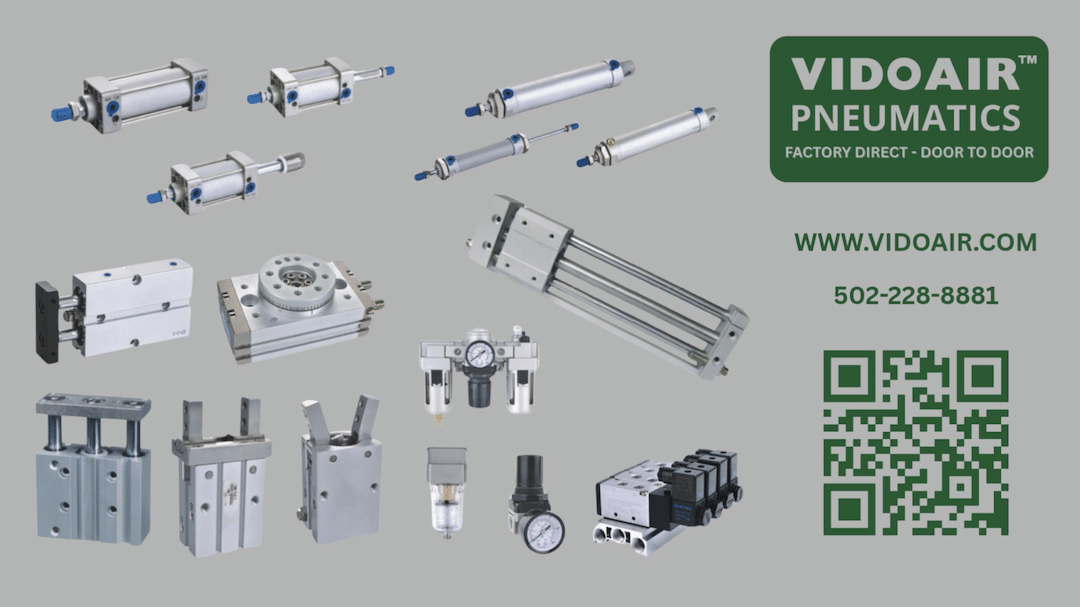
When you specify VidoAir™ pneumatic actuator cylinders you’re choosing components engineered to reduce downtime, simplify integration, and deliver predictable performance across millions of cycles.
We pride ourselves on delivering complete, high-quality pneumatic solutions tailored to your needs. All of our products are engineered for durability, efficiency, and ease of use, ensuring your operations run smoothly. Whether you’re upgrading an existing system or building a new one, VidoAir’s pneumatic componetns are designed to deliver top performance.
Best PracticesTo maximize the performance and lifespan of your pneumatic systems, regualr maintenance is critical. For more on maintaining pneumatic systems, visit Compressed Air Best Practices, a leading resource for compressed air system optimization.