Industrial Robots & Lean Production
AUTOMATION INTELLIGENCE
How robot-based automation systems are reshaping the North American manufacturing economy — and what your business needs to know before integrating one.

How the Industry Functions
Industrial robots sit at the intersection of mechanical engineering, controls technology, software intelligence, and process science. At their most fundamental level, they are programmable, multi-axis machines capable of executing precise, repeatable motion in manufacturing environments — but the ecosystem around them is far more complex than the hardware alone.
The North American manufacturing economy has experienced a sustained renaissance since the mid-2010s, driven largely by reshoring initiatives, tightening labor markets, and accelerating demand for higher product quality with shorter lead times. Industrial robots have moved from niche, high-volume automotive applications to broad adoption across aerospace, food & beverage, medical devices, electronics, logistics, and consumer goods.
“Industrial robots are no longer a luxury for Fortune 500 manufacturers — they are the operating infrastructure of competitive production in North America.”
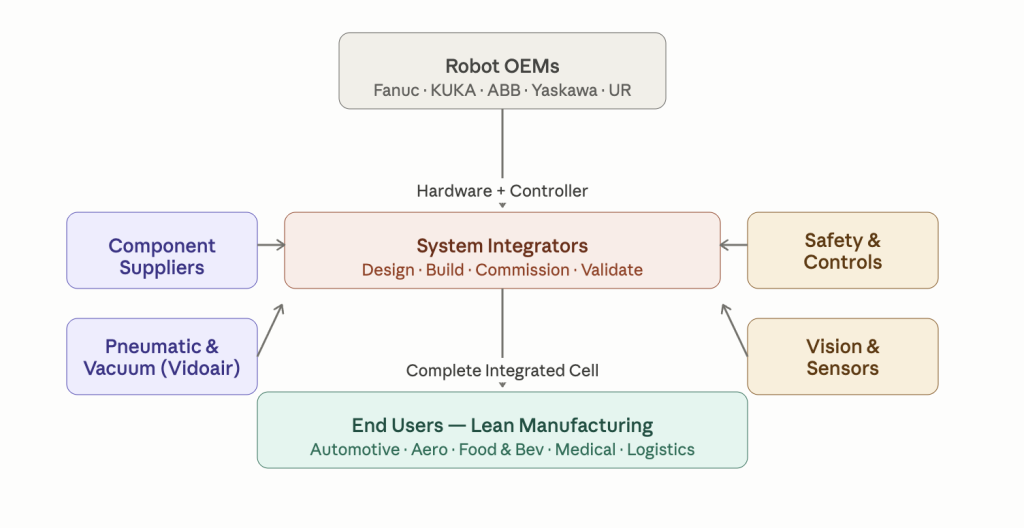
The supply chain supporting robotics is vast: robot OEMs (Fanuc, KUKA, ABB, Yaskawa, Universal Robots) produce the mechanical and controller hardware; system integrators design and build complete automation cells; component suppliers provide end-of-arm tooling (EOAT), sensors, conveyors, safety systems, and — critically for many applications — pneumatic actuators and vacuum handling systems. Essential in this ecosystem is a reliabel supplier of high quality, long-life pneumatic and vacuum solutions that enable the material-handling capabilities most robotic cells depend upon.
The integration ecosystem around industrial robots is typically organized around three tiers: the robot OEM, the Tier 1 system integrator who builds and validates the complete cell, and the Tier 2 component and service specialists who supply sub-systems. Lean Manufacturing philosophy — with its relentless focus on waste elimination, continuous flow, and pull-based production — provides the organizational framework within which robot-based automation delivers maximum impact.
Why Choose Robot-Based Automation
Before committing capital to a robotic system, manufacturers need a clear strategic rationale that goes beyond “our competitor has robots.” The compelling case for robot-based automation rests on several interconnected pillars:
- Labor Cost Certainty: Robots don’t require benefits, shift differentials, overtime, or turnover costs. In tight labor markets like the current North American environment, the predictability of automated labor cost is itself a competitive advantage.
- Quality Consistency: Robotic systems execute the same motion, at the same speed, with the same force, every cycle. For processes where human variation introduces defects — welding, painting, precision assembly, palletizing — the quality uplift is immediate and measurable.
- Throughput and Cycle Time: Robots operate 24/7, don’t take breaks, and can be programmed for cycle times that would be physically unsustainable for human operators. For bottleneck operations, this capacity expansion has immediate top-line impact.
- Ergonomic and Safety Improvement: Automating hazardous, heavy, or repetitive tasks reduces workplace injuries, OSHA recordables, and workers’ compensation costs — benefits that are often underweighted in ROI analyses.
- Scalability and Flexibility: Modern robots, particularly collaborative robots (cobots) and those equipped with vision systems, can be reprogrammed and redeployed as product lines change — a critical asset in high-mix, low-volume environments.
- Data and Process Intelligence: Robots generate rich operational data — cycle times, torque profiles, error rates — that feeds continuous improvement initiatives and predictive maintenance programs central to Lean operations.
Robots as Waste Eliminators
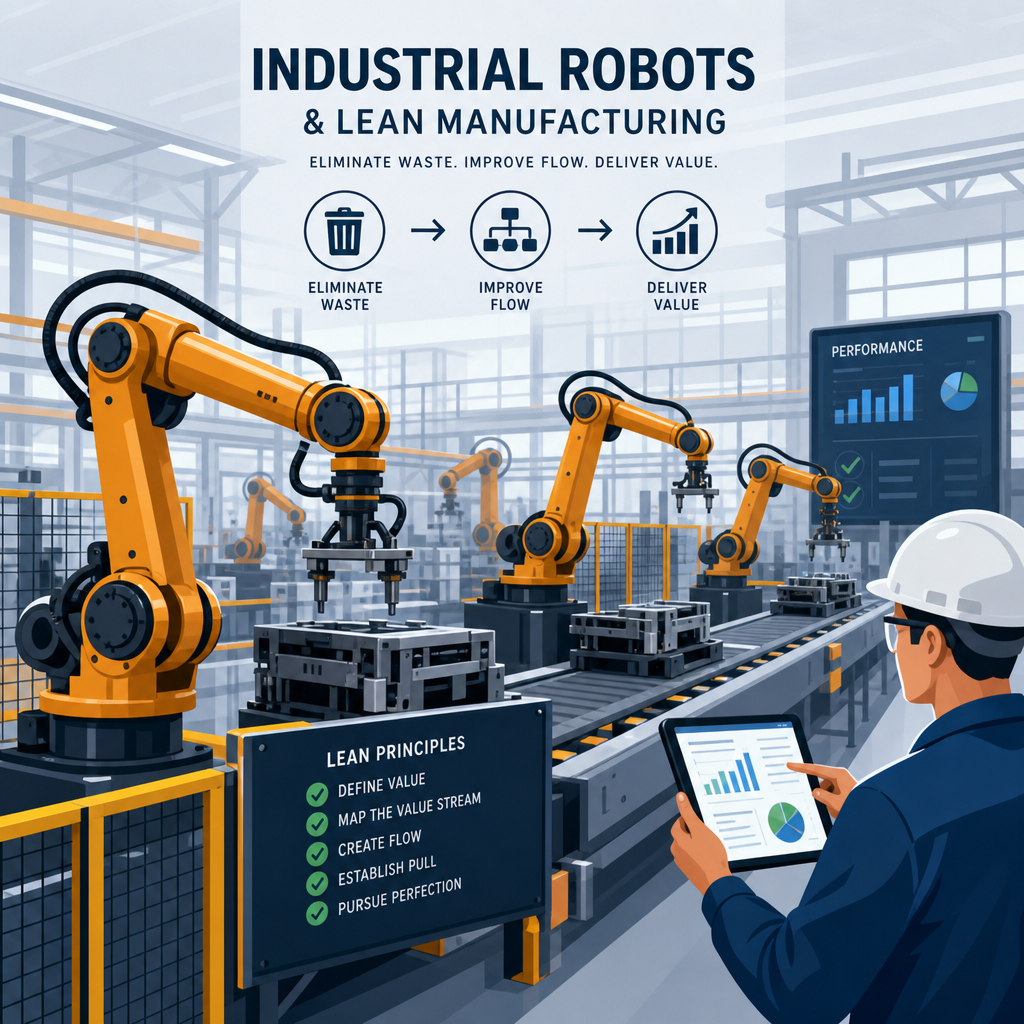
In Lean Manufacturing’s eight-waste framework (TIMWOODS), robots directly address Transport, Motion, Waiting, and Defects. When integrated with pull systems and one-piece flow, a robotic cell doesn’t just replace labor — it redesigns the process around uninterrupted value creation.
Principles of System Integration
A robot is not a solution — a system is a solution. The mechanical arm is perhaps 20–30% of the technical complexity of a complete robotic automation cell. Successful system integration requires disciplined engineering across mechanical, electrical, software, and process domains simultaneously.
Process-First Design
Integration begins with a deep process study — cycle time analysis, part geometry, tolerance requirements, upstream and downstream material flow. Robot selection follows process definition, never the reverse.
Reach & Payload Envelope
The robot must achieve every programmed point within its rated payload and reach envelope with adequate margin. Operating at the edge of envelope limits dramatically shortens joint life and degrades repeatability.
Tooling & EOAT Design
End-of-arm tooling — the gripper, suction cup array, welding torch, or other working end — must be engineered for weight, center of gravity, force requirements, and change-over time.
Controls Architecture
The robot controller must interface with PLCs, safety systems, conveyors, vision systems, and MES/ERP platforms via standardized protocols (EtherNet/IP, PROFINET, OPC-UA). Integration mapping should be defined before any wiring.
Safety System Design
ISO 10218 and ANSI/RIA 15.06 mandate a formal risk assessment. Safety architecture — light curtains, area scanners, safety-rated PLCs, compliant guarding — must be designed in, not bolted on after the fact.
Simulation & Validation
Offline programming (OLP) tools like RoboDK, KUKA Sim, or ABB RobotStudio allow cycle time verification, reach studies, and collision checking before steel is cut. Virtual commissioning dramatically reduces startup.
General Principles of Robot Technology
Understanding the underlying technology of industrial robots allows engineers and operations managers to make better decisions about selection, programming, maintenance, and capability expansion.
Robot Architectures
- Articulated (6-axis): The workhorse of industrial automation. Six rotary joints deliver full spatial and orientation flexibility. Ideal for welding, assembly, machine tending, palletizing.
- SCARA: Four-axis design optimized for high-speed, horizontal pick-and-place. Common in electronics and pharmaceutical assembly.
- Delta/Parallel: Extremely fast, low-payload robots suited to food sorting, small part handling. Up to 150+ picks per minute.
- Collaborative (Cobots): Force-limited robots with inherent safety features enabling human proximity without hard guarding. Ideal for flexible, low-volume, high-mix environments.
- Cartesian/Gantry: Linear axes for heavy payloads or large workspaces; common in machine tending and material handling of large parts.
Key Technical Specifications
- Repeatability: The ability to return to a taught position; typically ±0.02–0.05 mm for industrial robots. Critical for precision assembly and machining.
- Payload: Rated at full reach. Always include EOAT and workpiece weight; exceeding rated payload degrades performance and accelerates wear.
- Reach: Maximum horizontal distance from centerline to tool flange. Ensure adequate margin — programming at maximum reach limits speed and creates singularity risk.
- IP Rating: Determines suitability for washdown, dust, or chemical environments. IP65/IP67 is standard for food and pharmaceutical applications.
- Programming: Teach-pendant (online), offline programming (OLP), or lead-through/hand-guided (cobot). Each has appropriate use cases.
AI-Assisted Vision & Adaptive Gripping
2D and 3D vision systems combined with AI-based object recognition are rapidly expanding what robots can handle — random bin picking, deformable materials, unlabeled parts. This is particularly relevant to pneumatic and vacuum EOAT design, where adaptive suction cup geometry and multi-zone vacuum circuits allow a single gripper to handle wide product families.
The Business Case & Calculating ROI
A compelling business case for the introduction of industrial robots in production requires more than a simple payback calculation. Decision-makers need a full net present value (NPV) model that captures all costs, all benefits, and accounts for the time value of money and project risk.
Complete Cost Categories: Robot hardware, EOAT & tooling, controls & safety systems, installation & civil work, integration engineering, programming & commissioning, operator training, and a realistic contingency (typically 15–20% of total project cost). Many manufacturers underestimate software, training, and ongoing maintenance costs, which can represent 30–40% of total lifecycle cost.
Benefit Quantification: Direct labor savings are the most visible benefit but often not the largest. Factor in: scrap and rework reduction (value × defect rate improvement), throughput increase (units × contribution margin), changeover time reduction, floor space recapture, reduced workers’ comp claims, and avoided capital spending on alternative capacity.
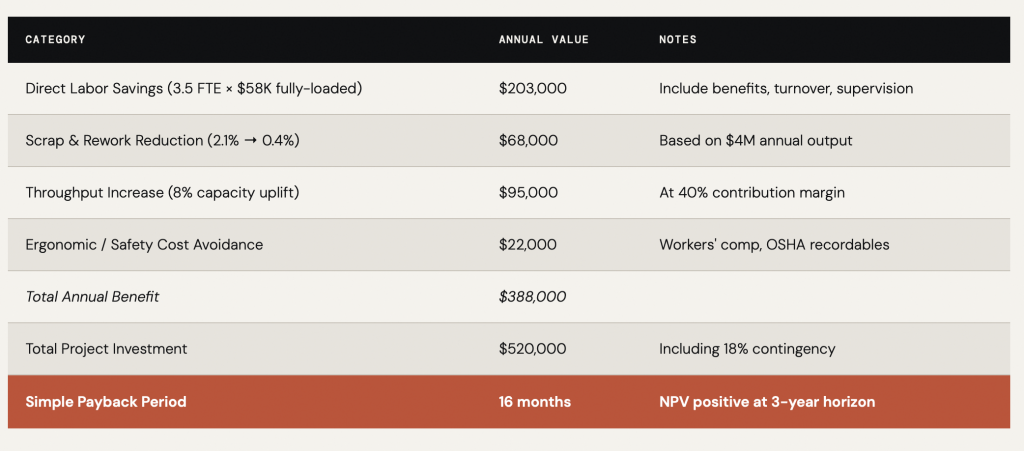
“The projects that fail ROI reviews typically either undercount costs or only count labor savings. A disciplined model captures the full benefit stack — and the full cost stack.”
For manufacturers considering their first robotic installation, a phased approach — beginning with the highest-volume, most repetitive operation — minimizes risk while generating the cash flow and organizational learning that supports subsequent phases. Avoid the temptation to over-automate the first project.
Pneumatic & Vacuum Solutions in Robot Automation
For the majority of industrial robot applications — assembly, pick-and-place, machine tending, palletizing, inspection — the interface between the robot and the workpiece is a pneumatic or vacuum-based end-of-arm tool. Selecting and integrating the right pneumatic and vacuum components is one of the highest-leverage decisions in system design.
Pneumatic Solutions
Compressed air-driven actuators provide the linear and rotary motion that opens/closes grippers, actuates clamps, drives slides, and controls part fixtures in robotic cells.
Parallel and angular pneumatic grippers for part handling
Rodless cylinders for long-stroke material transport
Pneumatic rotary actuators for part orientation
Compact air-driven clamping fixtures for machining
Proportional valves for controlled force and speed
Manifold assemblies for multi-function EOAT
IO-Link enabled valves for smart diagnostics
Blow-off circuits for chip and debris clearing
Vacuum Solutions
Vacuum-based gripping is the dominant technology for flat, smooth, and semi-porous surfaces — from sheet metal and corrugated cardboard to glass, PCBs, and food packaging.
Bellows and flat suction cups in multiple durometers
Multi-zone vacuum circuits for mixed product handling
Venturi generators for on-tool vacuum generation
Central vacuum pumps for high-volume, high-duty cycle applications
Foam-tipped cups for fragile or irregular surfaces
Electrically-actuated vacuum valves for fast cycle timing
Vacuum sensors for part-present confirmation
Leakage monitoring for predictive gripper maintenance
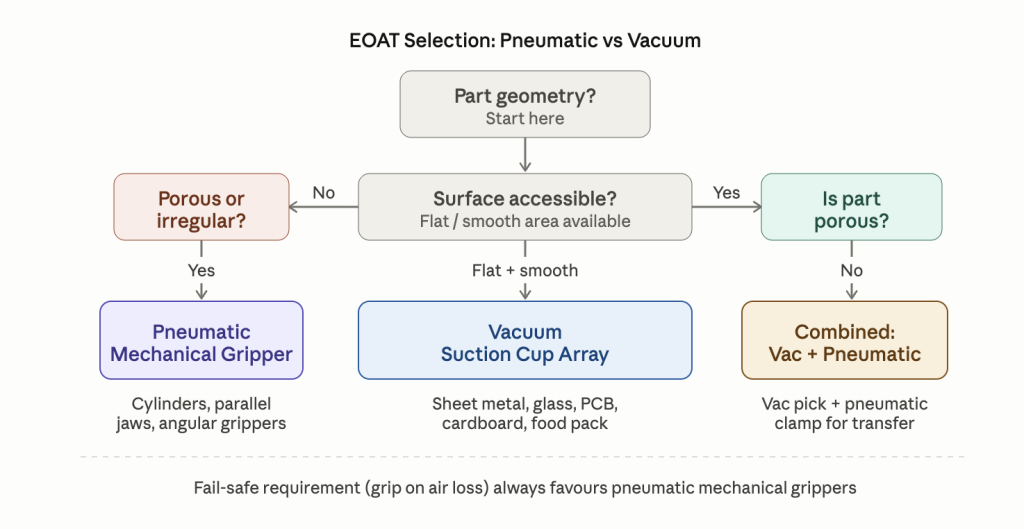
Pneumatic vs. Vacuum Selection Logic: Vacuum gripping excels when parts have adequate surface area, are relatively smooth and non-porous, and require gentle, distributed gripping force. Pneumatic mechanical grippers are preferred for cylindrical, irregular, or porous parts, or where positive retention (fail-safe grip retention on air loss) is a safety requirement. Many modern EOAT designs combine both — vacuum for initial pick, pneumatic clamp for secure transfer.
Design-for-Maintenance: In a production environment, EOAT components wear. Suction cup lips, gripper fingers, and valve seals have defined service lives. Design EOAT for rapid cup and finger replacement without robot teaching, and integrate vacuum leakage sensors to provide early warning before a missed pick causes a downstream defect or line stoppage.
Application Engineering for Pneumatic & Vacuum EOAT
Vidoair’s application engineers work directly with system integrators and end-users to select the optimal pneumatic and vacuum components for each robot application — accounting for part geometry, surface condition, cycle rate, payload, and environmental requirements. Early involvement in EOAT design prevents the costly late-stage redesigns that plague many integrations.
Common Mistakes in Robot Integration
Understanding where robot integration projects fail is as valuable as understanding the principles of good design. The following mistakes recur consistently across failed or under-performing installations — most of them are organizational and process failures rather than technical ones.
01
Choosing the Robot Before Defining the Process
Selecting a robot model based on familiarity, vendor relationship, or price before completing a thorough process study results in mismatched payload, reach, and cycle time capability. Define the process requirements first; let them drive the specification
02
Underestimating EOAT Complexity and Cost
EOAT is frequently underestimated at 5–10% of project cost when it may represent 20–30% or more. Custom pneumatic grippers, multi-function tool changers, and integrated vacuum circuits take significant engineering time and are rarely off-the-shelf.
03
Inadequate Part Presentation and Fixturing
Robots are not tolerant of part position variation. Inconsistent part presentation — from conveyors, trays, or upstream processes — is the leading cause of missed picks and cycle interruptions. Invest in consistent fixturing and positional repeatability upstream of the robot.
04
Underestimating EOAT Complexity and Cost
EOAT is frequently underestimated at 5–10% of project cost when it may represent 20–30% or more. Custom pneumatic grippers, multi-function tool changers, and integrated vacuum circuits take significant engineering time and are rarely off-the-shelf.
05
Insufficient Safety System Design
Safety is not a compliance checkbox — it is an engineering system. Risk assessments that are too superficial, safety distances that are miscalculated, or safety-rated components substituted for standard components create both liability and operational disruption when the safety system triggers unexpectedly.
06
Neglecting Operator Training and Changeover Procedures
A robot cell that only one engineer can program and maintain is an operational risk. Invest in thorough operator training, documented changeover procedures, and basic maintenance training for the production team. Operator acceptance is also critical — involve floor staff early in the design process.
07
Ignoring Pneumatic System Pressure and Flow Requirements
Vacuum grippers operating below required vacuum level and pneumatic actuators starved of flow are common causes of slow cycle times and missed picks — often traceable to undersized compressed air supply lines, incorrect regulator settings, or cumulative leakage in fittings and valves. Commission the pneumatic system as rigorously as the robot itself.
08
Over-Automating the First Project
The temptation to automate every step of a complex process in the first installation creates a long, risky project with an extended payback period and significant organizational learning requirements. Start with the clearest, highest-ROI operation and build from there.
Conclusion & Next Steps
Industrial robots are not the future of North American manufacturing — they are the present. The manufacturers who are thriving today have moved past the question of whether to automate and are focused on how to automate intelligently: selecting the right processes, engineering complete systems (not just placing robots), building disciplined ROI models, and learning from the integration mistakes that others have made.
Pneumatic and vacuum solutions remain foundational to the vast majority of robot cells. Selecting the right gripping technology — and integrating it correctly into the EOAT, robot program, and compressed air system — is one of the highest-leverage decisions in any automation project. It is also one of the most commonly underestimated.
“The best automation projects are process improvements that happen to use robots — not robot installations that happen to improve a process.”
Whether you are evaluating your first robotic cell or scaling an existing automation program, Vidoair’s team of pneumatic and vacuum application engineers is available to support your EOAT design, component selection, and system integration — from concept through commissioning.
READY TO AUTOMATE?
Vidoair’s application engineers are ready to help you select the right pneumatic and vacuum solutions for your next robotic integration project.