
Difference Between Pneumatic and Electro Pneumatic Systems
When a cylinder needs to extend at the right moment every time, the real question is not just air or electricity. It is control strategy. The difference between pneumatic and electro pneumatic system design shows up in response time, wiring, troubleshooting, scalability, and how easily the machine fits into a modern control architecture.
For engineers, OEM teams, and maintenance buyers, this is not a textbook distinction. It affects panel design, spare parts, commissioning time, and uptime on the floor. A basic pneumatic circuit can be fast, durable, and cost-effective. An electro-pneumatic system adds electrical signaling to pneumatic power, which often makes automation more precise and easier to integrate with PLC logic.
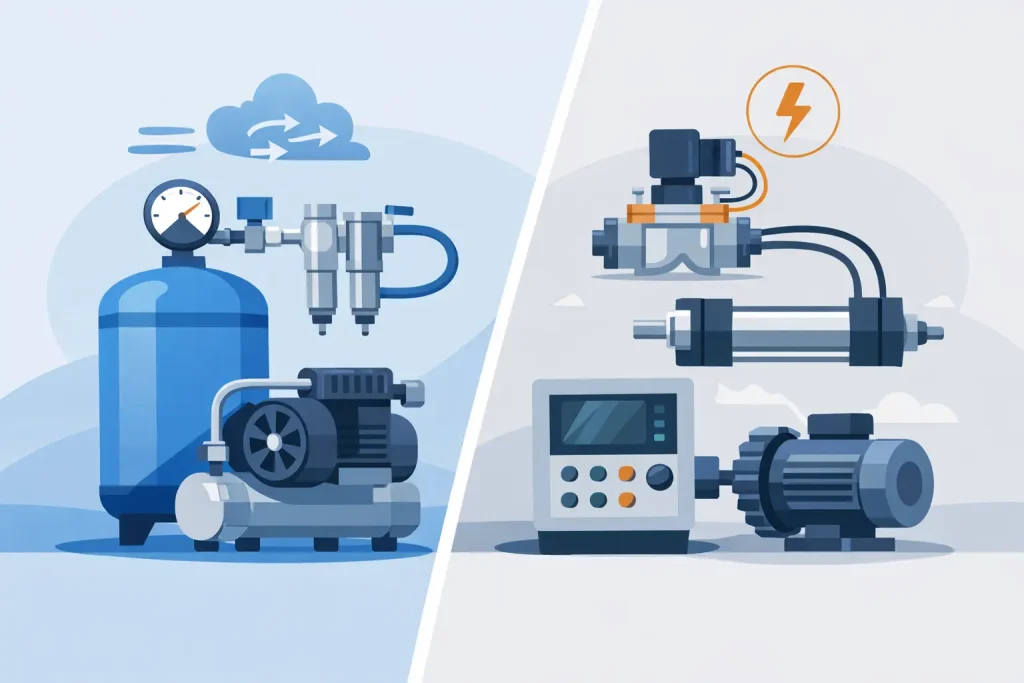
What is the difference between pneumatic and electro pneumatic system design?
At the simplest level, a pneumatic system uses compressed air to generate and control motion, usually through manual, mechanical, or air-actuated valves. An electro-pneumatic system still uses compressed air for motion, but valve shifting and control logic are triggered electrically, typically through solenoid valves, sensors, relays, or PLC outputs.
That means the force-producing medium is often the same in both systems: compressed air. The difference is how commands are issued and managed. In a conventional pneumatic setup, an operator may press a mechanical valve, or an air pilot signal may shift a directional valve. In an electro-pneumatic setup, an electrical signal energizes a solenoid, which shifts the valve and directs airflow to the actuator.
This distinction matters because it changes the entire control philosophy. Pure pneumatic control is simpler in some machines. Electro-pneumatic control is more flexible when sequencing, remote operation, interlocks, and sensor feedback are required.
How a pneumatic system works
A pneumatic system starts with compressed air generation and preparation. Air is filtered, regulated, and sometimes lubricated before it reaches valves and actuators. Directional control valves route the air, while cylinders or rotary actuators convert it into motion.
In a traditional pneumatic circuit, control can remain fully air-based. A pushbutton valve, roller lever valve, or air pilot valve can trigger actuator movement without any electrical input. This approach is common in straightforward applications where the motion sequence is simple and local operator control is enough.
The main advantage here is simplicity. Fewer electrical devices means less wiring, fewer electronic dependencies, and often lower upfront system complexity. In harsh industrial environments, that can be a real benefit, especially where washdown, contamination, or basic repetitive motion are the main concerns.
The trade-off is control depth. As soon as the sequence gets more complex, purely pneumatic logic becomes harder to modify, document, and troubleshoot.
How an electro-pneumatic system works
An electro-pneumatic system keeps compressed air as the working medium but introduces electrical control components. The most common example is a solenoid-operated directional valve controlling a pneumatic cylinder. A PLC, limit switch, sensor, or pushbutton sends the electrical signal. The valve shifts, air flows, and motion occurs.
This setup supports much tighter coordination with the rest of the machine. If a sensor detects part presence, the PLC can energize a solenoid only when all conditions are met. If another axis is not home, the motion can be blocked. If cycle timing needs to change, it can often be adjusted in logic instead of redesigning the air circuit.
That is why electro-pneumatic systems are standard in automated assembly, packaging, material handling, robotics support functions, and OEM machinery. They fit modern control panels, support diagnostics, and scale more easily as the machine grows.
Key differences that affect real-world performance
The biggest practical difference between pneumatic and electro pneumatic system layouts is control method. Pneumatic systems rely on air logic, mechanical actuation, or manual actuation. Electro-pneumatic systems rely on electrical signals to command pneumatic components.
Response and sequencing are also different. Both systems can be fast, but electro-pneumatic control usually offers better repeatability when multiple steps must occur in a precise order. With sensors and PLCs in the loop, it becomes much easier to build conditional logic and safety interlocks.
Installation requirements change as well. A pneumatic-only system needs air lines, valves, and actuators. An electro-pneumatic system needs those same pneumatic components plus wiring, connectors, power supply considerations, and often control hardware. That can increase initial integration work, but it usually pays off when the machine requires flexibility.
Troubleshooting follows the same pattern. Pneumatic-only systems may have fewer failure points on the electrical side, but diagnosing complex air logic can be time-consuming. Electro-pneumatic systems introduce electrical diagnostics, which means technicians can often isolate faults through PLC status, I/O indication, and sensor feedback. Of course, this assumes the plant has the right controls knowledge available.
Cost depends on the application. If the machine needs one or two simple motions, pure pneumatics can be the lower-cost path. If the system needs multiple stations, interlocked sequences, remote operation, or future upgrades, electro-pneumatic control often reduces total cost over the machine lifecycle.
Where pneumatic systems make the most sense
Pneumatic systems are still the right choice in many demanding applications. If the machine function is repetitive, local, and mechanically straightforward, adding electrical control may not improve enough to justify the extra components.
This is often true for basic clamping, indexing, door actuation, ejection, and simple transfer functions. Plants also choose pneumatic-only approaches where electrical complexity needs to stay minimal or where technicians prefer a straightforward maintenance profile.
There is also a durability argument. In rugged environments, fewer electronics can mean fewer variables. That said, component quality matters. Poor air preparation, inconsistent pressure, and low-grade valves will create problems no matter how simple the circuit looks on paper.
Where electro-pneumatic systems deliver better value
Electro-pneumatic systems are usually the stronger choice when the machine needs programmable control, sensor-based decisions, remote signaling, or integration with a larger automation platform. That includes most modern OEM equipment, semi-automated cells, and lines where uptime depends on fast fault isolation.
They also support expansion better. Adding another sensor, changing the cycle sequence, or connecting to a PLC is far easier when the control structure already includes electrical logic. For plant teams working on standardization, electro-pneumatic architecture often aligns better with current controls practices.
For procurement and maintenance teams, there is another benefit: parts strategy. Standardized solenoid valves, manifolds, sensors, air prep units, tubing, and fittings can make replacement planning and inventory control more predictable across multiple machines.
Common misconceptions
One common misconception is that electro-pneumatic means electric actuation. It does not. In most cases, the actuator is still pneumatic. The electrical portion controls the valve, not the force-generating mechanism itself.
Another misconception is that electro-pneumatic always means better performance. Not necessarily. If the application is simple and fixed, pneumatic control may be more efficient and easier to maintain. More advanced control is only valuable when the process actually needs it.
It is also a mistake to evaluate the system only by component price. The better comparison includes commissioning time, panel integration, diagnostics, spare parts, changeover flexibility, and expected downtime risk.
Choosing the right approach for your application
The best system starts with the job requirements. If you need basic motion with minimal control layers, pneumatic design can be the most efficient answer. If you need coordinated sequencing, sensor inputs, remote commands, or PLC integration, electro-pneumatic design is usually the better fit.
Start by asking a few direct questions. How many motion steps are involved? Does the machine need interlocks or conditional logic? Will the sequence change later? Who will maintain it? How fast do faults need to be identified? Those answers usually point clearly in one direction.
In demanding industrial applications, the right answer is rarely about what is newer. It is about what delivers reliable motion, practical maintenance, and control that matches the process. That is where a well-specified valve package, air prep setup, actuator selection, and controls plan make the difference. VidoAir works with manufacturers and integrators who need that balance right the first time, with components built for performance and delivered direct when lead time matters.
If you are comparing the two for a current project, do not ask which system is better in general. Ask which one gives your machine the right level of control without adding unnecessary complexity.



At VidoAir™, we pride ourselves on delivering complete, high-quality pneumatic solutions tailored to your needs. All of our products are engineered for durability, efficiency, and ease of use, ensuring your operations run smoothly. Whether you’re upgrading an existing system or building a new one, VidoAir’s pneumatic components are designed to deliver top performance.