
What Is a Pneumatic Electronic Control System?
When a cylinder extends too hard, a gripper misses position, or a valve reacts a fraction late, the issue is often not the actuator itself. It is the control layer. A pneumatic electronic control system brings compressed air and electronic logic into the same decision loop, giving manufacturers tighter control over motion, timing, pressure, and repeatability without giving up the speed and simplicity that make pneumatics attractive in the first place.
For OEMs, plant teams, and integrators, that matters because pure pneumatic logic can be fast and durable, but it is limited when the application needs variable control, feedback, diagnostics, or coordination with a PLC. At the same time, going fully electric is not always the best answer. It can raise cost, add mechanical complexity, and create issues in washdown, harsh-duty, or high-cycle environments where air power still has clear advantages.
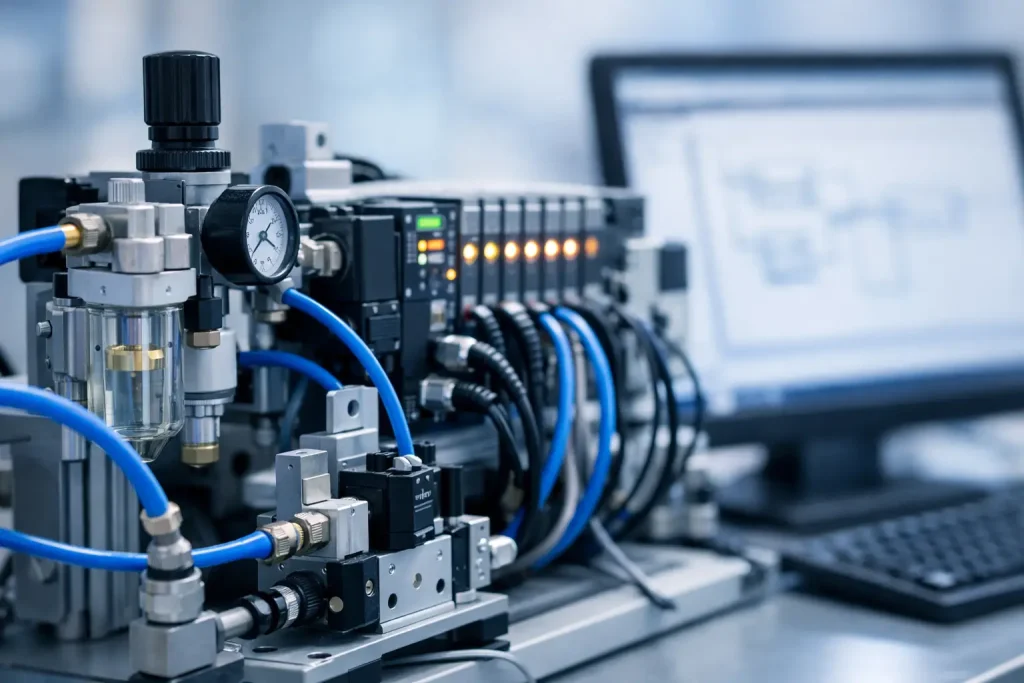
How a pneumatic electronic control system works
At its core, a pneumatic electronic control system uses electronic signals to command pneumatic devices. The electronics make the decision. The pneumatics deliver the force or motion. That sounds simple, but the value is in how precisely the two sides are coordinated.
A typical system includes a controller, often a PLC or dedicated control module, input devices such as sensors or switches, and output devices such as solenoid valves, proportional regulators, or valve manifolds. The controller reads conditions from the machine, processes the logic, and sends an electrical command. That command energizes a valve or regulator, which then directs compressed air to an actuator, gripper, vacuum generator, or other pneumatic device.
In a basic example, a photoeye detects a part at a station. The PLC confirms the machine is in sequence, then energizes a 5-port solenoid valve. Air shifts the cylinder forward, the part is clamped, and a magnetic cylinder switch confirms position. That feedback goes back to the controller, which can trigger the next action only after the clamp is verified. The result is more controlled motion and fewer process errors than a system running only on manual adjustment and open-loop timing.
Why electronic control improves pneumatic performance
The main reason to add electronics is control quality. Pneumatic systems are strong, fast, and cost-effective, but compressed air is compressible. That introduces variation if the machine depends only on fixed valve states and manual settings. Electronics help compensate for that by adding logic, sensing, and dynamic adjustment.
The first improvement is repeatability. Electronic control lets a machine react to real conditions instead of assuming every cycle is identical. If part presence changes, line pressure shifts, or a station lags, the system can wait, adjust, or alarm instead of forcing the next step.
The second improvement is flexibility. With electronic control, changing the sequence often means updating settings or software rather than replumbing the circuit. That is especially useful for OEM platforms, multi-product lines, and workcells that need recipe-based changeovers.
The third improvement is visibility. Once sensors, valve states, and pressure data are tied into a control platform, maintenance teams can troubleshoot much faster. They can identify whether the issue is electrical, pneumatic, mechanical, or sequence-related instead of chasing symptoms across the machine.
That said, more control is not always better if the application is simple. A hand-operated fixture or a single-stroke cylinder may not benefit much from advanced electronic control. The right level depends on cycle criticality, required precision, downtime cost, and how often the machine needs to adapt.
Key components in a pneumatic electronic control system
The controller is the brain. In many industrial applications, this is a PLC handling sequence logic, interlocks, timing, and communications with the rest of the machine. In more compact equipment, it may be a relay-based controller, I/O block, or embedded module.
Sensors provide the information the controller needs to make decisions. These can include cylinder position sensors, pressure switches, vacuum switches, proximity sensors, photoelectric sensors, and flow monitoring devices. Without good feedback, the system is still mostly guessing.
Solenoid valves are the main interface between electronic command and air flow. When energized, they shift the air path to extend, retract, hold, or vent an actuator. Valve response time, Cv, port size, duty rating, and environmental suitability all affect real machine performance.
For applications that need more than simple on-off control, proportional pressure regulators and proportional valves add another layer of precision. Instead of just opening or closing, they can vary pressure or flow in response to an analog signal. That is useful in force control, delicate gripping, tension control, and processes where product variation matters.
Air preparation remains foundational. Filters, regulators, lubricators where appropriate, and dryers protect the system from contamination and unstable supply conditions. Electronic control cannot compensate for poor air quality forever. If the upstream air is wet, dirty, or inconsistent, valve life and actuator performance will suffer.
Where these systems fit best
A pneumatic electronic control system is a strong fit where air power still makes sense but process control expectations are higher than basic valve logic can handle. Packaging machinery is a common example because it combines fast cycling with timing-sensitive functions like indexing, clamping, cutting, and pick-and-place handling.
In assembly automation, electronic control helps coordinate cylinders, grippers, and slides with sensor confirmation so the machine does not move blindly through the sequence. In robotic end-of-arm tooling, it supports better grip verification, vacuum monitoring, and pressure adjustment for mixed parts.
Process equipment also benefits when pressure and timing have to be managed more carefully. Dosing, gate control, part eject, cooling zone movement, and material handling often use pneumatics because they are durable and economical, but electronic supervision is what keeps the process stable.
There is also a strong case in retrofit work. Many plants have reliable pneumatic hardware already installed, but the original controls were built for a fixed process. Updating to an electronically managed system can extend machine life, improve diagnostics, and reduce changeover time without replacing every actuator.
Common design mistakes to avoid
One of the most common mistakes is undersizing the control valve or tubing while expecting high-speed actuator performance. The PLC may be fast, but if the air path restricts flow, the cylinder will still lag. Mechanical motion depends on the full chain, not just the signal.
Another issue is chasing precision with standard on-off components when the application really needs proportional control. If the goal is variable grip force or stable intermediate pressure, a conventional solenoid valve with a manually adjusted regulator may not be enough.
Feedback gaps are another problem. Many systems energize a valve and assume the commanded motion happened. In demanding applications, confirmation matters. Position sensors, pressure monitoring, and vacuum verification add cost, but they also prevent false cycles and improve troubleshooting.
Environmental fit gets overlooked too. Temperature swings, washdown exposure, vibration, and contaminated air can all shorten component life. Selecting electronics and pneumatic hardware for the actual duty conditions is part of designing for uptime, not just for startup.
What buyers should evaluate before specifying one
Start with the motion requirement. Is the application simply extend and retract, or does it need pressure control, force adjustment, speed consistency, or position confirmation? That determines whether standard solenoid valves are enough or whether proportional devices and more advanced sensing are justified.
Next, look at integration. The best pneumatic electronic control system is not just a collection of good parts. It has to fit the machine architecture, available I/O, voltage standard, communication method, service strategy, and maintenance skill level on the floor.
Supply conditions matter just as much as control strategy. Evaluate inlet pressure stability, air quality, duty cycle, and ambient conditions early. A well-specified filter-regulator setup and properly matched valves often prevent issues that later get misdiagnosed as software or electrical faults.
Finally, think about support and availability. Industrial buyers do not just need components that work on paper. They need parts that can be sourced quickly, matched across the system, and backed by technical guidance when the application is not straightforward. That is where a supplier with both broad pneumatic coverage and electro-pneumatic knowledge can save time during design and even more during service.
In industrial automation, the best control strategy is rarely about choosing air or electronics. It is about using each where it performs best. A well-designed pneumatic electronic control system does exactly that – delivering pneumatic power with electronic precision, and giving your machine a better chance to stay accurate, efficient, and ready for the next production demand.
At VidoAir™, we pride ourselves on delivering complete, high-quality pneumatic solutions tailored to your needs. All of our products are engineered for durability, efficiency, and ease of use, ensuring your operations run smoothly. Whether you’re upgrading an existing system or building a new one, VidoAir’s pneumatic components are designed to deliver top performance.