In the world of high-performance automation, even the smallest component can lead to the most significant system failure. A cracked tube from chemical exposure or a persistent leak from an improperly sized line doesn’t just halt production-it compromises efficiency, safety, and your bottom line. Selecting the correct pneumatic air tubing is not a matter of guesswork; it is a critical engineering decision that underpins the reliability and power of your entire system. The sheer number of materials, durometer, and sizing standards can be overwhelming, leaving even experienced technicians questioning their choice.
This definitive guide is engineered to eliminate that uncertainty. We provide the technical proficiency you need to navigate the vast landscape of tubing options with confidence. You will learn to differentiate key materials like Polyurethane, Nylon, and Teflon, master sizing standards to prevent leaks and pressure drops, and select the ideal tubing for any demanding environment-from high-temperature processes to abrasive industrial settings. By the end, you will be equipped to specify the perfect tubing for any application, ensuring long-term system integrity and preventing costly downtime.
Key Takeaways
- Match the tubing material to your application’s specific pressure, temperature, and flexibility demands for optimal performance.
- Accurately specify your tubing by understanding the critical difference between OD (Outside Diameter) and ID (Inside Diameter) in both imperial and metric systems.
- Go beyond basic dimensions by evaluating the working pressure rating and incorporating a safety factor to ensure long-term system reliability.
- Ensure a leak-free, high-efficiency system by mastering the proper cutting and installation techniques for your chosen pneumatic tubing.
What is Pneumatic Air Tubing and Why is it Critical for System Performance?
In the world of industrial automation, pneumatic air tubing is the essential conduit that transports compressed air, the lifeblood of the system. It functions as the critical link between the air compressor, control valves, and actuators that execute precise physical tasks. While the concept of using air to move objects has a long history, as detailed in this overview of what is a pneumatic tube, modern systems rely on meticulously engineered tubing to deliver power with unmatched efficiency and reliability. Unlike rigid pipe, which is used for main air lines, tubing offers the flexibility needed for complex machine layouts.
The selection of the correct tubing is not a minor detail-it is a foundational decision that directly impacts system performance, safety, and operational costs. Choosing the right component ensures optimal airflow, prevents costly leaks, and guarantees the longevity of your entire pneumatic circuit. The core factors in this decision-material, size, and pressure rating-dictate how effectively your system will perform under its specified operating conditions.
The Fundamental Role of Tubing in a Pneumatic Circuit
Think of pneumatic tubing as the veins and arteries of a high-performance automated machine. This network meticulously channels compressed air from its source, through air preparation units that filter and regulate it, to the solenoid valves that direct its flow, and finally to the actuators that perform the work. An undersized or improperly specified tube can bottleneck the entire system, starving a high-speed cylinder or gripper of the airflow it needs. This leads to sluggish performance, reduced cycle times, and a critical loss of system efficiency.
Tubing vs. Hose: Understanding the Key Differences
While often discussed together, tubing and hose serve distinct roles based on their construction and intended application. Understanding these differences is key to engineering a robust and cost-effective system.
- Pneumatic Tubing: Typically semi-rigid, tubing is valued for precise, clean routing within control cabinets and along machine frames. It is specified by its outside diameter (OD) to ensure accurate compatibility with a wide range of push-to-connect fittings.
- Pneumatic Hose: Characterized by its flexibility and more robust, often-reinforced construction, hose is ideal for applications requiring significant movement. It is specified by its inside diameter (ID) and is the preferred choice for connecting to handheld air tools or components on dynamic robotic arms.
Choosing the Right Material: A Deep Dive into Common Options
Selecting the correct material for your pneumatic tubing is a foundational step in designing a reliable and efficient system. The optimal choice is not universal; it hinges on a precise balance of operational demands, including required flexibility, pressure and temperature ratings, and the surrounding chemical environment. The three most prevalent materials-Polyurethane, Nylon, and PTFE-each offer a distinct profile of strengths engineered for specific applications. Making an informed decision here directly impacts system longevity, performance, and overall cost-effectiveness.
Polyurethane (PU): The Standard for Flexibility
Polyurethane is the go-to material when flexibility is paramount. Renowned for its excellent kink and abrasion resistance, PU tubing can be routed through tight spaces and is ideal for applications involving repetitive movement. Its primary limitation is a lower tolerance for high pressure and temperature compared to more rigid materials.
- Best Applications: Robotics, pneumatic control systems, pick-and-place automation, and any machinery with moving parts.
Nylon: The Choice for High Pressure and Durability
For applications demanding robust performance under high pressure and temperature, Nylon is the industry standard. It boasts superior chemical resistance and a low moisture absorption rate, ensuring dimensional stability. Its rigidity requires a larger bend radius, but its durability is unmatched for static, high-stakes industrial environments. This robustness makes it a staple in systems where operational integrity is critical, and installations must comply with standards like the OSHA Pneumatic Safety Regulations to guarantee workplace safety.
- Best Applications: Industrial automation, air brake systems, fuel lines, and chemical transfer lines.
PTFE (Teflon): The Expert for Extreme Environments
When conditions are harsh, PTFE (polytetrafluoroethylene) delivers unparalleled performance. It has the widest temperature range of any polymer and is virtually inert to most industrial chemicals. Its low-friction surface also minimizes pressure drop. While it comes at a higher price point and is less flexible than PU, it is the only viable solution for the most extreme applications.
- Best Applications: Food and beverage processing, high-temperature equipment, medical devices, and aggressive chemical handling.
| Material | Flexibility | Pressure Rating | Chemical Resistance |
|---|---|---|---|
| Polyurethane | Excellent | Good | Good |
| Nylon | Fair | Excellent | Very Good |
| PTFE | Good | Very Good | Excellent |
Other Materials: Polyethylene (PE) and PVC
While PU, Nylon, and PTFE cover most high-performance needs, materials like Polyethylene (PE) and PVC serve specific niches. PE is a highly cost-effective option for low-pressure pneumatic applications where chemical resistance is needed. PVC is a general-purpose material, often available in transparent forms for visual flow monitoring, but it can become brittle over time, especially with UV exposure. These are considered when budget is a primary driver and the operational demands are minimal.
Sizing and Dimensions: A Practical Guide to OD, ID, and Wall Thickness
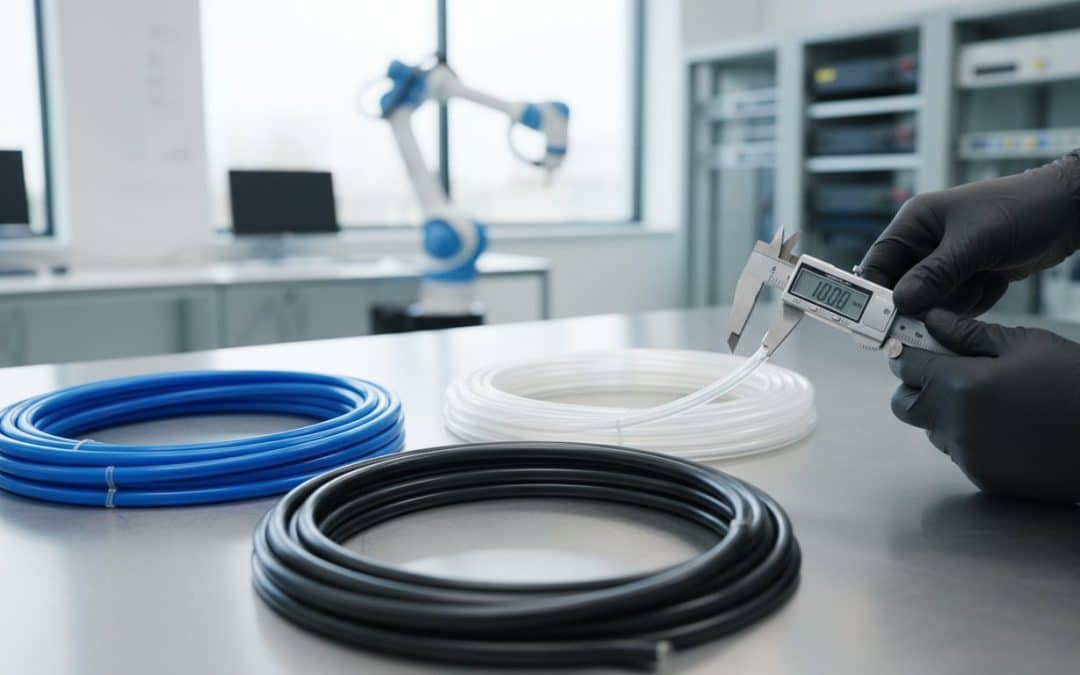
Selecting the correct size of pneumatic tubing is a critical step in engineering a reliable and efficient automation system. Unlike pipes, which are often specified by their internal bore, pneumatic tubing is universally specified by its Outside Diameter (OD). This single measurement is the key to creating secure, leak-proof connections that power your success. Understanding the relationship between OD, Inside Diameter (ID), and wall thickness ensures you choose a product with the right performance characteristics for your application.
Mastering OD, ID, and Wall Thickness
Imagine a cross-section of a tube: the OD is the measurement across the entire diameter, the ID is the diameter of the hollow space, and the wall is the material itself. These are linked by a simple formula: OD – (2 * Wall Thickness) = ID. A thicker wall provides greater structural integrity and kink resistance, directly contributing to a higher pressure rating and increased durability in demanding industrial environments.
Imperial vs. Metric Sizing: Avoiding Common Mismatches
Pneumatic systems are built on either imperial (inch) or metric (millimeter) standards, and the components are not interchangeable. A 1/4″ tube (6.35mm) will not seal correctly in a 6mm fitting. This mismatch is a common source of persistent, hard-to-diagnose leaks that compromise system efficiency. Before ordering, always confirm your system’s standard.
- Common Imperial Sizes: 1/8″, 5/32″, 1/4″, 3/8″, 1/2″
- Common Metric Sizes: 4mm, 6mm, 8mm, 10mm, 12mm
Common Pneumatic Tubing Sizes and Applications
4mm & 5/32″: Ideal for compact cylinders, pilot signals, and instrumentation.
6mm & 1/4″: The most common size for general automation, robotics, and standard actuators.
8mm & 5/16″: Used for medium-sized cylinders and applications requiring higher air flow.
12mm & 1/2″: Best for main air supply lines and powering large, high-demand actuators.
Matching Tubing to Fittings for a Perfect Seal
Modern push-to-connect fittings are meticulously engineered to create a perfect seal by gripping the OD of the tubing. For this mechanism to function, the tubing’s OD must precisely match the fitting’s specified size. Any deviation can compromise the seal, leading to pressure loss, reduced performance, and potential equipment failure. Ensuring this dimensional compatibility is fundamental to system integrity. Find the right pneumatic fittings for your tubing at VidoAir.
Key Performance Specifications for Optimal Reliability
Selecting the right material and size is the foundation, but for high-performance systems, delving into technical specifications is critical for long-term success. These advanced metrics directly impact the safety, efficiency, and longevity of your entire pneumatic circuit. Understanding these details ensures your chosen pneumatic tubing is not just compatible, but meticulously engineered for its specific application, POWERING SUCCESS™ in your operations.
Pressure and Temperature Ratings
A pressure rating, such as “150 PSI at 70°F,” defines the maximum safe operating pressure at a standard ambient temperature. It is crucial to understand that this is not a static value. As operating temperatures increase, the tubing material softens, and its pressure-holding capacity decreases-a principle known as de-rating. For a robust and safe system design, always select tubing with a working pressure rating significantly higher than your system’s maximum pressure spikes to create an essential safety factor.
Bend Radius and Flexibility
The minimum bend radius is the tightest curve a tube can be routed in without kinking, flattening, or sustaining damage. Exceeding this specification is a common cause of premature failure and inefficiency, leading to:
- Restricted or blocked airflow, reducing actuator speed and force.
- Weak points in the tubing wall, creating vulnerabilities for leaks or bursts.
Materials differ greatly in this regard. Polyurethane (PU) offers an excellent, tight bend radius ideal for compact routing, while more rigid materials like Nylon require a larger, more gradual curve to maintain structural integrity.
Environmental Resistance: Chemicals, Moisture, and UV
The operational environment dictates material survivability. Always cross-reference your system’s media-be it lubricated air, oils, or cleaning agents-with a chemical compatibility chart to prevent degradation. Be aware of material-specific traits; for instance, Nylon can absorb moisture in humid environments, which may affect its dimensional stability. For outdoor applications, selecting pneumatic tubing with specific UV-resistant additives is non-negotiable to prevent embrittlement from sun exposure. For detailed specifications across our entire range of robust tubing solutions, we invite you to explore the VidoAir™ product catalog.
Installation and Maintenance Best Practices
Selecting the correct pneumatic tubing is the first step toward a high-performance system. Ensuring its proper installation and ongoing maintenance is critical for maximizing lifespan, preventing costly downtime, and maintaining peak operational efficiency. Adhering to these best practices will protect your investment and keep your automated systems running reliably.
Proper Cutting and Connection Techniques
Precision starts with the cut. Always use a dedicated, sharp tubing cutter to achieve a clean, square cut perpendicular to the tubing length. An angled or crushed cut, often caused by using scissors or wire cutters, will not seal properly within a push-to-connect fitting. This creates an immediate leak path, compromising system pressure and efficiency. When connecting, insert the tube firmly into the fitting until it fully bottoms out. A gentle tug will confirm it is securely locked in place.
Routing for Maximum Lifespan
The physical path of your tubing directly impacts its durability. Strategic routing is essential to avoid premature failure and ensure consistent performance. Follow these core principles for a robust installation:
- Prevent Mechanical Stress: Allow sufficient slack for moving components to prevent tension, but avoid excessively long runs that can sag and snag. Use clamps and supports to secure the tubing and prevent abrasion against machine frames or other components.
- Avoid Sharp Edges: Never route tubing over sharp corners or burred edges. If unavoidable, use protective sheathing or grommets to shield the tubing from cuts and chafing.
- Mind the Heat: Keep a safe distance from high-heat sources like motors, exhaust ports, or heaters. Excessive heat can cause the tubing material to soften, swell, or become brittle, leading to catastrophic failure.
A Proactive Maintenance Checklist
Regular inspection is the key to identifying potential issues before they cause a system shutdown. We recommend a periodic visual check for common signs of wear and degradation in your pneumatic tubing system.
- Kinks and Flattening: Indicates the tubing was bent beyond its minimum bend radius.
- Cuts and Abrasion: Caused by contact with sharp or vibrating surfaces.
- Swelling or Softening: Often a sign of chemical incompatibility or exposure to excessive heat.
- Hardening and Cracking: Typically results from age, UV exposure, or extreme temperature cycles.
By integrating these installation and maintenance protocols, you empower your system with the reliability needed to drive success. For components engineered for durability and peak performance, explore the complete range of solutions at vidoair.com.
Empower Your System with Precision Pneumatic Tubing
As this guide has demonstrated, selecting the correct pneumatic tubing is a foundational decision for any high-performance system. The success of your automation hinges on matching the right material to your application’s environment and ensuring dimensions are precisely specified to maintain pressure integrity and optimal flow. Mastering these elements transforms tubing from a simple component into a cornerstone of operational reliability and efficiency.
When you are ready to implement these principles, VidoAir™ is your direct partner for success. We provide meticulously engineered solutions with the unmatched value of factory-direct pricing. Our extensive inventory of materials and sizes is ready to ship, and our dedicated technical support team is on hand to provide expert guidance for your specific application.
Elevate your system’s performance and ensure lasting reliability. Source high-performance pneumatic tubing directly from the factory. Explore VidoAir’s selection.
Frequently Asked Questions About Pneumatic Tubing
What do the different colors of pneumatic tubing signify?
Pneumatic tubing colors primarily serve as an organizational tool for identifying different lines within a complex system. While there is no universal, mandated standard, many facilities adopt an internal color code. For instance, blue often indicates standard pressurized air, red might be used for emergency stop circuits, and green could signify a return line. This systematic approach simplifies maintenance, troubleshooting, and enhances safety by allowing technicians to quickly trace circuits and understand their function.
Can I use pneumatic tubing for liquids or vacuum applications?
While primarily designed for compressed air, certain types of tubing can be used for other applications if explicitly rated for them. For liquids, you must verify the tubing material’s chemical compatibility and pressure rating to prevent degradation or rupture. For vacuum systems, many standard tubes like polyurethane perform well, but it is critical to check the manufacturer’s vacuum rating. Softer materials or thin-walled tubing may collapse under negative pressure, impeding system performance.
How do I measure the bend radius of my tubing installation?
The minimum bend radius is the tightest curve a tube can make without kinking or restricting flow. To measure the radius of an existing installation, identify the tightest bend in the line. Measure from the inside curve of the tube to the center point of the circle that the bend would form. This value must be equal to or greater than the manufacturer’s specified minimum bend radius to ensure optimal airflow and prevent premature wear or system failure.
What is the most common cause of pneumatic tubing failure?
The most frequent cause of pneumatic tubing failure is physical damage from improper installation and environmental exposure. Kinking the tube beyond its minimum bend radius creates a weak point and restricts flow, leading to system inefficiency and eventual rupture. Abrasions from rubbing against machinery or sharp edges, along with degradation from UV light, extreme temperatures, or chemical exposure, are also primary contributors to leaks and catastrophic failures. Proper routing and material selection are critical for longevity.
Is it safe to reuse pneumatic tubing after disconnecting it?
Reusing tubing is generally not recommended, especially with push-to-connect fittings. The fitting’s grab ring and o-ring create small scratches and indentations on the tubing surface upon connection and removal. These imperfections can compromise the seal when the tube is reinserted, leading to slow, persistent leaks that reduce system efficiency and waste energy. For critical applications, always use a fresh, clean-cut section of tubing to guarantee a reliable, leak-free connection.
How does tubing diameter affect air flow rate and pressure?
Tubing diameter has a direct and significant impact on both flow rate (measured in CFM or L/min) and pressure. A larger inner diameter (ID) provides a wider channel, reducing friction and allowing for a higher volume of air to pass through, thus increasing the flow rate. Conversely, an undersized tube acts as a restriction, creating a significant pressure drop over its length. This starves the downstream component of the required pressure and flow, impairing performance and efficiency.