
A Buyer’s Guide to Pneumatic Pressure Units and Why There Are So Many (Bar, PSI, kgf/cm², Pascals)
Introduction
Pull up a solenoid valve datasheet from a US supplier, an FRL unit from a Chinese factory, and a cylinder spec from a European catalog, and you’ll often see three different pneumatic pressure units on three otherwise identical components. None of them are wrong. They’re just speaking different dialects of the same physical quantity, and if you’re sourcing pneumatic components across borders — which, in this industry, is basically everyone — knowing how to convert between them isn’t optional.
Here’s what each unit actually measures, where it came from, and when it’s the right (or wrong) one to trust.
What Pressure Actually Is
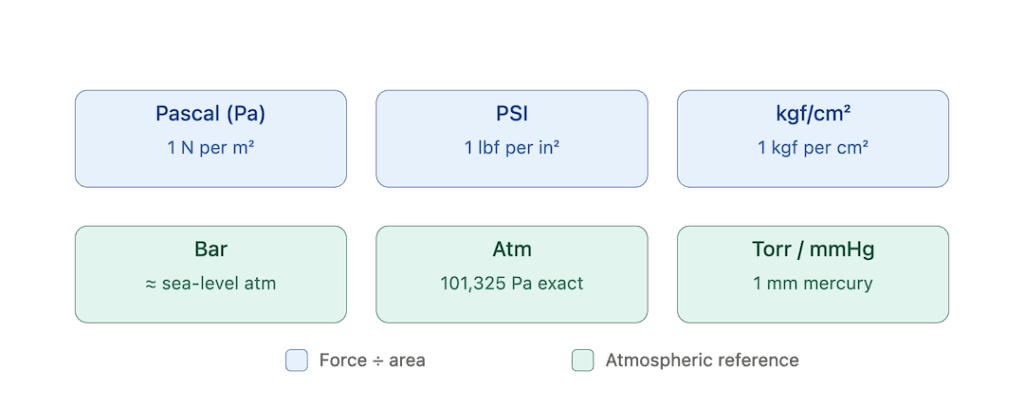
Before comparing pneumatic pressure units, it helps to remember what they’re all measuring: force applied over an area. Everypneumatic pressure units on this list is some combination of a force unit and an area unit, which is exactly why there are so many — different countries standardized on different force and area units before anyone agreed on a single global system.

Pascal (Pa) — The SI Standard
The pascal is the pressure exerted by one newton of force over one square meter. It’s the official SI unit of pressure, named after Blaise Pascal, the 17th-century French mathematician and physicist who studied fluid pressure and vacuums.
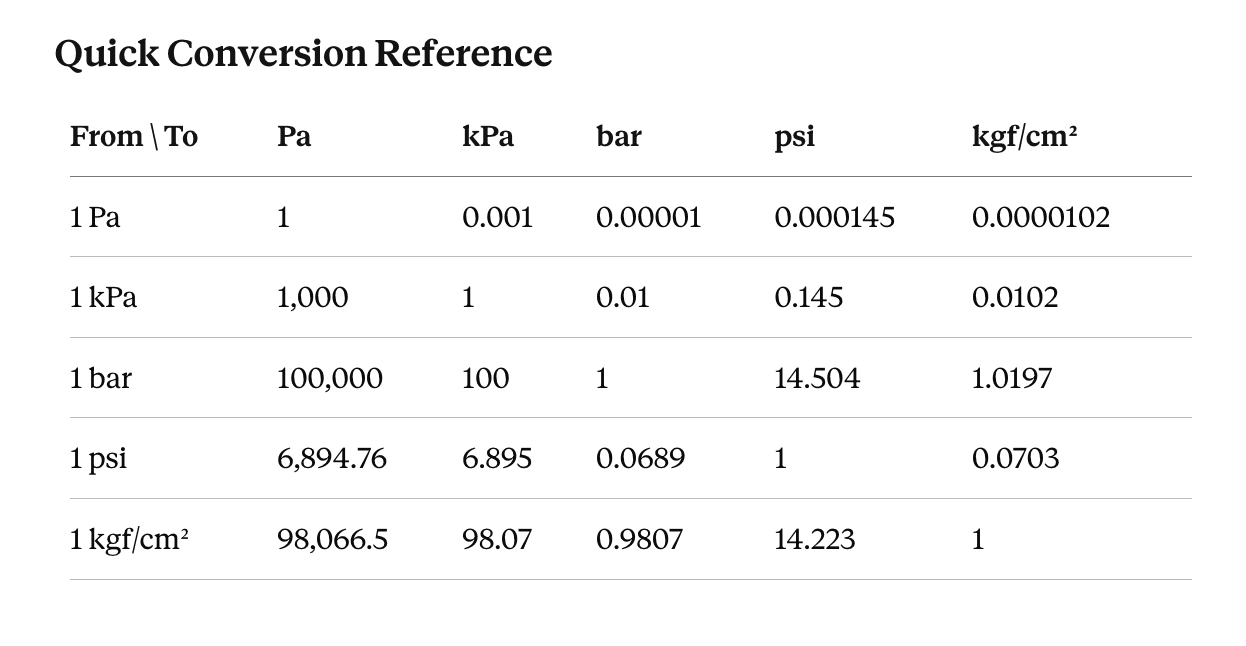
1 Pa = 1 N/m²
Strength: It’s the internationally standardized, scientifically “correct” unit — every other unit on this list can be defined in terms of it.
Weakness: A single pascal is a tiny amount of pressure. Atmospheric pressure at sea level is about 101,325 Pa, so working in raw pascals on an industrial spec sheet means dealing with large, unwieldy numbers.
That’s why pneumatics almost never uses bare pascals — it uses kilopascals (kPa) or megapascals (MPa) instead.
1 kPa = 1,000 Pa
1 MPa = 1,000,000 Pa = 10 bar (roughly 145 psi)
MPa shows up constantly in pneumatic component specs — working pressure, burst pressure, and proof pressure ratings are almost always given in MPa on component and tubing datasheets, because it keeps the numbers in a clean, readable range (0.1 to 10, roughly) instead of six-digit pascal figures.

Bar — The Practical Metric Standard
The bar was defined to sit close to standard atmospheric pressure, which makes it intuitive for everyday engineering use.
1 bar = 100,000 Pa = 100 kPa
1 atmosphere ≈ 1.01325 bar
The name comes from the Greek baros, meaning weight. It was introduced by the British meteorologist William Napier Shaw in the early 1900s, originally for atmospheric pressure work, and it stuck around because “close to 1 atmosphere” is a genuinely useful reference point for engineers.
Strength: Round numbers. A shop air system running at “6 bar” is a number technicians can hold in their head, and it maps almost exactly to a familiar physical reference (sea-level atmospheric pressure).
Weakness: It’s not an official SI unit, even though it’s metric-adjacent and widely tolerated in industry. Some standards bodies discourage its use in favor of kPa/MPa, even though bar remains dominant on the shop floor.
Bar is the default working-pressure unit across most of Europe and increasingly across global pneumatic component catalogs, including SMC, Festo, and Parker documentation.
The pascal is the pressure exerted by one newton of force over one square meter. It’s the official SI unit of pressure, named after Blaise Pascal, the 17th-century French mathematician and physicist who studied fluid pressure and vacuums.
1 Pa = 1 N/m²
Strength: It’s the internationally standardized, scientifically “correct” unit — every other unit on this list can be defined in terms of it.
Weakness: A single pascal is a tiny amount of pressure. Atmospheric pressure at sea level is about 101,325 Pa, so working in raw pascals on an industrial spec sheet means dealing with large, unwieldy numbers.
That’s why pneumatics almost never uses bare pascals — it uses kilopascals (kPa) or megapascals (MPa) instead.
1 kPa = 1,000 Pa
1 MPa = 1,000,000 Pa = 10 bar (roughly 145 psi)
MPa shows up constantly in pneumatic component specs — working pressure, burst pressure, and proof pressure ratings are almost always given in MPa on component and tubing datasheets, because it keeps the numbers in a clean, readable range (0.1 to 10, roughly) instead of six-digit pascal figures.
Pneumatic Pressure Units

PSI — Pounds per Square Inch
PSI is the standard pressure unit in the US and a handful of other countries that still use imperial units for engineering.
1 psi = 6,894.76 Pa ≈ 0.0689 bar
1 bar ≈ 14.5 psi
It’s exactly what it sounds like: the force in pounds exerted over one square inch of area.
Strength: It’s the unit most American technicians, plant engineers, and OSHA-facing documentation are trained on, and gauge equipment across US manufacturing floors is calibrated in it.
Weakness: It’s an imperial holdover in an otherwise metric industry, which means constant unit conversion any time equipment crosses borders — and unit-conversion errors are a real, documented source of mis-specified components. (NASA lost the Mars Climate Orbiter to a metric/imperial mismatch — a $327 million reminder that unit conversion isn’t a rounding exercise.)
PSI is unavoidable for US-facing sales literature and technician-facing documentation, even when the underlying component was engineered and rated in bar or MPa.

kgf/cm² — The Legacy Asian Manufacturing Standard
Kilogram-force per square centimeter is exactly what it sounds like: the force exerted by one kilogram under standard gravity, spread over one square centimeter.
1 kgf/cm² = 98,066.5 Pa ≈ 0.9807 bar ≈ 14.22 psi
This is a legacy metric-adjacent unit — technically not SI, since it mixes a gravity-dependent force unit (kilogram-force) with an area unit — but it’s still widely used in China, Japan, and Korea on pneumatic and hydraulic component spec sheets, largely for historical reasons: it predates the pascal’s adoption as the SI standard and never fully got displaced in regional industrial documentation.
Strength: Conveniently, 1 kgf/cm² is almost exactly 1 bar (within about 2%), so it’s an easy mental approximation for anyone used to metric pressure.
Weakness: It’s not internationally standardized, technically depends on the local value of gravitational acceleration (a subtlety almost nobody accounts for in practice), and it’s a frequent point of confusion when a Chinese-manufactured OEM datasheet gets translated into an English spec sheet — it’s easy to misread as kPa, which is off by roughly a factor of 100.
If you’re converting Chinese-language source documentation — which is a recurring task in this industry — kgf/cm² is one of the more common units to watch for, and one of the easiest to mis-translate.

Atmosphere (atm) and mmHg/Torr — The Reference and Vacuum Units
Two more units show up specifically in vacuum and low-pressure work:
Atmosphere (atm) — defined as exactly 101,325 Pa, based on standard sea-level atmospheric pressure. Mostly used as a reference point rather than a working spec, though you’ll see it in vacuum gripper and vacuum generator documentation.
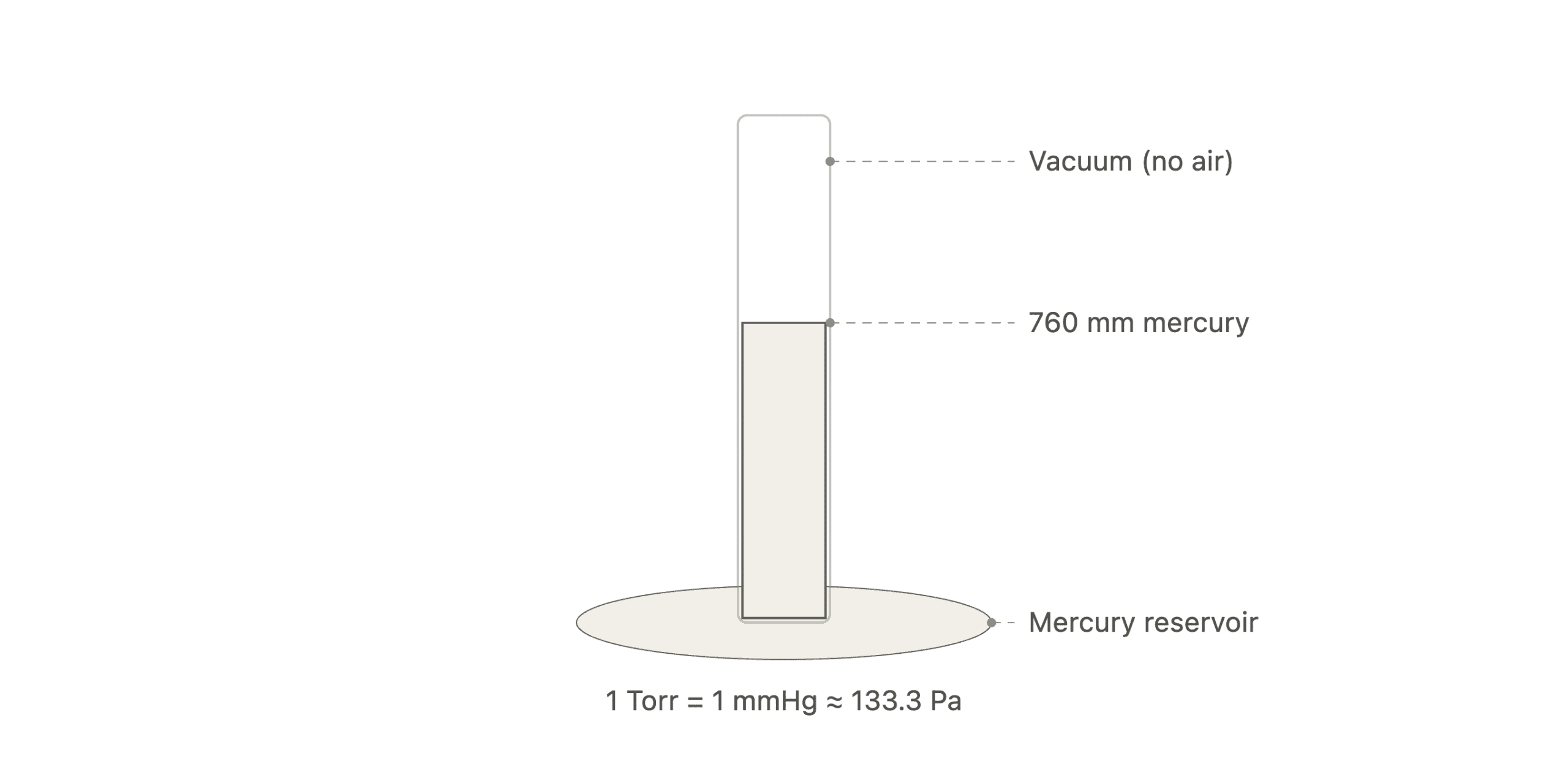
mmHg / Torr — millimeters of mercury, based on the height of a mercury column a given pressure will support. 1 mmHg ≈ 133.3 Pa. Named after Evangelista Torricelli, inventor of the mercury barometer. This unit dominates vacuum pressure specs, medical pressure readings (blood pressure is still reported in mmHg), and some legacy gauge equipment.
For vacuum gripper and EOAT applications, you’ll frequently see vacuum level specified in kPa (negative, relative to atmosphere) or in mmHg/Torr rather than bar or psi — because at low pressures, bar and psi produce awkward, tiny decimal numbers.

Why So Many Pneumatic Pressure Units Survive
The honest answer is history, not engineering necessity. Every industrialized region standardized its own measurement system before anyone coordinated a single global standard, and by the time SI units were formalized, imperial and regional legacy units were too deeply embedded in tooling, gauges, training, and regulation to fully replace. The pascal is the “correct” answer on paper; bar, psi, and kgf/cm² are the units that actually show up on the gauge in front of a technician, because that’s what their region’s industry standardized on generations ago — and nobody re-calibrates an entire national manufacturing base just because SI says so.
What This Means for Sourcing Pneumatic Components
If you’re specifying or sourcing across borders — comparing a US actuator catalog in psi against a factory-direct Chinese datasheet in kgf/cm², or reading a European FRL unit’s rating in bar — the practical takeaway is simple: always convert to a single reference unit before comparing working pressure, burst pressure, or proof pressure specs. A component rated “0.7 MPa” and one rated “100 psi” are close, but not identical (100 psi ≈ 0.689 MPa) — a gap that matters when you’re specifying a safety margin.
At VidoAir™, our datasheets carry MPa as the primary engineering reference (matching international pneumatic industry convention) with bar and psi cross-referenced wherever it helps US-based buyers move faster, so you’re never left doing the conversion math yourself before you can compare parts.
Questions about a specific pressure rating on one of our components? Reach out to the VidoAir™ team — we’re happy to walk through the spec in whatever unit your system runs on.
Why Engineers Specify VidoAir™
- Dimensional consistency across product families
- High cycle life validated through real‑world testing
- Fast customization without long engineering lead times
- Application‑driven design support from pneumatic specialists
- Full system compatibility with VidoAir valves, air prep, fittings, and tubing
When you specify VidoAir™ pneumatic actuator cylinders you’re choosing components engineered to reduce downtime, simplify integration, and deliver predictable performance across millions of cycles.
We pride ourselves on delivering complete, high-quality pneumatic solutions tailored to your needs. All of our products are engineered for durability, efficiency, and ease of use, ensuring your operations run smoothly. Whether you’re upgrading an existing system or building a new one, VidoAir’s pneumatic componetns are designed to deliver top performance.
Best PracticesTo maximize the performance and lifespan of your pneumatic systems, regualr maintenance is critical. For more on maintaining pneumatic systems, visit Compressed Air Best Practices, a leading resource for compressed air system optimization.
Learn More
Looking for industrial robots automation components?
Explore VidoAir’s complete selection of:
- Pneumatic Cylinders
- Solenoid Valves
- Air Preparation Units
- Pneumatic Fittings
- Polyurethane Tubing
- Vacuum Components
- Finger Grippers
- Electro-Pneumatic Controls
Contact the VidoAir™ Engineering Team to discuss your automation application.