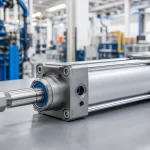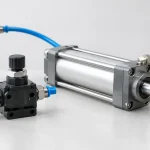

A pneumatic actuator that looks fine on paper can still miss cycle time, stall under load, or hammer end caps if the sizing work stops at bore diameter. That is why engineers asking how to size pneumatic actuator assemblies usually are not looking for a textbook formula – they are trying to avoid undersized motion, wasted air, and field corrections after install.
For demanding industrial applications, actuator sizing is a system decision. Cylinder force, supply pressure, valve flow, tubing length, payload orientation, guide friction, shock at end of stroke, and duty cycle all affect whether the actuator performs as expected. If one variable is off, the rest of the design can be technically correct and still fail in production.
How to size pneumatic actuator force correctly
The starting point is force, but not just the static force needed to move a load. You need the actual working force required at the actuator after friction, misalignment, load angle, pressure variation, and acceleration are considered.
For a basic cylinder, theoretical extension force is piston area multiplied by operating pressure. Retraction force is lower because the rod reduces effective area. That difference matters in clamping, lifting, and any application where the return stroke does real work.
If you are moving a horizontal guided load, the force requirement may be modest and driven mostly by friction and acceleration. If you are lifting vertically, gravity becomes a constant load and the safety margin needs to be more conservative. If the mechanism uses a lever arm or offset linkage, convert the required output force back to the cylinder mounting point rather than sizing from the end effector load alone.
A common sizing mistake is to use line pressure from the compressor nameplate instead of pressure at the actuator during motion. Real systems lose pressure across regulators, solenoid valves, flow controls, tubing, quick fittings, and long runs. If your plant header is 100 psi but the actuator only sees 72 psi at peak flow, the cylinder will not deliver catalog force.
For most industrial applications, it is smart to size with a reasonable reserve rather than using the bare minimum theoretical force. That margin depends on the application. Precision handling and controlled positioning may need moderate oversizing to maintain repeatability without excessive speed. Heavy shock loads or sticky process conditions may justify more reserve. Too much oversizing, however, creates its own problems – higher air consumption, harder impact at end of stroke, and more sensitivity to control tuning.
The variables that change actuator sizing
Force gets attention because it is easy to calculate, but speed and air delivery often decide whether an actuator succeeds in the field. A cylinder can have enough theoretical thrust and still move too slowly because the valve Cv is too low or the tubing is too restrictive.
Stroke length changes the picture as well. A short stroke pick-and-place motion may tolerate a compact actuator with aggressive speed control. A long stroke application can introduce rod deflection, side loading, and cycle time penalties that push you toward a guided actuator, slide table actuator, or a different mounting strategy.
Load direction matters. Horizontal movement is usually the easiest case. Vertical applications require holding force, controlled descent, and protection against pressure loss. Angled motion sits in between and should be resolved into force components rather than estimated by feel.
Duty cycle also deserves real attention. An actuator that works fine in an occasional indexing function may overheat cushions, wear seals faster, or consume too much air in a high-cycle machine. When uptime matters, sizing for continuous production conditions is the only sizing that counts.
How to calculate cylinder force and select bore size
In practice, sizing follows a straightforward sequence. First define the true load the actuator must move. Then account for friction, mechanism losses, and the acceleration needed to hit cycle time. Once you know the required working force, divide by the actual available pressure to estimate piston area. From there, choose the nearest standard bore that provides enough force on the working stroke.
The basic relationship is simple:
Force = Pressure x Area
For extension, use full piston area. For retraction, subtract rod area from piston area. If the return stroke must pull a fixture, retract a slide, or resist process drag, check retraction force separately instead of assuming the same result in both directions.
Suppose an application needs 180 lbf of working force on extension, and the actual pressure at the actuator under flow is 80 psi. The required piston area is 180 divided by 80, or 2.25 square inches. That points to a bore a little larger than 1.5 inches. Then check the actual catalog force at your operating pressure, not just the geometric estimate.
That gets you close, but it is still not the final answer. Next verify that the selected bore can achieve the required stroke time with your valve, tubing, and supply conditions. Many sizing errors happen because the bore is selected from force alone, then the machine team tries to recover speed by opening flow controls or raising pressure after installation.
Speed, valve flow, and air volume are part of how to size pneumatic actuator systems
Larger bore cylinders create more force, but they also require more air volume per stroke. If the valve and plumbing cannot fill and exhaust that volume quickly, motion slows down and the machine misses target cycle time.
This is where catalog-level sizing often breaks down. Engineers may choose a larger actuator for margin, then pair it with a small manifold valve and long 1/4-inch tubing. On the bench it moves. In production, under full rate, it becomes inconsistent.
To avoid that, estimate the air volume per cycle and compare it against valve flow capacity and acceptable pressure drop. Long tubing runs increase fill time and can make cushioning unpredictable. Small fittings can choke exhaust flow, especially on fast retract strokes. If response time matters, actuator sizing and valve sizing need to be done together.
For high-speed applications, a slightly smaller bore with better pressure utilization and higher-flow valving can outperform a larger actuator starved for air. For heavy loads with moderate speed, the larger bore may be the better choice. It depends on whether your limiting factor is force, air delivery, impact energy, or all three.
Don’t ignore mounting, guidance, and side load
A standard rod cylinder is designed to generate linear force, not absorb significant side load. If the load is offset, unsupported, or subject to moment loading, the actuator may wear prematurely even when the bore size is technically adequate.
That is why actuator sizing should include mechanical support. Guided actuators and slide table actuators often solve problems that look like force problems but are really alignment and load control problems. In assembly equipment, packaging machines, and material handling systems, adding guidance can improve repeatability and service life more than increasing bore size.
Mounting style also affects usable performance. A trunnion mount behaves differently than a rigid foot mount. Clevis and pivot mounts can reduce binding in some applications, but they may introduce other motion constraints. If the cylinder is misaligned with the load path, you are sizing around a problem that should be corrected mechanically.
Build in safety margin without oversizing the actuator
There is no universal safety factor that fits every pneumatic application. A clean horizontal transfer with low friction and stable pressure can run with a tighter margin than a vertical load in a dirty plant environment with variable supply conditions.
The right margin depends on consequence of failure, process variability, and maintenance reality. If a stalled actuator stops a packaging cell for ten minutes, your risk tolerance is different than in a fixture clamp where missed force can damage product or create a safety issue.
Still, oversizing should be controlled. An oversized pneumatic actuator can hit too hard at end of stroke, consume unnecessary compressed air, and make speed control more difficult. That extra air cost adds up quickly in high-cycle equipment. Precision engineering is not about choosing the biggest cylinder that fits – it is about selecting enough actuator for reliable motion without paying for waste and instability.
Final checks before release to production
Before finalizing the actuator, review the application under worst-case conditions. Check minimum supply pressure, maximum load, fastest required cycle, hottest and coldest operating conditions, and the actual duty cycle expected in production. Verify both extension and retraction performance. Confirm that cushioning, external shock absorption, or flow control settings can manage impact energy at the intended speed.
If the application involves unusual geometry, side loading, or high cycle rates, prototype testing is worth the time. It is far less expensive to correct actuator sizing before the machine ships than after reliability complaints start coming back from the field.
When engineers ask how to size pneumatic actuator assemblies correctly, the best answer is usually broader than a formula. Start with force, but finish with the whole motion system in mind. That approach delivers the result industrial teams actually need – reliable performance, controlled air use, and fewer surprises once the equipment is running.