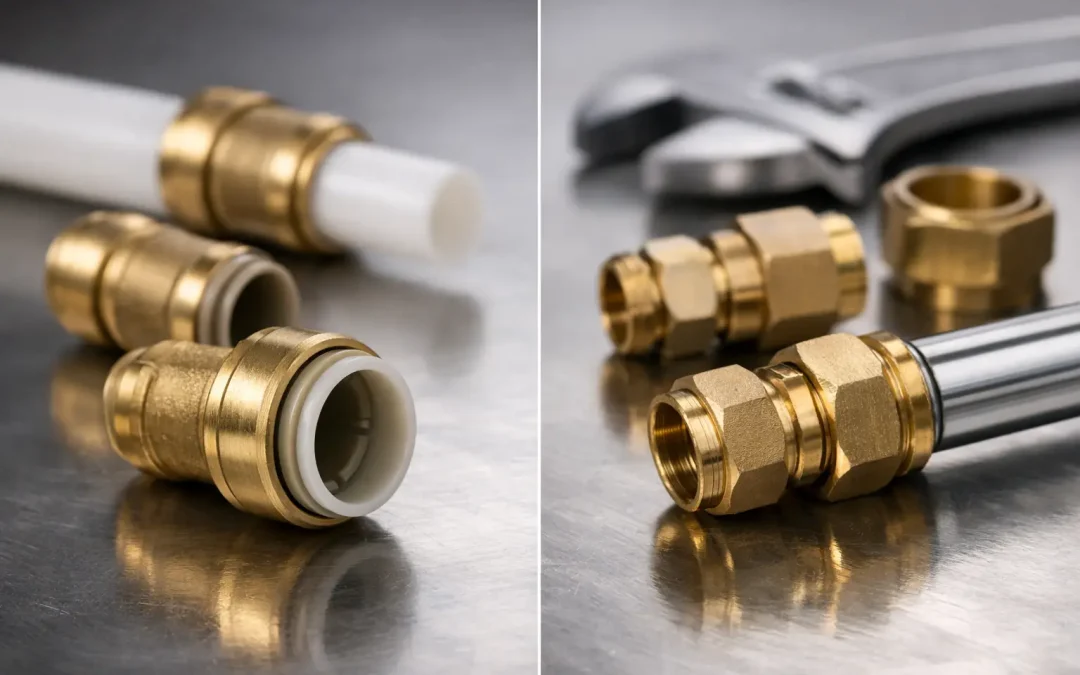
A leaking fitting rarely fails at a convenient time. It shows up after startup, during a pressure decay check, or halfway through a production run when nobody wants to pull guards and chase air loss. That is why push to connect vs compression fittings is not a catalog-level choice. In pneumatic systems, the fitting style affects assembly speed, vibration performance, maintenance time, and how forgiving the system will be when tubing gets replaced in the field.
For engineers and maintenance teams, the right answer usually comes down to application conditions rather than preference. Both fitting types have a place in industrial air systems. The mistake is treating them as interchangeable when the tubing, duty cycle, environment, and service expectations say otherwise.
Push to connect vs compression fittings in real applications
Push to connect fittings are built for speed and repeatability. Insert the tubing to the proper depth, confirm engagement, and the connection is made. In high-volume machine builds or service scenarios where downtime matters, that simplicity is a real advantage. They are common in pneumatic automation because they reduce assembly labor and make tubing changes faster.
Compression fittings take a more mechanical approach. The tube or tube insert is secured by tightening a nut over a ferrule or compression ring, which grips and seals as torque is applied. That extra assembly step costs time, but it can pay back in applications where tubing movement, vibration, or more demanding environmental conditions make a stronger mechanical hold desirable.
If your team is building standard pneumatic panels, machine air circuits, pick-and-place systems, or automation cells with frequent modifications, push to connect often wins on efficiency. If the circuit will see repeated vibration, harsher mechanical stress, or a tubing material that does not pair well with push-in grab rings, compression fittings deserve a closer look.
Where push to connect fittings have the edge
The biggest advantage is installation speed. For OEM assembly and maintenance work, push to connect fittings reduce labor and lower the chances of inconsistent torque from one technician to the next. In a busy production environment, that matters. Faster installation also helps when layouts are tight and wrench access is limited.
They also support easier rework. Tubing can be removed and rerouted without cutting threads, replacing ferrules, or rebuilding the connection each time. On systems that evolve during commissioning, this flexibility saves time and reduces wasted material.
In clean pneumatic applications using common tubing materials such as nylon or polyurethane, push to connect fittings are often the practical choice. They support neat routing, quick replacement, and efficient service. Many engineers prefer them for machine air logic, cylinder circuits, valve manifolds, and compact automation packages where serviceability is part of the design intent.
That said, push to connect fittings are only as reliable as the tubing condition and installation quality behind them. Tubing needs a clean, square cut. Outer diameter tolerance matters. Surface damage near the end of the tube can compromise the seal or retention. If technicians are pulling tubing with side load, reusing scarred tube ends, or mixing tubing that is slightly out of spec, leak risk goes up fast.
Where compression fittings make more sense
Compression fittings are slower to install, but they can be more forgiving in applications where retention strength is a bigger concern than assembly time. Once properly tightened, they provide a solid mechanical connection that holds up well in installations with movement, repeated vibration, or tougher routing conditions.
This is one reason compression fittings remain common in instrumentation, some heavy-duty pneumatic runs, and applications where tubing is less likely to be frequently removed. They are also useful when the tubing material is harder or less ideal for push-in retention systems. In some cases, that stronger mechanical grip provides more confidence than a release-collar design.
Compression fittings also appeal to teams that want a connection less dependent on perfect tube-end preparation every time. Good installation practice still matters, but the sealing mechanism is different enough that certain field conditions may favor compression over push-in style assemblies.
The trade-off is maintenance. Once a compression fitting has been assembled, disassembly and reinstallation take longer. Ferrules may not be reusable depending on design and condition. In fast-moving maintenance environments, that extra effort can turn a minor tubing change into a longer service event.
Sealing performance is about more than pressure rating
When buyers compare push to connect vs compression fittings, they often start with pressure specs. That is necessary, but it is not enough. Both types can perform well within their intended ratings. The bigger difference usually shows up in how they handle real-world installation variables.
Push to connect fittings rely heavily on tubing quality, insertion depth, and side-load control. They perform very well in properly built pneumatic systems, but they do not hide poor tubing practices. If the tube is ovalized, scratched, or not fully seated, leaks can appear at startup or later after motion cycles begin.
Compression fittings depend on proper tightening. Under-tighten them and sealing may be incomplete. Over-tighten them and you risk damaging the ferrule, tubing, or fitting body. In skilled hands, this is manageable. In mixed-skill maintenance environments, torque consistency can become a problem.
So the better question is not which fitting seals better in theory. It is which fitting seals more consistently with your tubing, your technicians, and your operating conditions.
Vibration, movement, and machine dynamics
Dynamic machinery changes the equation. If tubing is routed close to moving assemblies, exposed to constant vibration, or subject to operator contact, fitting retention becomes more important than bench-top convenience.
Push to connect fittings can perform well in dynamic systems when tubing is supported correctly and side loads are minimized. Good routing, proper bend radius, and clipping the tube near the connection all help. But when the connection itself becomes a mechanical anchor point, push-in fittings can be less forgiving.
Compression fittings generally offer stronger resistance in harsher mechanical conditions. That does not mean they are always better for vibrating machinery, only that they often provide more retention margin when routing is less controlled or movement cannot be fully isolated.
For machine builders, this is usually a design discipline issue. If you want the speed and serviceability of push to connect fittings, support the tubing so the fitting only has to seal. If the fitting will also be asked to resist repeated mechanical stress, compression may be the safer specification.
Material compatibility and tubing choice
Tubing drives fitting performance more than many buyers expect. Push to connect fittings are widely used with polyurethane and nylon tubing because those materials work well with the internal grab and seal design. If your application uses these standard pneumatic tubes, push-in fittings are usually a straightforward fit.
Compression fittings offer broader flexibility in some cases, especially where harder tubing or specialized materials are involved. That can matter in industrial environments with temperature variation, chemical exposure, or installation constraints that push the system outside normal light-duty pneumatic practice.
This is also where catalog discipline matters. Not every fitting series supports every tubing material equally well, and not every tube listed by outer diameter behaves the same under load. Engineers should verify pressure, temperature, media, and tubing compatibility together rather than selecting a fitting by thread and size alone.
Cost is not just the fitting price
Push to connect fittings often look attractive because they reduce installation time. Across a machine build, that labor savings adds up quickly. They also tend to lower maintenance time during changeouts, which improves uptime economics.
Compression fittings may carry a higher total assembly cost when labor is included, but they can be cost-effective if they prevent repeat service in tougher environments. If a fitting is buried in a machine base, mounted in a vibrating enclosure, or installed where access is poor, long-term retention may be worth the extra installation effort.
The cheapest fitting on paper is not always the lowest-cost decision in operation. For industrial buyers, labor, downtime, leak chasing, and replacement frequency usually matter more than unit price alone.
How to choose without guessing
If the priority is fast assembly, easy tubing replacement, and clean pneumatic routing in standard automation service, push to connect is typically the stronger option. If the application brings more vibration, harsher mechanical loads, or tubing that falls outside common push-in sweet spots, compression fittings often make more sense.
For many plants and OEMs, the right answer is not one or the other across the entire system. It is selective use. Push to connect fittings can be ideal for valve manifolds, control circuits, and service-friendly machine sections, while compression fittings may be reserved for harder-to-access runs or areas exposed to greater mechanical stress.
That is the practical view of push to connect vs compression fittings. The better fitting is the one that matches the machine’s real operating conditions, the tubing in use, and the way your team actually installs and services the system. Specify with that level of discipline, and you spend less time chasing leaks later.