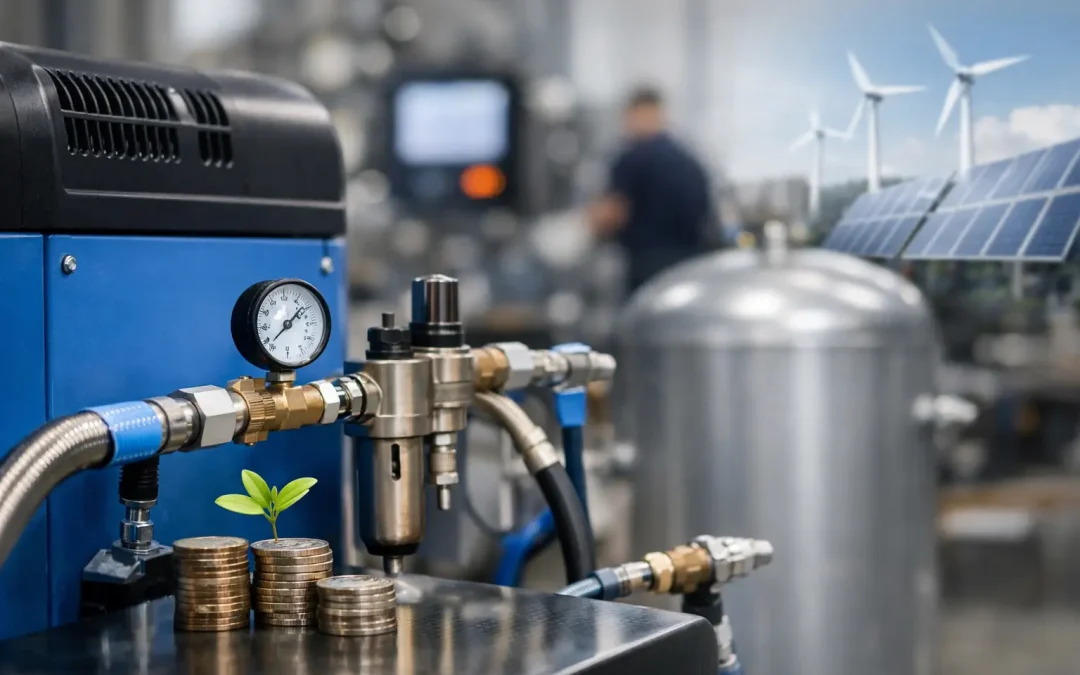
A plant can spend years optimizing machine cycle time and still lose margin through one neglected utility line. That is why compressed air efficiency trends are getting more attention from engineers, maintenance teams, and OEM designers. The shift is not about chasing buzzwords. It is about reducing power draw, stabilizing pressure at the point of use, and avoiding the hidden production losses that come from poorly matched pneumatic hardware.
For industrial operations, compressed air remains one of the most expensive utilities on the floor when measured against useful work delivered. The old approach was simple – buy compressor capacity, keep pressure high, and solve demand spikes with more air. That model is fading. The current trend is system-level efficiency, where controls, air preparation, tubing layout, valve response, actuator sizing, and leakage all get treated as one performance problem.
Where compressed air efficiency trends are heading
The biggest change is that plants are looking beyond the compressor room. For years, energy projects focused on compressor selection, variable speed drives, and storage capacity. Those still matter, but many facilities have already captured the obvious gains there. The next layer of savings is in distribution and end use, where pressure drop, oversizing, contamination, and poor control logic quietly waste air every shift.
This matters because compressed air systems do not fail in one dramatic way. They lose efficiency in small, cumulative ways. A regulator set higher than necessary, undersized fittings creating pressure loss, a leaking valve manifold, or an oversized cylinder on a high-cycle station can each look minor on their own. Together, they change the operating cost of the line and can reduce repeatability at the same time.
Another clear trend is that efficiency is now tied to uptime, not just energy. Plants are less interested in a narrow utility savings pitch if it introduces complexity or maintenance risk. They want stable pressure, repeatable actuator performance, lower heat load, and components that hold settings in demanding applications. In practice, the most effective efficiency upgrades are often the ones that improve machine behavior while trimming air consumption.
Lower pressure operation is becoming standard
One of the strongest compressed air efficiency trends is the move toward lower pressure system design. Many systems still run at a plant standard that is higher than the actual application requires. The reason is usually historical. Someone raised pressure years ago to compensate for a problem, and the new setting became permanent.
Running at higher pressure than necessary increases compressor energy use and can aggravate leakage rates. It also puts more stress on seals, fittings, and some downstream components. Lowering pressure sounds easy, but it depends on whether the whole circuit has been designed correctly. If a machine needs 90 psi at the actuator but loses too much through poor piping, restrictive fittings, or neglected filtration, simply turning down the header pressure will expose the weakness rather than solve it.
That is why lower pressure strategies work best when paired with better distribution design and point-of-use regulation. Engineers are specifying air prep units, valves, tubing, and fittings with closer attention to flow performance rather than assuming pressure can compensate for every sizing mistake.
Point-of-use control is replacing one-size-fits-all settings
Centralized settings are giving way to zoned control. Instead of feeding every branch at the same pressure, more plants are regulating by machine or by function. A gripper circuit, blowoff station, and main actuator bank rarely need identical pressure. Treating them as if they do wastes air and can hurt performance.
This trend also supports better troubleshooting. When pressure control is localized, teams can isolate a problem to a station faster. It becomes easier to see whether a motion issue is caused by flow restriction, contamination, regulator drift, or a component mismatch.
Leak management is getting more disciplined
Leak detection is not new. What is changing is how seriously plants are treating it. In many facilities, leaks used to be seen as background noise unless they became loud enough to force action. With tighter energy targets and more data from connected equipment, that attitude is harder to justify.
A mature leak program does more than walk the plant with an ultrasonic tool once a year. It ranks leaks by cost, recurrence, and criticality. It also asks why leaks keep returning. If the same machine keeps developing issues, the root cause may be tubing abrasion, vibration, poor fitting selection, contaminated seals, or pressure that is too high for the application.
There is also a product selection angle here. Lower-cost fittings and valve components can look acceptable on paper, but repeated leakage events erase that purchase price advantage quickly. In demanding applications, durability and dimensional consistency matter. Experienced buyers already know this, but current efficiency pressure is making the economics more visible.
Smarter controls are reducing wasted air motion
Another important trend is the use of smarter electro-pneumatic control strategies to reduce unnecessary air consumption. This does not always mean a major controls overhaul. In many cases, it means reviewing machine sequences and asking where air is being consumed without adding value.
Examples are common on automated lines. Cylinders dwell under pressure longer than needed. Blowoffs run continuously when an intermittent pulse would do the job. Vacuum circuits are left on through the full cycle instead of being switched based on part presence. Double-acting cylinders are used where a spring return or different actuator design would be more efficient. These are design choices, not just maintenance issues.
Better valve timing, pressure zoning, and sensor feedback can cut air use while improving consistency. The trade-off is that tighter control logic may require more commissioning effort and better documentation. For plants already struggling with controls support, the right answer depends on internal capability. Efficiency gains are real, but the control strategy has to remain maintainable.
Air treatment is being viewed as an efficiency issue
Filtration, regulation, and moisture control are often discussed as reliability topics, but they are also efficiency topics. Contaminated air increases friction, accelerates seal wear, and changes valve behavior. That leads to sluggish actuation, pressure loss, and more frequent replacement cycles.
This is especially relevant in systems that cycle fast or operate in wet, dirty, or temperature-variable environments. When air prep is underspecified or poorly maintained, teams often respond by raising pressure to keep machines running. That workaround masks the real problem and adds operating cost.
High-performance air preparation components, including corrosion-resistant options where needed, help maintain flow and pressure stability over time. The benefit is not just cleaner air. It is more predictable system behavior, which supports lower setpoints and fewer compensating adjustments.
End-use component sizing is under closer review
Oversizing has long been a quiet source of inefficiency in pneumatic design. Engineers often build in extra force or flow capacity for safety, future-proofing, or because standardization is simpler. Sometimes that is reasonable. In other cases, the result is a machine that consumes more air than needed on every cycle for the life of the equipment.
Current design practice is moving toward closer sizing of actuators, valves, and tubing to actual load and speed requirements. This does not mean designing with no margin. It means using enough margin to handle real operating variation without turning every station into an oversized air consumer.
For OEMs and integrators, this trend matters early in the design cycle. Once a machine ships, resizing cylinders or rebuilding manifolds is expensive. Reviewing force calculations, stroke requirements, duty cycle, and response time before release has become a more valuable exercise because energy cost and uptime pressure both keep rising.
Data is useful, but only if it leads to action
Connected sensors and system monitoring are appearing in more compressed air installations, and that is generally positive. Pressure, flow, dew point, and compressor performance data can reveal waste patterns that were easy to miss before. Still, not every facility needs a highly instrumented architecture to improve efficiency.
A plant with chronic leaks, poor point-of-use regulation, and inconsistent maintenance may get better returns from basic corrective work than from a major monitoring investment. On the other hand, large multi-line operations with variable demand can justify deeper visibility because the data helps them balance supply, identify drift, and verify results.
The practical trend is not just more data. It is better use of data to support maintenance, component selection, and pressure control decisions. That is where measurable gains show up.
For manufacturers and maintenance teams, the best response to compressed air efficiency trends is not a single product or one audit. It is a tighter approach to system design and component discipline – from air prep and valves to tubing, fittings, and actuator selection. The shops that get ahead are the ones that stop treating compressed air as a fixed overhead and start treating it like a performance system that can be engineered, measured, and improved.