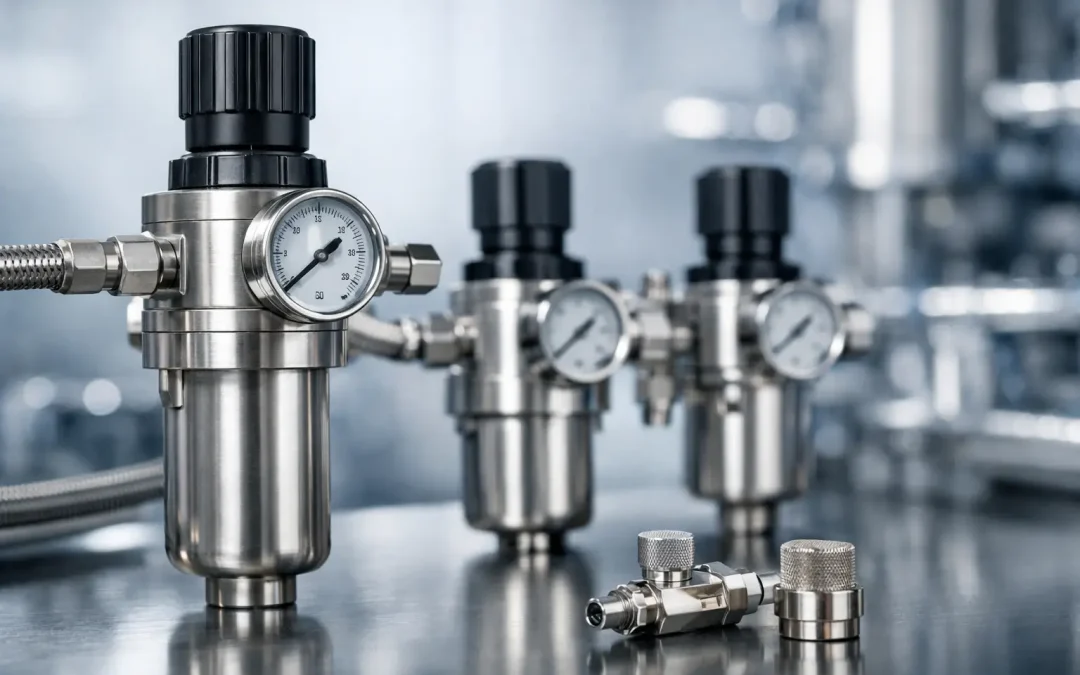
A stainless steel air regulator usually gets specified after something has already gone wrong – corroded housings in washdown zones, pressure drift in humid service, or repeated replacements in food, chemical, or outdoor equipment. In those environments, the regulator is not a commodity. It is a control point that directly affects cycle consistency, valve response, actuator force, and maintenance frequency.
For engineers and maintenance teams, the real question is not whether stainless is better. It is whether the regulator you install will hold set pressure accurately, resist the media and atmosphere around it, and stay serviceable over time. That decision comes down to more than body material.
Where a stainless steel air regulator earns its keep
The most obvious reason to move to stainless is corrosion resistance, but that only tells part of the story. In demanding industrial service, the regulator often sits in the same exposure zone as fittings, valves, and cylinders, yet it is expected to maintain stable downstream pressure while seeing constant inlet variation and repeated adjustment. If the body, spring chamber, adjusting hardware, or internal wetted components degrade, pressure control suffers long before the part visibly fails.
That is why stainless steel air regulator assemblies show up so often in food processing, beverage packaging, washdown automation, chemical handling skids, offshore or coastal equipment, and outdoor mobile systems. These are applications where plated zinc or standard aluminum units may function initially, but their service life shortens once cleaning chemicals, condensation, salt exposure, or aggressive ambient conditions take over.
There is also a practical procurement angle. When a plant standardizes on stainless in known problem areas, it often reduces the stop-start cycle of replacing lower-cost regulators that never fully match the environment. The upfront price is higher, but the installed cost can be lower when you account for downtime, labor, and process variation.
Stainless steel air regulator selection starts with the environment
Many buyers start with port size and pressure range, then work backward. In harsh service, that is often the wrong sequence. The first filter should be exposure.
If the regulator lives in a washdown area, check not only whether the body is stainless but whether the adjusting knob, lock nut, fasteners, bracket, gauge ports, and drain-related accessories are equally suited to that environment. A stainless body paired with vulnerable secondary hardware can still create a failure point.
Chemical exposure needs the same level of scrutiny. Stainless grade matters, and seal compatibility matters just as much. A regulator handling standard compressed air in a plant with caustic washdown has a different requirement than one exposed to solvent vapors, sanitizers, or marine air. In many cases, 316 stainless is the better fit for corrosive service, while 304 may be acceptable in less aggressive environments. The trade-off is cost, but replacing the wrong grade later costs more.
Temperature and humidity also change the equation. In refrigerated spaces, high-moisture compressed air can create icing or sluggish response if upstream air preparation is inadequate. In hot outdoor installations, seal aging and pressure stability may become the limiting factors. Stainless helps with structural durability, but it does not fix poor air quality.
Pressure control performance matters more than the housing
A regulator can look ideal on paper and still underperform in the machine. That usually shows up as pressure droop, slow recovery, hysteresis, or a setpoint that wanders under cycling load.
For actuator circuits and valve pilot lines, stable downstream pressure is what protects repeatability. If the application has frequent flow swings, the regulator needs enough flow capacity and response speed to keep up without excessive droop. An undersized unit may hold pressure fine at static conditions and then fall off during actual production.
This is where experienced buyers separate material selection from control performance. Stainless construction is valuable, but it does not automatically mean high precision. Review the regulator’s flow characteristics, relieving versus non-relieving design, pressure adjustment sensitivity, and repeatability under real operating conditions.
A relieving regulator is often the right choice when downstream overpressure must vent automatically during adjustment or transient events. A non-relieving design may be preferred where venting downstream pressure into the environment is not acceptable. Neither is universally better. It depends on the machine, the safety approach, and what happens downstream when pressure spikes or trapped pressure remains in the line.
Sizing mistakes that create avoidable problems
Oversizing and undersizing both cause issues. An undersized regulator restricts flow and amplifies pressure drop under demand. An oversized regulator can make fine adjustment harder at the low end of its range, especially in circuits where small pressure changes affect force or speed.
The cleanest approach is to size from actual flow demand at operating pressure, not just matching pipe thread. Thread size is not capacity. A 1/2 inch regulator may fit the manifold, but if the application only needs moderate flow and fine low-pressure control, a smaller regulator with better regulation characteristics may perform better.
Likewise, selecting a 0-150 psi range when the machine runs at 20-40 psi usually sacrifices adjustment resolution. Choose the narrowest practical pressure range for the job.
Air quality still decides service life
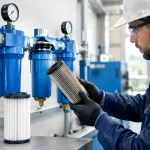
One common mistake is assuming a stainless steel air regulator can tolerate poor compressed air just because the outside is more durable. Internal contamination still damages seats, diaphragms, and seals. Water, oil carryover, pipe scale, and compressor debris remain the main causes of regulator drift and premature wear.
In demanding applications, the regulator should be treated as one part of an air preparation strategy, not a standalone fix. Upstream filtration, moisture management, and correct drainage practices matter as much as the regulator body material. If the system sees frequent condensate or contaminant loading, a stainless regulator downstream of inadequate filtration will simply fail more expensively.
For washdown and corrosive environments, that usually means evaluating the full prep train – filter, regulator, combination unit, gauges, and fittings – as one package. Mixed-material assemblies often undermine the reliability gains buyers expect from switching to stainless.
Application fit: where stainless delivers the most value
In food and beverage machinery, stainless regulators are often specified because cleaning cycles are as punishing as production cycles. Caustic cleaners, hot water washdown, and hygiene-driven maintenance routines attack external surfaces and exposed hardware. The payoff from stainless is not just longer life. It is more predictable pressure control between cleanings.
In chemical and process skids, the benefit is usually environmental resistance and maintenance reduction. Corrosive ambient conditions can attack conventional regulators even when the compressed air itself is clean. Here, the right stainless configuration helps preserve adjustment integrity and external serviceability.
In outdoor automation, transportation equipment, and coastal installations, stainless helps offset weather and salt exposure, but enclosure strategy still matters. If the regulator is exposed directly, gauge selection, vent protection, and mounting orientation become important details. A good material choice can still be compromised by poor installation.
Installation details that affect regulator performance
Mounting location has a direct impact on how a regulator behaves over time. If it is installed too far from the point of use, pressure drop in the downstream line can distort what the operator sees at the regulator versus what the actuator actually receives. If it is buried in a hard-to-access panel, proper adjustment and inspection become less likely.
Drainage and orientation matter too. In wet systems, trapped condensate around gauges, ports, or adjacent components can create corrosion points even in partially stainless assemblies. Vibration is another issue that gets missed, especially on mobile or skid-mounted equipment. Repeated vibration can affect gauge life, fittings, and adjustment stability unless the assembly is mounted correctly.
What buyers should verify before specifying
For OEM teams and plant buyers, the safest approach is to verify five things early: stainless grade, seal compatibility, pressure range, flow performance, and environmental fit of the complete assembly. That last point is where many specifications go soft. The regulator may be stainless, but the gauge, bracket, drain element, or accessory hardware may not be.
It also helps to look at serviceability. Can the unit be adjusted with gloves? Is the gauge readable in the installed position? Will maintenance be able to replace accessories quickly? In real production environments, those details influence total cost more than brochure language.
Factory-direct sourcing can help here because it shortens the gap between catalog specification and application review. For buyers managing uptime, that matters. A regulator that is technically acceptable but slow to source is still a production risk.
A stainless steel air regulator is usually justified when standard units have already proven they cannot hold up to the environment or the duty cycle. The best results come from treating it as a control component first and a corrosion-resistant housing second. When the material, internals, sizing, and air prep strategy all line up, you get the outcome industrial teams actually care about – stable pressure, longer service intervals, and fewer surprises on the line.
If your system keeps burning through regulators, the answer is rarely just “buy stainless.” The better move is to identify exactly what is attacking performance, then specify a regulator that matches the machine, the environment, and the maintenance reality.
Check Out Our Stainless Steel Air Regulators
Why Engineers Specify VidoAir™
- Dimensional consistency across product families
- High cycle life validated through real‑world testing
- Fast customization without long engineering lead times
- Application‑driven design support from pneumatic specialists
- Full system compatibility with VidoAir valves, air prep, fittings, and tubing
When you specify VidoAir™ pneumatic actuator cylinders you’re choosing components engineered to reduce downtime, simplify integration, and deliver predictable performance across millions of cycles.
We pride ourselves on delivering complete, high-quality pneumatic solutions tailored to your needs. All of our products are engineered for durability, efficiency, and ease of use, ensuring your operations run smoothly. Whether you’re upgrading an existing system or building a new one, VidoAir’s pneumatic componetns are designed to deliver top performance.
Best PracticesTo maximize the performance and lifespan of your pneumatic systems, regualr maintenance is critical. For more on maintaining pneumatic systems, visit Compressed Air Best Practices, a leading resource for compressed air system optimization.