A missed pick at 60 cycles per minute is not a small error. It becomes scrap, downtime, nuisance alarms, and an operator call that interrupts the whole cell. That is why selecting the right vacuum gripper for industrial automation is less about suction in general and more about matching gripping force, flow, response time, and surface tolerance to the real production environment.
In high-throughput systems, vacuum handling often looks simple from the outside. A cup touches a part, vacuum turns on, the robot moves, and the part releases. On the plant floor, the reality is tighter. Material porosity changes performance. Surface oil changes seal quality. Acceleration forces change part stability. If the gripper is undersized, picks become inconsistent. If it is oversized, air consumption and control complexity climb faster than they should.
Where a vacuum gripper for industrial automation works best
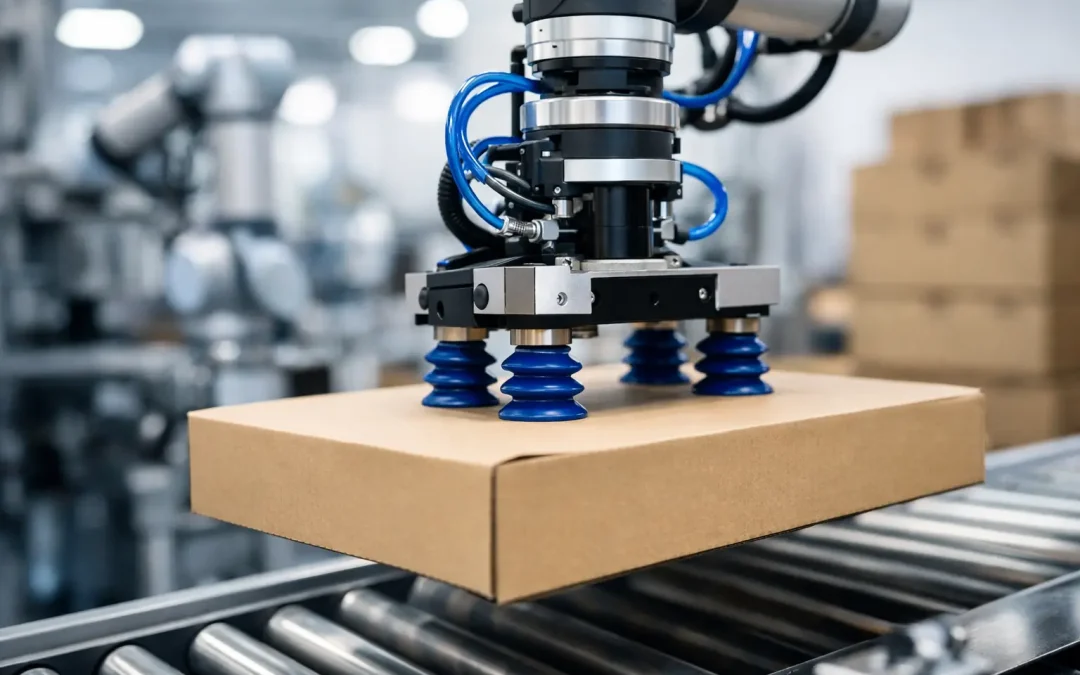
Vacuum gripping is usually the strongest option when the product is flat, smooth, bagged, sheet-like, or too variable in shape for a rigid jaw gripper. Cartons, glass, metal blanks, thermoformed trays, plastic housings, wood panels, and sealed packages are common examples. In these applications, vacuum gives integrators fast engagement, low mechanical complexity at the point of contact, and gentle handling when the part surface can support a seal.
That said, there is always a boundary. Extremely porous materials, heavily textured surfaces, parts with frequent dimensional instability, or products with unstable center-of-gravity shifts can push vacuum beyond its efficient range. Engineers often try to solve these cases by adding more cups or more vacuum level, but that is not always the right answer. Sometimes a hybrid end-of-arm tool with compliance, mechanical support, or soft gripping features delivers better reliability.
Start with the part, not the catalog
The fastest way to overspecify or underspecify a system is to choose by cup diameter alone. A proper selection starts with the part itself – weight, surface finish, rigidity, temperature, contamination, orientation, and transfer motion.
Part weight matters, but dynamic load matters more. A 2-pound carton handled in a slow vertical lift creates one kind of demand. The same carton moved by a delta robot with aggressive acceleration creates another. The vacuum gripper has to resist not only gravity, but peel forces, shock loads, and any moment created when the part is picked off-center.
Surface condition is just as critical. A clean glass panel supports a very different seal than a stamped metal part with draw oil or a corrugated case with slight crush variation. In practice, vacuum cup material and lip geometry often decide whether a system performs consistently after week one. Flat cups may work well on rigid smooth surfaces, while bellows cups add compliance for uneven positioning or curved parts. Foam gripping surfaces can help on variable or warped products, but they often increase air demand and can reduce precision.
Vacuum source selection changes the economics
When engineers discuss a vacuum gripper for industrial automation, they often focus on the cups and forget the source. That choice affects response time, air consumption, noise, maintenance, and fault behavior.
Venturi generators are common because they are compact, fast, and easy to mount near the point of use. For many pick-and-place stations, that simplicity is the reason they win. The trade-off is compressed air consumption. In a single cell, that may be manageable. Across multiple machines running around the clock, the operating cost becomes more visible.
Electric vacuum pumps can be more efficient in some installations, especially where duty cycles are high or centralized vacuum makes sense. But centralized systems introduce line losses, response lag, and more plumbing. There is no universal winner. A short-cycle robotic cell may benefit from decentralized ejectors close to the gripper. A broader packaging line may justify a different architecture if efficiency and service access are stronger priorities.
Cup design is usually where reliability is won or lost
Cup diameter, material, shape, and mounting compliance should be treated as performance variables, not accessories. If the part surface is oily, high-temperature, delicate, or prone to marking, the wrong material can create chronic handling problems even when vacuum level looks acceptable on paper.
Silicone, nitrile, polyurethane, and specialized compounds all have their place. Silicone handles temperature well but may not be ideal for every wear condition. Nitrile performs well with many oily environments. Polyurethane can offer good wear resistance. The right choice depends on actual exposure, cycle count, and how often the cups can be serviced without hurting uptime.
Cup shape matters too. A larger cup can increase holding force, but it also needs enough contact area to seal. On small or interrupted surfaces, multiple smaller cups may outperform one large cup. Bellows styles provide stroke and flexibility, which helps with part variation and height differences. The trade-off is that they can introduce more movement during high-speed travel if the tool is not mechanically stable.
Controls and sensing are not optional extras
A vacuum system that cannot verify grip condition is a risk to uptime and product quality. At minimum, the system should confirm part presence and monitor vacuum level against the actual process window. That sounds basic, but many handling issues come from relying on a simple vacuum switch with no real understanding of leak rate, response timing, or release behavior.
For high-speed automation, the control package should support fast evacuation, blow-off where needed, and clear diagnostics for maintenance. A good design tells the operator whether the failure is a missing part, a leaking cup, contaminated contact surface, inadequate supply pressure, or a worn ejector. Without that visibility, troubleshooting turns into part swapping.
This is where component quality matters. Precision-engineered vacuum hardware with stable switching characteristics and repeatable performance gives engineers a tighter process window. That reduces false trips and helps maintenance teams isolate faults faster.
Common sizing mistakes in vacuum gripper systems
The first mistake is designing only for static vertical lift. Real systems accelerate, decelerate, rotate, and sometimes handle imperfectly presented parts. Safety factor should account for actual motion profile, not an idealized bench test.
The second mistake is ignoring leakage. Porous boxes, textured plastics, and worn cups can all pull flow demand above the original estimate. If the source cannot maintain vacuum under leak conditions, the system may work during commissioning and fail during production.
The third is treating release as an afterthought. Some parts need fast positive blow-off to avoid sticking, especially lightweight films, labels, thin plastics, or smooth sheets. Slow release can reduce throughput or cause placement errors.
The fourth is overlooking maintenance access. Cups wear. Filters load up. Tubing gets damaged. If the gripper design makes these items difficult to inspect or replace, a minor service event becomes a line interruption.
Application-specific trade-offs matter
A carton palletizing cell, a sheet metal transfer system, and a robotic packaging line may all use vacuum, but they should not be engineered the same way. Carton handling often needs tolerance for surface variation and minor leakage. Sheet metal handling may need anti-slip support, oil resistance, and careful release control. Packaging lines may prioritize cycle speed, low mass, and compact tooling for crowded robotic envelopes.
For OEMs and integrators, this is where factory-direct support can make a difference. If the supplier can help configure vacuum components around the application rather than just sell a standard part number, engineering time drops and startup risk tends to drop with it. VidoAir’s approach is built around that practical requirement – getting the right pneumatic and vacuum hardware specified for demanding applications, delivered direct, and backed by technical support that understands production constraints.
What to validate before sign-off
Before locking the design, test with real parts from real production conditions. Use the actual surface contamination level, actual line pressure, and actual robot motion profile. Validate cold starts, long runs, and part variation across multiple lots. A vacuum gripper that works perfectly on clean sample parts in a lab may behave very differently after a week on the floor.
It also pays to monitor air use early. If the gripper meets pick reliability targets but drives excessive compressed air demand, the design may still be expensive to own. Good automation decisions balance performance, serviceability, and operating cost.
The best vacuum handling systems are not the ones with the highest vacuum number on a datasheet. They are the ones that keep picking through dust, variation, fast cycles, and routine wear without constant adjustment. If the gripper fits the part, the motion, and the maintenance reality, the cell tends to stay productive for the reasons that matter most – repeatability, uptime, and control.