A cylinder that sticks once a shift is easy to ignore. A vision system that starts rejecting parts after a humid weekend is not. In most plants, compressed air contamination shows up as scattered symptoms – slow actuators, sticky valves, failed seals, poor finish quality, drifting instruments, and nuisance downtime that never seems to trace back to one root cause. That is exactly why engineers keep asking how to prevent compressed air contamination before it turns into scrap, rework, or premature component failure.
The short answer is that you do not prevent contamination with one filter or one drain. You prevent it by controlling what enters the system, what condenses inside it, and what gets carried downstream to the point of use. The right solution depends on the application. Air for general shop tools has a different tolerance than air feeding electro-pneumatic controls, packaging equipment, paint processes, food handling equipment, or precision automation.
Why contamination keeps returning
Compressed air systems naturally concentrate contaminants. The compressor pulls in ambient air that already contains dust, water vapor, hydrocarbons, and seasonal particulates. Compression raises temperature and pressure, which changes how water behaves in the system. Once that air cools in the receiver, headers, or branch lines, moisture condenses. At the same time, piping scale, compressor wear particles, and oil aerosols can travel through the network.
This is why contamination is rarely a single-source issue. A plant may install a decent particulate filter near the compressor and still fight water at end-of-line equipment because the piping layout traps condensate. Another facility may have a dryer sized for average demand, but not for summer peak humidity or production expansion. Good air quality is a system design problem first and a component selection problem second.
How to prevent compressed air contamination at the source
If you want clean air downstream, start upstream. Intake location matters more than many plants admit. Compressors placed near loading docks, machining areas, washdown zones, chemical storage, or vehicle traffic will ingest a more difficult mix of contaminants than units drawing from a clean indoor space. Simply moving or ducting the intake can reduce dust, moisture load, and hydrocarbon exposure before treatment even begins.
Compressor type also matters. Oil-lubricated compressors can be the right choice for demanding industrial use, but they require proper downstream separation and maintenance to control oil carryover. Oil-free designs reduce that specific contamination risk, but they are not automatically contamination-proof. They still ingest ambient moisture and airborne solids, and they still need filtration and drying.
After compression, cooling and separation do the heavy lifting. An aftercooler removes heat so water can condense in a controlled location rather than throughout the plant. A moisture separator and automatic drain should follow. If drains fail open, you waste air. If they fail closed, water carries downstream. In either case, contamination control breaks down.
Drying is where many systems fall short
Water is often the most damaging compressed air contaminant because it creates secondary problems. It corrodes piping, washes lubricant from components, promotes sludge formation, and changes valve and actuator behavior in cold or high-cycle applications. Preventing compressed air contamination usually comes down to managing dew point correctly, not just removing visible liquid.
For general manufacturing environments, a refrigerated dryer is often the practical baseline. It is cost-effective and handles a wide range of standard plant air loads. But it has limits. If your application sees cold ambient conditions, sensitive instrumentation, outdoor lines, or processes that cannot tolerate residual moisture, a desiccant dryer may be the better fit.
The trade-off is straightforward. Refrigerated dryers are efficient for many systems, while desiccant dryers achieve lower dew points but demand more attention to purge losses, maintenance, and lifecycle cost. The wrong choice is not always the cheaper unit. It is the dryer that matches the purchase budget but not the actual process requirement.
Filtration should be staged, not improvised
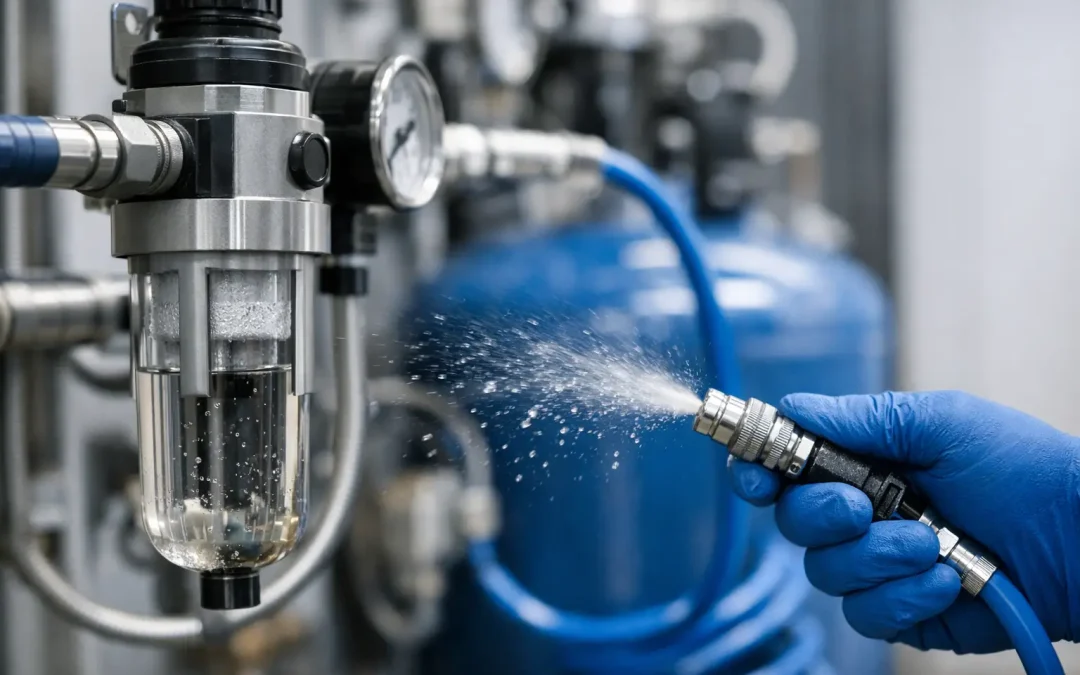
A common mistake is treating filtration as a single point solution. In reality, compressed air filtration works best in stages, with each stage handling a different contaminant profile. Bulk liquid and large particles should be removed upstream. Fine particulates and oil aerosols should be addressed with coalescing filtration. At the point of use, final filtration should match the sensitivity of the application.
This matters because filters are not interchangeable. A particulate element will not remove oil aerosol effectively. A coalescing filter installed ahead of heavy water carryover will load too quickly and lose efficiency. An activated carbon stage may be needed where oil vapor or odor must be minimized, but that only works well when upstream filtration has already done its job.
For plants running mixed-use systems, one central treatment train is often not enough. The header may support general utility air, while a branch serving automation cells or precision valves needs tighter local conditioning. That is where modular air preparation becomes more than a catalog choice. It becomes a reliability decision.
Piping design can either protect air quality or ruin it
You can buy high-performance dryers and filters and still send contamination to the machine if the piping layout is poor. Long horizontal runs without proper slope allow condensate to collect. Dead legs trap moisture and debris. Low-point drains get ignored. Branch connections taken from the bottom of headers pull water directly into production equipment.
A better layout uses sloped mains, drop legs with drain points, and branch takeoffs from the top or side of the header. Receiver placement also matters. Additional storage downstream of treatment can stabilize demand swings, but it must be installed thoughtfully so it does not become another condensation trap.
Material selection matters too. Corroded black iron piping can generate internal scale that contaminates downstream valves, regulators, and cylinders. Aluminum and stainless options can reduce that risk in demanding applications, especially where air quality and long-term cleanliness are priorities. The right material depends on environment, budget, and expected service life.
Maintenance discipline is part of prevention
Even a well-designed system drifts out of spec without routine attention. Filter elements load gradually, which means pressure drop rises before anyone notices a quality problem. Drains foul. Dryer performance slips. Leaks increase compressor runtime, which raises system temperature and moisture load. Contamination prevention is not a one-time installation task.
The practical approach is to treat air quality components like production-critical assets. Set replacement intervals based on operating hours, differential pressure, and actual contaminant exposure rather than waiting for failure. Verify automatic drains are functioning. Check dryer dew point performance, not just power status. Inspect receiver tanks, separators, and drop legs for accumulated liquid and debris.
Monitoring helps, especially in plants where compressed air quality directly affects yield. Dew point sensors, differential pressure indicators, and oil vapor checks can reveal developing problems before they turn into line stoppages. For high-speed automation, this kind of visibility often pays for itself faster than another reactive maintenance cycle.
Match air quality to the application
One reason contamination problems persist is that systems are often overgeneralized. Not every point of use needs instrument-grade air, but some absolutely do. Solenoid valves, compact cylinders, vacuum handling devices, proportional controls, and precision end effectors can be far less forgiving than impact tools or blowoff stations.
That is why the best answer to how to prevent compressed air contamination starts with classification by use case. Identify which applications are moisture-sensitive, oil-sensitive, or particulate-sensitive. Then design the treatment strategy around the most critical loads or isolate those loads on conditioned branches. This avoids overbuilding the entire plant while still protecting equipment that drives uptime and product quality.
For OEMs and integrators, it also helps to specify air preparation as part of the machine package rather than leaving it to site conditions. That reduces startup variability and protects performance in the field. A well-matched filter-regulator-lubricator setup, or a lubrication-free prep package where appropriate, can make the difference between stable cycling and recurring service calls.
How to keep prevention practical
The most effective contamination control plans are not the most complicated. They are the ones the plant can actually maintain. Start by auditing the system from intake to end use. Look at compressor environment, aftercooling, separation, dryer sizing, filter staging, piping design, drain performance, and point-of-use preparation. Then prioritize fixes based on risk to uptime, product quality, and component life.
In many cases, the biggest gains come from a few disciplined corrections: proper drying, staged filtration, better drain management, and branch-specific air prep for sensitive equipment. For manufacturers sourcing components direct, this is where a broad portfolio helps. It is easier to standardize around proven filtration, regulation, drying, and pneumatic control hardware when the parts are selected as a system instead of pieced together under downtime pressure.
Clean compressed air is not a luxury specification. It is a performance input. When the air supply is stable, dry, and properly filtered, everything downstream works closer to design intent – valves shift cleanly, actuators cycle consistently, seals last longer, and troubleshooting gets a lot more honest. If your plant keeps solving the same pneumatic problem twice, the air quality is probably still asking for attention.