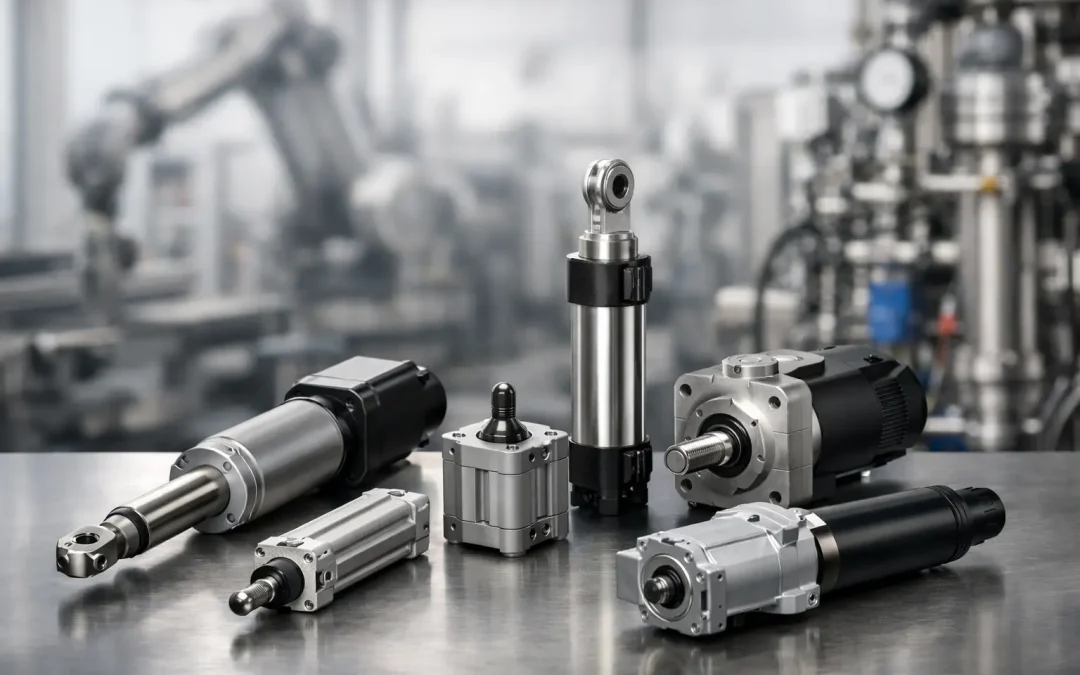
A cylinder that moves the load but misses its end position, slams into a stop, or loses force after a pressure drop is not correctly specified. This industrial actuator buying guide is built for the decisions that affect uptime: calculating usable force, selecting the right motion platform, matching controls, and accounting for the conditions that cause field failures.
For OEMs, integrators, and maintenance teams, the lowest initial unit cost is rarely the lowest operating cost. An actuator must fit the load, the machine sequence, the available utilities, and the maintenance reality of the production floor. A properly selected unit delivers repeatable motion for millions of cycles. A marginal one creates adjustments, damaged tooling, air waste, and unplanned downtime.
Industrial Actuator Buying Guide: Start With the Motion Requirement
Before comparing bore sizes or mounting styles, define what the actuator must do at the point of motion. “Move a 50-pound fixture” is not enough. The specification should identify the required stroke, orientation, payload, external resistance, cycle rate, end-of-stroke behavior, and required positional repeatability.
A vertical application requires special attention. The actuator is working against gravity during extension or retraction, depending on orientation, and it may need to hold a load safely if air pressure falls. Horizontal motion still has resistance from guides, seals, belts, bearings, and process contact. Pushing a carton across a low-friction conveyor is fundamentally different from clamping a stamped part against a locating fixture.
Also separate actuator force from the force required at the workpiece. Linkages, lever arms, wedges, and toggle mechanisms change mechanical advantage through the stroke. A cylinder that has adequate breakaway force may not maintain enough force at the end of travel. When tooling or part geometry varies, build that variation into the calculation instead of assuming an ideal condition.
Size Force for Real Operating Pressure
The basic pneumatic force calculation is straightforward:
Force = pressure × effective piston area
For extension, use the full piston area. For retraction on a double-acting rod cylinder, subtract the rod area from the piston area. The resulting number is theoretical force, not guaranteed usable force at the machine.
Actual available force is lower because of seal friction, flow losses, pressure regulator accuracy, tubing restrictions, valve capacity, and changes in supply pressure when other equipment cycles. A common failure is sizing from the compressor’s nominal pressure rather than pressure measured at the actuator while the machine is running.
For a cylinder with a 2-inch bore operating at 80 psi, theoretical extension force is about 251 pounds. That may appear sufficient for a 200-pound load. But if plant pressure dips, the valve and fittings restrict flow, and the application needs force to accelerate the load, the margin disappears quickly. The cylinder may move reliably during testing and fail during peak production.
Use a safety factor appropriate to the application. A low-friction horizontal transfer may need a modest margin, while pressing, clamping, vertical lifting, or contamination-prone equipment requires more. The right factor depends on how predictable the load and air supply are. Oversizing has trade-offs too: larger cylinders consume more air, can accelerate too aggressively, and may require heavier mounting and more controlled cushioning.
Choose the Actuator Architecture, Not Just a Bore Size
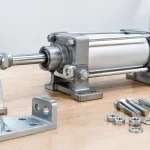
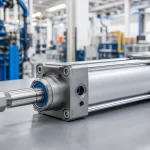
Standard tie-rod and ISO-profile cylinders remain effective for general linear motion because they are serviceable, widely configurable, and available across a useful range of bores and strokes. They are a practical choice for transfer, ejection, clamping, gate movement, and fixture automation where external guides carry side loads.
Compact cylinders fit where space is limited, but their shorter bearing length makes alignment more critical. They are well suited to short-stroke functions such as part stops and light clamping. Avoid treating a compact cylinder as a guided slide when the load is offset from the rod centerline.
Rodless cylinders provide long stroke in a smaller overall envelope than a rod-style cylinder. They can be effective for material transfer, door movement, and pick-and-place axes, especially where machine length is constrained. The trade-off is that sealing, carrier guidance, and contamination control must match the operating environment. A long-stroke rodless unit without suitable external guidance can suffer from deflection and premature wear.
Guided cylinders and slide table actuators combine linear motion with integrated bearing support. They are often the better choice for pressing, positioning, and tool movement with an offset payload. The guide system carries moments that would otherwise transfer into a piston rod and rod bushing. This is a major reliability advantage, not an optional feature, when a fixture hangs beyond the actuator centerline.
For precise angular motion, rotary actuators may be preferable to adapting a linear cylinder with a rack, linkage, or custom bracket. Electric actuators become more compelling when the process needs multiple programmed positions, force feedback, coordinated axes, or controlled velocity profiles. Pneumatics usually win on simplicity, speed, and cost for end-to-end motion. Electric motion earns its higher complexity when the process needs more than two or three repeatable positions.
Evaluate Side Load, Moment Load, and Mounting
Many actuator failures are actually mounting failures. A cylinder is designed to produce linear force along its axis. Side loading from a misaligned slide, sagging tooling, or a poorly supported load creates bending force on the rod. The result can be seal wear, bushing damage, rod scoring, and inconsistent motion.
Calculate or obtain the manufacturer’s allowable moment ratings for the selected configuration. Consider the three moment directions: pitch, yaw, and roll. The farther a load sits from the guide or rod centerline, the more severe the moment becomes. A small payload can create a large moment when mounted on a long arm.
Mounting style also changes how force enters the machine. A centerline mount is often preferred for pure thrust. Clevis and trunnion mounts allow pivoting but need correct alignment through the motion arc. Flange mounts provide rigid attachment but can concentrate stresses if the structure is not flat and square. Design the bracket and mating structure with the same care as the actuator selection.
Match Valves, Flow Controls, and Air Preparation
A correctly sized actuator can still underperform if the pneumatic circuit cannot supply and exhaust air fast enough. Valve flow capacity, port size, tubing inside diameter, fitting restrictions, and mufflers all influence speed. A large-bore cylinder supplied through undersized tubing may have excellent static force but slow, uneven movement.
For most double-acting pneumatic cylinders, a 5-port directional valve provides controlled extension and retraction. Select valve function based on the machine’s required safe state. A spring-return valve may be appropriate where a cylinder must return automatically after a signal loss. In other applications, a detented valve holds its last commanded state, which can be useful or hazardous depending on the process.
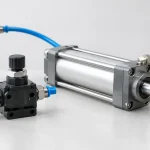
Meter-out flow control is commonly used to regulate cylinder speed because it provides backpressure that helps control moving loads. Meter-in control can work for resisting loads, but it may allow unstable motion with overrunning loads. Adjustable cushions reduce end-of-stroke impact, yet they are not a substitute for proper speed control or external shock absorption where kinetic energy is high.
Air quality belongs in the actuator specification. Moisture, oil carryover, pipe scale, and debris shorten seal life and can cause valves to stick. Specify filtration appropriate to the equipment, drain condensate consistently, and confirm whether components are designed for lubricated or non-lubricated service. In washdown, food-adjacent, corrosive, or outdoor applications, material selection matters as much as bore size. Stainless steel air preparation and corrosion-resistant actuator components may justify their cost by preventing recurring replacement cycles.
Specify Feedback and Controls Around the Process
Do not add sensors by default without identifying what the control system needs to know. End-of-stroke magnetic switches are valuable for sequence confirmation, jam detection, and cycle verification. They are not a measurement system for high-accuracy positioning, particularly if pneumatic compressibility, load changes, or mechanical play affect the final position.
Specify sensor type, cable connection, voltage, output logic, environmental rating, and connector standard early. A sensor that fits the cylinder but does not match the PLC input architecture creates unnecessary integration work. For demanding automated cells, consider how the control program will respond when a sensor does not switch within the expected time. A timeout alarm is useful; a controlled recovery sequence is better.
Questions to Resolve Before Releasing a Purchase Order
A complete actuator request should answer these questions:
- What force is required at minimum available pressure, including friction and acceleration?
- What stroke, cycle rate, speed, and end-of-stroke energy will the actuator see?
- Is the load centered and externally guided, or will the actuator carry side and moment loads?
- What are the ambient temperature, contamination, washdown, corrosion, and duty-cycle conditions?
- Which valve function, flow capacity, sensors, fittings, and air preparation components are required for the installed system?
- Is a standard catalog configuration sufficient, or does the machine need a custom stroke, mounting arrangement, seal package, or sensing option?
Those answers make supplier comparisons meaningful. They also prevent procurement from comparing parts that have similar dimensions but very different bearing capacity, seal materials, cushioning, sensing capability, and expected service life.
VidoAir supports this process with factory-direct pneumatic actuators, guided motion products, valves, air preparation, fittings, and configured solutions for applications that cannot be solved with an off-the-shelf cylinder alone. When production depends on a motion sequence, specify the complete motion system, not only the actuator body.
The most useful buying decision is the one that gives maintenance a clear replacement path and gives engineering enough operating margin to stop revisiting the same failure. Measure pressure at the machine, account for the true load path, and select motion hardware that can hold its performance after the new equipment shine is gone.