A cylinder that extends late, a valve bank that chatters, an input that looks true on the PLC but never shifts the spool – most electro-pneumatic problems start long before startup. If you are working out how to configure electro pneumatic controls, the real job is not just wiring devices together. It is building a control chain that matches load, timing, air quality, voltage, and machine logic well enough to stay stable under production conditions.
For engineers and technicians, that means configuration is part schematic work, part component selection, and part failure prevention. A circuit that works on the bench can still miss cycle targets on the line if the valve is undersized, the exhaust is restricted, the sensor placement is sloppy, or the PLC logic assumes ideal response times. Good configuration closes those gaps early.
Start with the motion, not the wiring
The fastest way to misconfigure an electro-pneumatic system is to begin with the electrical diagram before defining the machine action. Start with the actuator and ask a few practical questions. Does the load need fast extension and cushioned return, equal force in both directions, or a fail-safe spring return if power drops? Does the machine need intermediate positioning, simple end-of-stroke detection, or tightly sequenced motion between stations?
Those answers determine whether you should use a single-acting cylinder, double-acting cylinder, guided slide, rotary actuator, or specialty actuator. They also shape the valve choice. A 3/2 valve may be right for a spring-return actuator. A 5/2 or 5/3 valve may fit a double-acting application better. If the process needs a known center condition on loss of command, the spool function matters as much as the coil voltage.
This is where experienced teams save time. They define the required motion profile first, then back into the control hardware. That avoids overspending on components that add no value, and it prevents under-specifying the valve or air prep package in ways that create unstable performance later.
How to configure electro pneumatic controls around valve logic
Once the motion is defined, build the control architecture around the valve state and the machine state. In most industrial systems, the electrical side commands the pneumatic side through solenoid valves, while sensors confirm that motion actually occurred. That sounds simple, but it introduces a common weak point: electrical command does not guarantee pneumatic result.
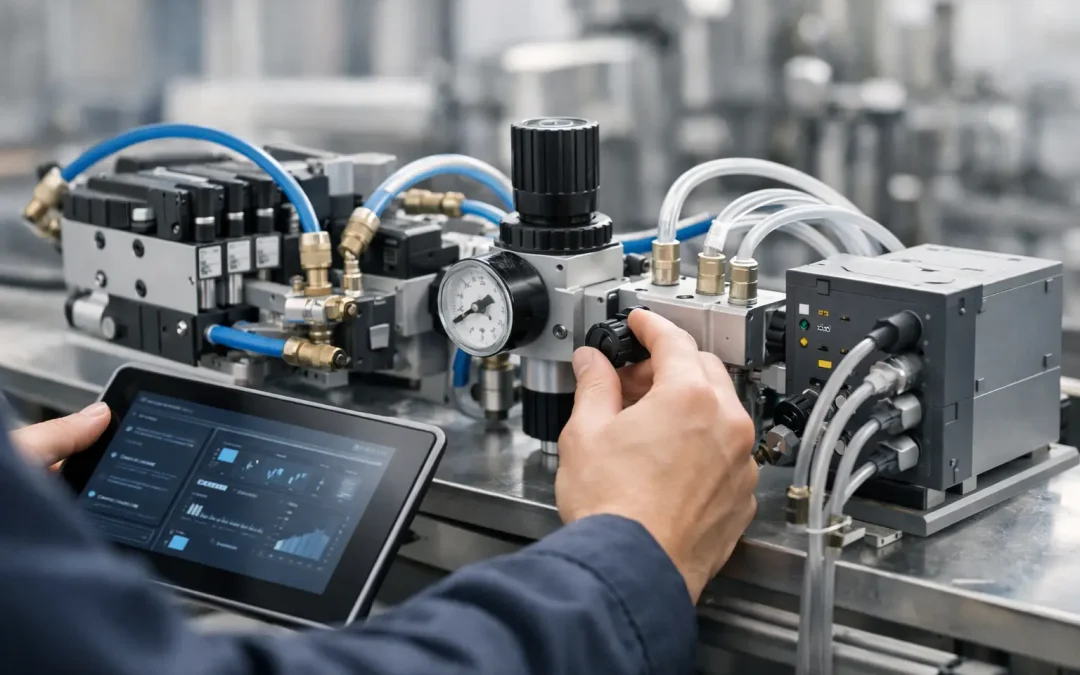
A proper configuration accounts for all three layers – command, shift, and verification. The PLC output energizes the solenoid. The solenoid shifts the valve spool. The valve directs air to move the actuator. A sensor, pressure switch, or reed switch then tells the controller whether the expected state has been reached.
If any one of those layers is missing, troubleshooting gets slower and machine recovery gets less predictable. For example, if a cylinder is expected to clamp before a downstream station indexes, relying only on an output bit is risky. It is far better to verify clamp position or pressure before allowing the next step.
That does not mean every circuit needs full feedback everywhere. It depends on the consequence of failure. On a low-risk eject function, open-loop control may be acceptable. On clamping, part handling, guarding, or timed multi-axis sequences, closed-loop confirmation is usually worth the added hardware.
Match voltage and coil duty to the machine environment
Electro-pneumatic controls often fail at the interface between panel design and field conditions. A valve coil rated for 24 VDC may still behave poorly if the power supply is undersized, the cable run is too long, or multiple loads create voltage drop during peak actuation.
Use coil voltage and power requirements as real design inputs, not catalog footnotes. Check inrush and holding current, especially on grouped manifolds. If the machine includes inductive loads, add proper suppression and verify that the output device is suitable for the coil type. Not every PLC output card tolerates the same transients or load profiles.
Heat and duty cycle matter too. In high-cycle applications, coil temperature rise can affect long-term reliability. If the valve sits near ovens, hot tooling, washdown zones, or vibration-heavy equipment, standard assumptions may not hold. Configuration should reflect the actual environment the machine sees on second shift, not the clean conditions of a test bench.
Air quality is part of control configuration
Many teams treat filtration and regulation as utilities rather than control components. That is a mistake. If the air supply is dirty, wet, unstable, or poorly regulated, electro-pneumatic controls will act inconsistent even when the electrical design is correct.
Set the FRL or air prep assembly based on the most sensitive downstream device, not just the main line pressure. Solenoid valves with tight clearances, proportional devices, and compact actuators all respond differently to contamination and pressure drift. If a machine needs repeatable motion, the regulator should maintain stable downstream pressure under dynamic flow, not just static pressure at idle.
This is also where line sizing and fitting choice show up in real machine performance. If tubing is too small or routed with excessive restriction, the valve may be correct on paper but slow in operation. Long runs between valve and actuator increase response lag and can soften control. In fast cycling systems, mounting valves closer to the actuator often improves repeatability.
Sensor placement decides whether the sequence is trustworthy
If you want a reliable sequence, place sensors to confirm useful machine states, not just convenient mounting points. An end-of-stroke sensor should indicate that the cylinder reached the position required for the next process step. That may or may not be the physical end cap.
For example, a cylinder that opens a gate may not need full retraction before allowing product flow. A clamp cylinder may need confirmation near full force position, not merely first movement. Reed switches, solid-state sensors, pressure switches, and external position sensors each have trade-offs. Reed switches are simple and proven, but vibration and magnetic interference can create nuisance signals. Solid-state sensors offer faster switching and longer life, but they still need disciplined mounting and cable management.
When configuring inputs, filter noise in a controlled way. Too little filtering and the sequence chatters. Too much filtering and the system feels slow or misses a brief but valid event. The right setting depends on machine speed and sensor type.
Build timing into the design, not into operator habits
A lot of poorly configured systems technically work because operators unconsciously compensate for them. They pause between cycles, re-hit a pushbutton, or wait for pressure to recover. That is not control. That is a process gap hidden by human behavior.
The better approach is to define expected response times and use them in logic. If a valve should shift and a cylinder should reach sensor within 400 milliseconds, set an alarm window that reflects real machine capability with reasonable margin. If the process includes deliberate dwell for sealing, cooling, or part settling, make that dwell explicit in the program rather than leaving it to inconsistent air dynamics.
This is where commissioning data pays off. Measure actual extend and retract times under load, then adjust flow controls, pressure settings, and timer values accordingly. A circuit that is too fast can hit hard, bounce, or damage parts. A circuit that is too slow can kill throughput. Configuration is usually an optimization problem, not a max-speed contest.
Common mistakes when you configure electro pneumatic controls
The same problems show up repeatedly in the field. Valves are selected by port size alone instead of flow capacity. Speed controls are installed backward, so motion becomes unstable. Input commons are miswired, leaving technicians chasing a pneumatic issue that is actually electrical. Exhaust mufflers clog and are never considered during troubleshooting. Manual overrides get left engaged after setup and create intermittent failures that waste hours.
Another common issue is assuming every cylinder sees the same load across the stroke. Vertical loads, off-center tooling, and varying product contact can change required force dramatically. If the pressure setting barely works at ideal conditions, the machine will fail when friction rises or supply pressure sags.
Documentation matters here more than most teams admit. Label the valve station, output point, input point, normal state, and actuator function clearly enough that maintenance can isolate a fault quickly. Clean documentation shortens downtime as much as premium hardware does.
Commission in layers
The most efficient startup method is layered commissioning. First verify electrical I/O without air. Then verify air prep pressure and leak integrity. Then jog each valve manually or through controlled outputs. Then confirm sensor feedback and only after that run the full sequence.
This approach isolates faults before they overlap. If a cylinder will not move, you can decide quickly whether the problem is command, valve shift, air supply, plumbing, or mechanical binding. Trying to commission everything at once usually creates false leads.
For demanding applications, factory-direct component support can be valuable during this phase, especially when manifolds, custom valve assemblies, or configured-to-order packages are involved. A supplier that understands both the electrical and pneumatic sides can help resolve integration issues faster than a generic parts source.
The best electro-pneumatic control configuration is not the one with the most features. It is the one that gives the machine exactly the control authority, feedback, and stability it needs to run cleanly every shift. When the design reflects actual motion, actual air behavior, and actual production conditions, the system becomes easier to commission, easier to troubleshoot, and harder to knock out of spec.