
In high-performance automation, precision is paramount. Yet, selecting the correct rotary actuator can present significant challenges, from complex torque calculations to navigating the distinct advantages of pneumatic, electric, and hydraulic systems. A single miscalculation can lead to underperformance, premature component failure, and costly operational downtime, undermining the integrity of your entire industrial application. This uncertainty often stands between a good design and an exceptional one.
This comprehensive guide delivers the technical clarity required to bridge that gap. We will equip you with the knowledge to master torque requirements, confidently evaluate actuator types, and align critical specifications with your system’s performance goals. By following this definitive process, you will move beyond guesswork to make informed decisions, avoiding the common pitfalls of improper sizing. The result is a robust, efficient, and reliable solution engineered for success, ensuring your application is powered for optimal performance from day one.
Key Takeaways
- Master the critical data collection process required for precise torque calculation, preventing costly oversizing or catastrophic failure.
- Evaluate the performance, cost, and infrastructure trade-offs between pneumatic, electric, and hydraulic power sources to make the most effective selection.
- Accurately sizing your rotary actuator is the single most important step for guaranteeing operational efficiency and long-term system reliability.
- Look beyond core specifications to assess environmental factors and material compatibility, ensuring your actuator delivers robust performance in demanding industrial conditions.
Fundamentals of Rotary Actuators: Beyond the Basics
A rotary actuator is a robust component meticulously engineered to convert energy-typically from a pneumatic, electric, or hydraulic source-into controlled rotary motion. In modern automation, its core function is indispensable for tasks requiring precise turning, opening, closing, and positioning of loads. From actuating quarter-turn valves to reorienting parts on a production line, these devices provide the rotational force that drives operational efficiency. A comprehensive understanding of rotary actuator fundamentals is the first step toward optimizing any automated system.
Selecting the correct actuator is not merely about function; it is a critical engineering decision that directly impacts system performance and longevity. An undersized unit will fail prematurely under load, while an oversized one wastes energy and increases initial costs. Meticulous sizing ensures that the actuator delivers the required performance efficiently and reliably for its entire operational lifespan.
Key Performance Metrics You Must Understand
To specify the ideal actuator for your application, you must master these four critical performance metrics:
- Torque: The rotational force generated by the actuator, measured in Newton-meters (Nm) or pound-inches (lb-in). This is the primary measure of the actuator’s power to move a load.
- Angle of Rotation: The total arc of movement the output shaft can achieve. Common configurations include 90°, 180°, and 360°, though custom angles are often available.
- Speed: The time it takes for the actuator to complete its full angle of rotation. This is a crucial factor in high-cycle automation applications where throughput is paramount.
- Backlash: The small amount of play or “slop” in the output shaft when changing direction. Low backlash is essential for applications demanding high precision and repeatability.
Common Types: Rack-and-Pinion vs. Vane Actuators
While numerous designs exist, two common pneumatic types dominate many industrial applications due to their distinct performance characteristics:
- Rack-and-Pinion Actuators: These devices utilize a linear piston (the rack) with gear teeth that engage a circular gear (the pinion). This mechanism efficiently translates linear motion into powerful rotary motion. They are prized for their ability to produce high, constant torque throughout the entire rotation, making them exceptionally durable and suitable for heavy-duty tasks.
- Vane Actuators: Featuring a simpler and more compact design, these actuators use a paddle-like vane that rotates within a circular chamber. Pressurized air acts on the vane, causing it to turn. Their compact footprint makes them ideal for lighter-duty, space-constrained applications where high torque is not the primary requirement.
Step 1: How to Correctly Size Your Rotary Actuator
Selecting the correct rotary actuator for your automation task is the most critical step in ensuring operational success. Improper sizing is a leading cause of premature failure, reduced efficiency, and unnecessary operational costs. An undersized unit will fail under load, while an oversized unit wastes energy and capital. Before proceeding, it is essential to collect precise data on your application’s load, speed, and motion requirements.
To ensure robust, long-term performance, always incorporate a safety factor into your calculations. This industry-standard practice involves selecting an actuator with 25% to 50% more torque than the calculated minimum requirement. This buffer accounts for variables like friction, wear over time, and unexpected system demands, providing a crucial margin of reliability.
Calculating Torque Requirements
Torque is the rotational force an actuator must generate to move a load. It is crucial to distinguish between static torque (the “breakaway” force needed to start motion) and dynamic torque (the force required to maintain motion and accelerate the load). The fundamental calculation is Torque = Force x Distance, where distance is the lever arm from the pivot point. Key factors influencing this calculation include:
- Load mass and inertia
- Friction from bearings or seals
- Required acceleration and deceleration rates
- Load orientation relative to gravity
These principles apply across all actuator types, from pneumatic rack-and-pinion models to high-power hydraulic rotary actuators, which are meticulously detailed in engineering handbooks. For complex or non-uniform loads, we recommend using sizing software or consulting with an application engineer.
Determining Speed and Duty Cycle
Cycle time is the total time required for the actuator to complete one full operation (e.g., extend and retract). This determines the required speed. Equally important is the duty cycle, which is the ratio of operating time to rest time within a given period. A high duty cycle can generate significant heat and accelerate wear. Meticulously matching the actuator to these demands is essential; for instance, pneumatic actuators are frequently specified for high-speed, high-cycle-rate applications due to their excellent thermal dissipation.
Defining Angular Stroke and Positional Accuracy
Precisely define the required angle of rotation for your task, whether it’s a standard 90° for a valve or a custom 270° for a positioning arm. Consider if the application requires adjustable end-of-stroke stops for fine-tuning or multiple, fixed positions. Finally, evaluate the need for positional accuracy. Backlash-the inherent play in a gear mechanism-can affect precision. For applications demanding high accuracy and repeatability with minimal backlash, servo-electric actuators provide superior control and performance.
Step 2: Selecting the Right Power Source for Your Application
Once your torque and sizing requirements are calculated, the next critical decision is selecting the power source. This choice is a strategic balance between required performance, total cost of ownership, and your facility’s existing infrastructure. Each power source-pneumatic, electric, and hydraulic-offers a distinct set of advantages, making it crucial to align the technology with your specific application demands.
The table below provides a high-level comparison to guide your selection of the ideal rotary actuator for your system.
| Feature | Pneumatic | Electric | Hydraulic |
|---|---|---|---|
| Precision | Good | Excellent | Very Good |
| Speed | Very High | High | Moderate |
| Initial Cost | Low | High | Very High |
| Maintenance | Low | Very Low | High |
| Environment | Excellent (incl. hazardous) | Good (not for explosive env.) | Good (leak risk) |
Pneumatic Rotary Actuators: The Industrial Workhorse
Known for their simplicity and durability, pneumatic actuators are the workhorses of industrial automation. They offer an exceptional force-to-size ratio and operate at high speeds, making them ideal for rapid open/close or pick-and-place operations. For applications demanding robust, high-cycle performance, pneumatic solutions deliver unmatched value.
- Pros: Cost-effective, simple design, highly reliable, and intrinsically safe for hazardous or explosive environments.
- Cons: Precise mid-stroke positioning can be challenging; requires a clean, dry compressed air supply.
Discover VidoAir’s robust pneumatic actuator solutions.
Electric Rotary Actuators: Precision and Programmability
When an application demands sophisticated control, an electric rotary actuator is the premier choice. They provide unparalleled precision over position, velocity, and torque, enabling complex motion profiles and seamless integration with modern control systems. They are typically driven by either stepper motors for simple positioning or servo motors for dynamic, high-performance applications requiring closed-loop feedback.
- Pros: Fully programmable, excellent accuracy and repeatability, quiet operation, and provides valuable data feedback.
- Cons: Higher initial investment and generally not suitable for explosive atmospheres without special enclosures.
Hydraulic Rotary Actuators: Unmatched Power
For the most demanding tasks requiring immense force, hydraulic actuators are in a class of their own. They leverage incompressible fluid to generate the highest torque density available, making them essential for heavy machinery, large valve actuation, and construction equipment. This power source is a specialized solution reserved for applications where no other technology can meet the extreme torque requirements.
- Pros: Unmatched power and torque, extremely rigid, and holds position firmly under heavy loads.
- Cons: System complexity (requires a hydraulic power unit), higher maintenance, and the potential for fluid leaks.
Step 3: Final Checks and Industrial Considerations
Once you have defined the core performance specifications-such as torque, rotation angle, and speed-the final selection process focuses on ensuring long-term reliability and seamless integration. Moving beyond the numbers on a spec sheet to consider the operating environment and system architecture is critical for maximizing the performance and lifespan of your chosen rotary actuator. These final considerations are where a robustly engineered component proves its value.
Environmental Factors and Material Selection
The operating environment dictates the necessary durability of an actuator. Look for an Ingress Protection (IP) rating that matches your needs; for example, IP65 indicates protection against dust and low-pressure water jets, while IP67 is required for temporary submersion. Material selection is equally vital. While anodized aluminum is a cost-effective choice for general automation, stainless steel bodies are essential for washdown applications, corrosive chemical exposure, or food-grade environments where hygiene is paramount.
Mounting, Shafts, and System Integration
A high-performance actuator is useless if it cannot be physically integrated into your machine. Meticulously check the component’s physical specifications against your design, paying close attention to:
- Mounting Style: Ensure compatibility with options like flange mounts, foot mounts, or direct-threaded holes.
- Shaft Configuration: Match the output shaft-whether keyed, splined, or a custom design-to the load interface for secure power transmission.
- Physical Footprint: Verify that the overall dimensions and the location of air or hydraulic ports will not interfere with other components.
Feedback and Control Requirements
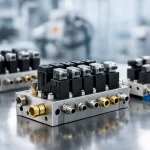
Modern automation systems demand precision and control. For applications requiring exact positioning, select a rotary actuator compatible with position feedback sensors or encoders. This data is essential for integration with a PLC or other machine controller. Also, consider the system’s fail-safe requirements. A spring-return actuator will automatically revert to a safe home position upon loss of power, whereas a double-acting model will hold its last position. For pneumatic systems, pair the actuator with appropriately sized solenoid valves for actuation and flow controls for precise speed management.
Making these final checks ensures your component selection is not just adequate, but optimized for performance and reliability. For expert guidance on selecting the ideal component for your application, explore the robust, factory-direct solutions at vidoair.com.
Your Partner in Precision Motion Control
Mastering the selection process for a high-performance rotary actuator is a critical step toward operational excellence. As this guide has shown, success hinges on a meticulous approach that goes beyond basic specifications. Correctly calculating torque and load requirements, strategically matching the power source to your application’s duty cycle, and validating your choice against crucial industrial considerations are the pillars of a reliable and efficient system. These steps ensure your component doesn’t just fit-it excels.
At VidoAir, we understand that precision engineering requires a partnership. Our team offers dedicated technical support to guide you through every step of the sizing and selection process. We combine this expertise with a commitment to value, offering custom-configured, made-to-order components at factory-direct pricing. This unique approach guarantees you receive a meticulously engineered solution that delivers both unmatched performance and exceptional value, without compromise.
Take the next step toward powering your success. Request a quote for your custom actuator solution from our engineers. We are ready to help you build a more powerful and efficient future.
Frequently Asked Questions About Rotary Actuators
What is the main difference between a rotary actuator and a stepper motor?
The fundamental distinction lies in control and motion range. A rotary actuator is engineered for high-torque, limited-arc rotation between fixed points, ideal for valve control or part clamping. In contrast, a stepper motor provides precise, incremental positioning over a continuous 360-degree range. Stepper motors excel in positioning tasks like 3D printing, whereas actuators deliver powerful turning force for demanding industrial automation applications.
How do I calculate the torque required for my rotary actuator application?
To calculate the required torque, use the basic formula: Torque (T) = Force (F) × Distance (r), where ‘r’ is the lever arm length. You must also account for the load’s moment of inertia, frictional forces, and any required acceleration. For dynamic applications, a comprehensive analysis is critical to prevent under-sizing the component, which compromises performance and operational reliability. Accurate calculation ensures optimal efficiency and system longevity.
What is backlash in a rotary actuator and why is it an important specification?
Backlash is the mechanical clearance or “play” between mating gears or components in the drivetrain. This specification is critical because it directly impacts positional accuracy and repeatability. In high-precision applications like robotics or automated assembly, excessive backlash can lead to positioning errors and reduced process quality. Selecting a rotary actuator with low or zero backlash is essential for tasks demanding precise, consistent motion control.
Can rotary actuators provide continuous 360-degree rotation?
Most standard pneumatic and hydraulic rotary actuators are designed for limited-arc rotation, typically offering fixed stops at 90, 180, or 270 degrees. They do not provide continuous 360-degree rotation. For applications requiring full, continuous rotation, a different component, such as an electric servo motor or a specialized air motor, is the appropriate, high-performance solution. Always verify the actuator’s specified rotation range to match your application’s requirements.
What is a typical safety factor to use when sizing a pneumatic actuator?
For pneumatic actuators, a standard engineering practice is to apply a safety factor of 25% to 50% above the calculated minimum required torque. This means sizing the actuator to provide 1.25 to 1.5 times the necessary torque output. This margin accounts for variables like friction, potential drops in air pressure, component wear over time, and unexpected system demands, ensuring robust and reliable performance throughout the actuator’s service life.
How does operating temperature affect the performance of a rotary actuator?
Operating temperature significantly impacts performance and longevity. Extreme heat can degrade internal seals, causing leaks, and reduce the viscosity of lubricants, leading to increased wear and potential failure. Conversely, low temperatures can cause seals to become brittle and increase the viscosity of air or hydraulic fluid, resulting in sluggish, inefficient operation. Adhering to the specified temperature range is critical for maintaining peak performance and system reliability.