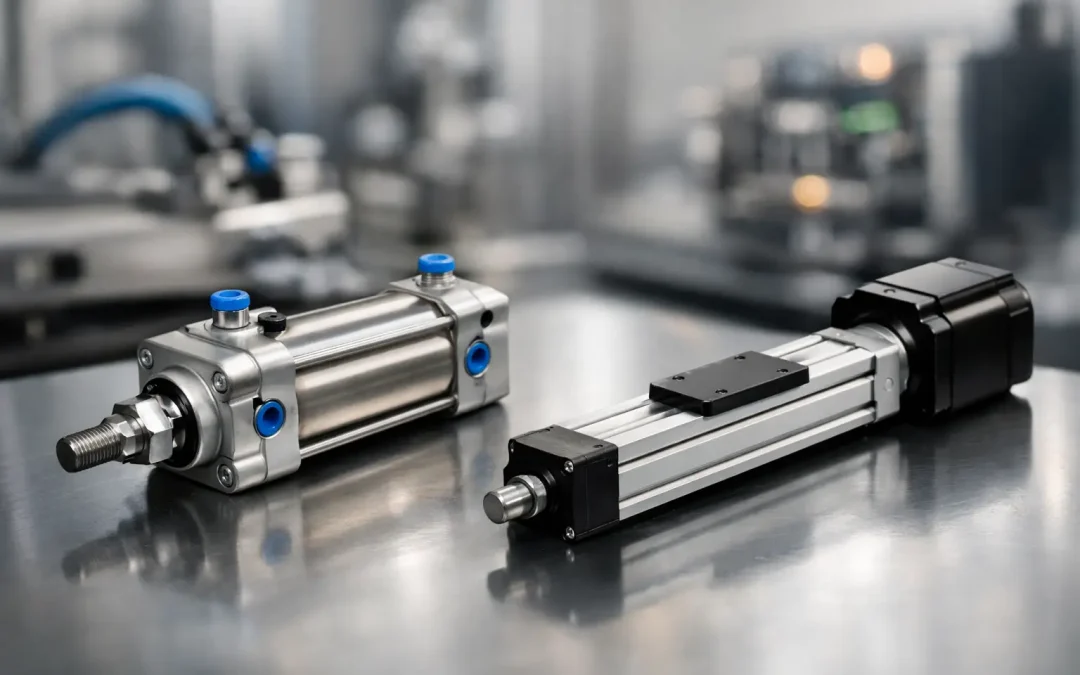
When a line starts missing cycle targets or a machine upgrade needs tighter positioning, the pneumatic cylinders vs electric actuators question stops being theoretical fast. It becomes a decision tied directly to throughput, scrap, maintenance hours, and how much integration pain your team is willing to absorb.
For most industrial buyers, this is not a debate about which technology is better in absolute terms. It is a sizing and application problem. The wrong choice shows up later as overspending, unstable motion, premature wear, or controls complexity that looked manageable on paper and turned into a commissioning delay.
Pneumatic cylinders vs electric actuators in real applications
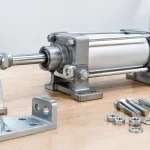
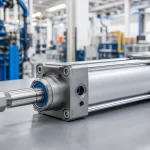
Pneumatic cylinders still make a lot of sense when the job is simple, repetitive, and force-driven. Clamp, press, lift, eject, stop, grip, and transfer motions often favor air because the components are familiar, cycle quickly, and fit harsh plant conditions well. If your machine already has compressed air available and the motion is end-to-end with limited intermediate positioning, pneumatics remain a highly efficient answer.
Electric actuators gain ground when motion quality matters as much as motion itself. If the application needs precise position control, adjustable speed profiles, repeatable acceleration, or programmable force behavior, electric usually wins. That is especially true in assembly, packaging, electronics handling, and systems where recipe changes are frequent.
The practical difference is this: pneumatic cylinders are excellent at doing the same move thousands of times with dependable force and straightforward control. Electric actuators are better when you need the move to be intelligent, configurable, and measurable.
Start with motion requirements, not technology preference
Teams often start with familiarity. Plants with a strong pneumatic maintenance culture lean toward cylinders. Controls-heavy OEMs often default to electric. That bias is understandable, but it can lead to poor system economics.
A better starting point is the motion profile. Ask whether the axis is point-to-point or multi-position. Ask whether force needs to remain high through the stroke or whether controlled velocity is more important. Ask how often the product changes, how much accuracy the process truly needs, and what failure mode is least acceptable.
A pick-and-place stop gate in a dusty, wet environment has different priorities than a servo-driven dosing slide. So does a fixture clamp versus a synchronized gantry axis. Once the application is defined clearly, the technology choice usually narrows quickly.
Where pneumatic cylinders have the edge
Pneumatic cylinders are hard to beat on simplicity. The architecture is familiar: cylinder, valve, tubing, air prep, flow controls, and sensors if needed. For maintenance teams, troubleshooting is often faster because the system behavior is visible and the parts are well understood.
They also perform well in demanding environments. Dirt, washdown exposure, vibration, and high-cycle repetitive motion are all areas where pneumatic hardware remains strong, especially when the right seals, body materials, and air preparation are specified. In many machine designs, a cylinder is also physically compact for the force it delivers.
Initial component cost is another reason pneumatic systems stay relevant. For straightforward extension and retraction, they are often more economical than an electric package that requires actuator, motor, drive, cabling, and programming. In high-volume OEM builds, that difference matters.
Pneumatics are also forgiving in overload conditions. Air compression can provide a natural cushion that helps in part handling, clamping variation, and contact-based operations where mechanical compliance is useful.
Where electric actuators have the edge
Electric actuators offer much tighter control over position, speed, and motion sequence. That matters when product quality depends on repeatable movement, not just reaching the end of stroke. If the process needs soft landings, variable stroke lengths, or motion changes from the HMI without manual adjustment, electric brings clear value.
Energy usage can also favor electric in the right duty cycle. Compressed air is convenient, but it is not cheap. If the machine holds position for long periods, runs variable recipes, or cycles in a way that makes air consumption significant, electric can reduce operating cost over time.
Diagnostics are another advantage. Electric systems can provide status feedback, position data, current draw, fault history, and performance trends that support predictive maintenance and faster root cause analysis. For production lines where traceability and process validation matter, that visibility is valuable.
Electric motion also simplifies some multi-axis applications. Synchronization, camming, and profile coordination are easier when motion is handled in a common controls environment instead of trying to tune multiple pneumatic movements with mechanical stops and flow controls.
Cost is more than purchase price
This is where many comparisons fall apart. Pneumatic cylinders often win the upfront quote. Electric actuators often make a stronger case across the full equipment life cycle. But neither outcome is automatic.
If a machine already has properly sized compressed air infrastructure, adding a few cylinders may be low-cost and low-risk. If that same machine needs proportional behavior, position verification, and frequent recipe changeovers, the hidden cost of pneumatic workarounds can rise quickly. Extra sensors, hard stops, regulators, shock absorbers, and commissioning time add up.
On the electric side, the bill of materials may be higher from day one, and integration typically demands more engineering. There is more to configure, more to protect electrically, and more to account for in controls architecture. If the application is simply extending a stop or opening a gate, that added capability may never pay back.
The right question is not which actuator is cheaper. It is which architecture delivers the required performance with the lowest total burden on energy, controls, maintenance, and downtime.
Maintenance and uptime trade-offs
Pneumatic systems are often easier to repair quickly, but they are also more sensitive to air quality than some teams admit. Contamination, moisture, poor lubrication strategy, and pressure instability create the kind of intermittent issues that eat technician time. Cylinder wear is not usually the only problem. Valves, fittings, and tubing connections can become the real uptime risk.
Electric systems avoid those compressed air variables, but they introduce their own maintenance profile. Motors, screws, bearings, encoders, and drives require correct sizing and protection from shock loads, contamination, and thermal stress. When something fails, the replacement may take more skill to diagnose and commission.
That is why maintenance capability should be part of the selection process. A plant with strong pneumatic support, stocked spares, and technicians who can isolate valve and cylinder faults in minutes may prefer air for many duties. A facility built around networked automation, servo diagnostics, and software-based setup may gain more from electric motion.
Environmental fit matters more than spec sheet comparisons
On paper, electric actuators can look like the modern answer to almost everything. In practice, environment still decides a lot. Heat, moisture, washdown chemicals, abrasive dust, impact loading, and explosive atmospheres all change the selection logic.
Pneumatic cylinders have long been favored in harsh industrial settings because the core design is durable and straightforward. With the right materials and sealing, they tolerate a lot of abuse. Electric actuators can absolutely be engineered for tough environments, but the cost and protection requirements usually rise.
If the axis is mounted near weld spatter, coolant, or aggressive contaminants, a simple cylinder may offer the most durable path. If the axis sits inside a guarded automated cell with controlled conditions and needs flexible motion, electric becomes easier to justify.
A practical decision framework
For engineers and buyers trying to move fast, a few filters usually separate the right answer from the wrong one. If the motion is two-position, high-cycle, force-oriented, and exposed to harsh conditions, pneumatic cylinders are typically the stronger choice. If the motion needs precision, programmability, variable profiles, or integrated feedback, electric actuators are usually the better fit.
Then check the plant realities. Is compressed air capacity already strained? Does the controls platform support the level of electric integration required? Will maintenance teams be comfortable owning the system after startup? Is the cycle time target aggressive enough that motion tuning matters?
This is also where supplier support makes a difference. A catalog alone does not solve application risk. Proper bore sizing, force calculations, side-load review, cushioning, sensor selection, and environmental matching all affect field performance. Factory-direct suppliers with real technical support can shorten that path and reduce specification errors before the machine is built.
The better choice depends on what failure you can afford
If your process can tolerate limited flexibility but cannot tolerate complexity, pneumatic cylinders are often the safer industrial decision. If your process cannot tolerate variability, overshoot, or manual adjustment, electric actuators justify their cost quickly.
There is no smart shortcut around application details. The best motion system is the one that matches the machine, the environment, and the people who have to keep it running. Choose the actuator that makes production easier six months after startup, not just the one that looks good on the first quote.