A cylinder that used to hit full stroke now hesitates. A valve shifts late. End-of-arm tooling loses grip right when cycle time matters most. When teams ask what causes air pressure drop, they are usually not chasing theory – they are trying to stop lost production, unstable motion, and repeat maintenance calls.
In industrial pneumatic systems, pressure drop is rarely caused by one dramatic failure. More often, it builds from several small restrictions, leaks, sizing mistakes, and demand changes across the system. The practical challenge is that the pressure at the compressor or main header can look acceptable while the pressure at the point of use is not. That gap is where troubleshooting needs to focus.
What causes air pressure drop in a working system?
At its simplest, pressure drop happens when compressed air loses usable pressure as it moves through the system. Friction in pipe and tubing, restrictions in valves and fittings, contamination in air prep devices, and leakage all consume pressure before the actuator or tool sees it.
Some pressure loss is normal. Every pneumatic system has a designed pressure drop across filters, regulators, valves, tubing, and flow controls. The problem starts when normal loss becomes excessive loss. That is when a circuit that was once stable begins to run slow, chatter, fail to reach force targets, or become sensitive to peak demand.
For most plants, the root cause falls into one of five areas: leaks, undersized flow paths, dirty or saturated air preparation components, regulator or valve performance problems, or distribution design that cannot support real-world demand.
Leaks are still the first place to look
Small air leaks are easy to normalize because they do not always stop the machine. They simply make the compressor work harder and reduce available pressure under load. Over time, multiple minor leaks across fittings, push-to-connect connections, tubing ends, valve bodies, manifolds, cylinders, and quick disconnects create a measurable drop where it matters most.
This becomes more obvious during peak consumption. A line that holds pressure while idle may sag sharply when several actuators cycle together. That is a classic sign that leakage is eating into system reserve.
Not every leak is audible. In loud production environments, a pressure decay test or sectional isolation test is usually more useful than walking the floor and listening. If pressure recovers when one branch is isolated, that branch deserves closer inspection.
Undersized tubing, fittings, and valves create hidden restrictions
A common answer to what causes air pressure drop is simple undersizing. Engineers often evaluate pressure rating but not flow capacity. A component can be rated for the system pressure and still be too restrictive for the required flow.
This shows up in long tubing runs, small inside diameters, high-Cv demand circuits, and fittings with narrow internal passages. Elbows, tees, check valves, quick couplers, silencers, and flow controls all add resistance. One restrictive component may not look significant on paper, but several in series can starve an actuator.
Valve selection matters just as much. If a directional control valve does not have adequate flow capacity for the cylinder speed and load, the downstream pressure can collapse during motion. The machine may still function, but response time slows and repeatability suffers.
The trade-off is straightforward. Oversizing every component adds cost and can complicate packaging, while undersizing creates instability and wasted troubleshooting hours. In demanding applications, the better approach is to size around actual flow demand, duty cycle, and acceptable pressure loss at the point of use.
Air preparation components often become the bottleneck
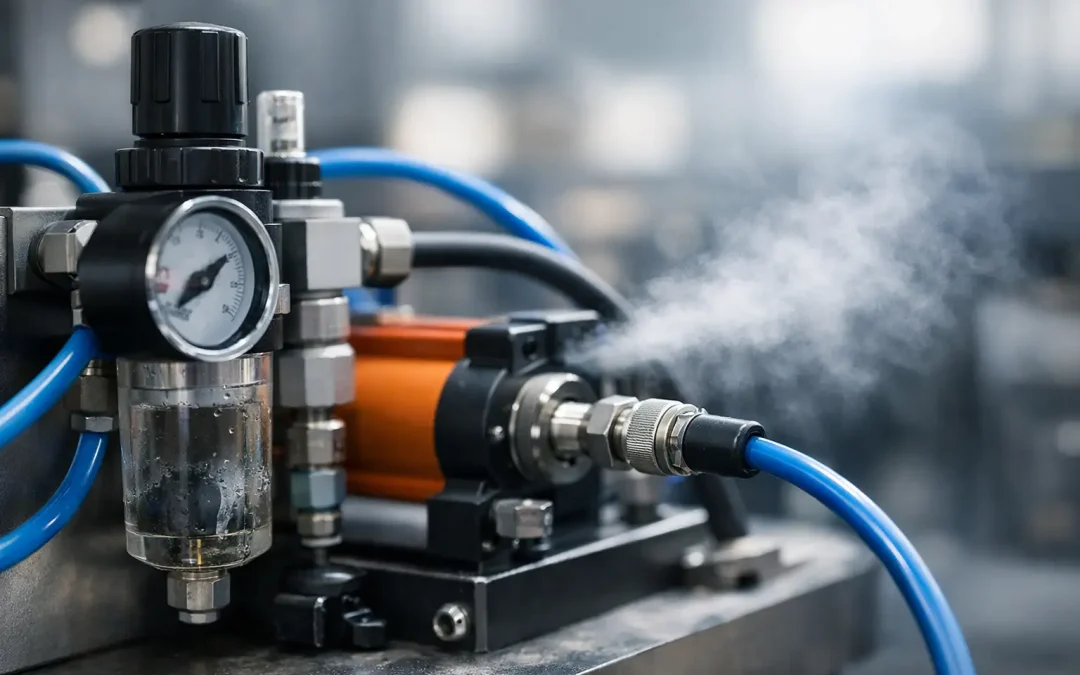
Filters, regulators, lubricators, soft-start valves, and dryers protect the system, but they also introduce pressure drop. When these components are clean and properly sized, the drop is manageable. When they are clogged, saturated, damaged, or simply too small for the application, they become a major restriction.
A dirty filter element is one of the most common causes. As contamination loads the media, differential pressure increases. Operators may see adequate upstream pressure and low downstream pressure without realizing the filter is the issue.
Regulators can also create problems even when they are technically working. If the regulator is undersized, set incorrectly, installed too far from the point of use, or suffering from droop under changing flow conditions, outlet pressure may fall well below the intended setpoint during operation.
This is especially relevant on circuits with intermittent high demand. A regulator that looks stable at low flow may not hold pressure when multiple actuators fire at once. In these cases, pressure gauges should be checked during actual cycle conditions, not only during static setup.
System layout and pipe length matter more than many teams expect
Compressed air does not move through a plant without cost. Long pipe runs, unnecessary bends, poor manifold layout, and branch lines that were added over time all contribute to cumulative pressure loss.
In older facilities, distribution networks often evolve faster than the original design intended. New machines are added, legacy headers remain in place, and temporary routing becomes permanent. The result is a system that technically operates but delivers uneven pressure across production areas.
Distance from the compressor is only part of the issue. The bigger problem is often how many restrictions the air passes through before reaching the load. Every connection, reduction, valve station, and treatment stage adds another opportunity for pressure drop.
If one machine consistently sees lower pressure than others, compare not just its distance from supply but its total path complexity. A shorter run with restrictive components can perform worse than a longer run with correctly sized hardware.
Demand spikes can make a healthy system look unhealthy
Sometimes nothing is broken. The system simply has more simultaneous demand than the supply and distribution path can support. This can happen after a tooling change, a cycle time increase, or a machine retrofit that added air consumption without revisiting supply sizing.
Large-bore cylinders, vacuum generators, air knives, blow-off circuits, and multiple rapid shifts on a valve manifold can create momentary pressure sag. If the compressor response, receiver capacity, or branch flow capacity is limited, downstream pressure drops during those events.
This is why troubleshooting should separate steady-state pressure from dynamic pressure. A system may appear fine while idle or during manual jogging but fail during full automatic operation. Data logging or at least observing gauges during peak cycle events often reveals the true source of the complaint.
Temperature, moisture, and contamination also play a role
Air quality problems do more than shorten component life. Moisture, oil carryover, and particulate contamination increase restriction and degrade regulator, valve, and seal performance. In colder environments, condensate can create intermittent blockage. In dirty environments, contamination loads filters faster and can interfere with valve spool movement.
Temperature shifts also affect measured pressure and apparent performance. That does not mean temperature is usually the primary answer to what causes air pressure drop, but it can intensify an existing weakness in the system.
If pressure loss appears seasonal or location-specific, review the air prep strategy, condensate management, and environmental exposure around the affected equipment.
How to diagnose pressure drop without wasting time
The fastest troubleshooting starts by measuring pressure at multiple points under real operating conditions. Check pressure at the compressor discharge, after primary air prep, at the machine inlet, before the valve manifold, and as close as practical to the actuator circuit. That tells you where the drop is being introduced.
If pressure is stable at the machine inlet but low at the actuator circuit, the problem is local – often valve capacity, fitting restriction, regulator droop, or localized leakage. If pressure is already low at the machine inlet, focus on the upstream distribution network, air prep, and plant demand.
It also helps to isolate branches one at a time. If closing one section restores pressure elsewhere, that branch is consuming more air than expected through leakage, high demand, or restriction-driven inefficiency.
For recurring issues, replacing random components is expensive and slow. A better path is to verify flow requirements, compare them to actual component Cv and line sizing, and inspect the pressure differential across filters and regulators. In many cases, the fix is not a major redesign – it is correcting one undersized or contaminated component that has become the choke point.
The right fix depends on the cause
There is no single cure for pressure drop because the symptom can come from very different conditions. Leak repair restores system reserve. Larger tubing or higher-flow fittings reduce friction loss. Properly sized FRL assemblies stabilize downstream pressure. Better manifold and valve selection improve response at the actuator. Additional local storage can help with short demand spikes. In some systems, the real fix is redesigning a branch layout that grew beyond its original capacity.
For OEMs and plants running demanding applications, component quality matters here. Tight tolerances, predictable flow performance, and durable air prep hardware reduce variation that turns into troubleshooting later. That is one reason many engineers standardize around factory-direct pneumatic components with clearly defined performance data instead of mixing parts with unknown flow behavior.
Pressure drop is rarely mysterious once the system is tested under load and the flow path is treated like a chain of losses instead of a single pressure number. When the circuit gets the pressure it was designed to have at the point of use, everything downstream works better – speed, force, repeatability, and uptime. That is usually where the real savings begin.