A cylinder that will not hold position is rarely a mystery for long, but it can waste hours if the wrong component gets blamed first. If you need to know how to troubleshoot pneumatic cylinder drift, start by treating it as a system problem, not just a cylinder problem. Drift can come from internal seal leakage, directional valve bypass, pressure imbalance, tubing leaks, load-induced movement, or even a cushioning setting that masks the real fault.
In production, drift usually shows up in one of three ways. The rod slowly creeps after stopping, the actuator settles under load when air is removed or reduced, or the cylinder reaches position and then backs off enough to affect sensors, clamps, or part alignment. Those symptoms may look similar, but the failure path is not always the same. The fastest troubleshooting happens when you separate what is moving, what is leaking, and what is failing to lock.
How to troubleshoot pneumatic cylinder drift without guessing
The first step is to define the operating condition where drift occurs. Does it happen only under load, only at one end of stroke, only after a warm-up period, or only when the valve is de-energized? A vertically mounted cylinder holding a suspended load behaves very differently from a horizontal stopper cylinder or a guided slide table actuator. Load direction matters because gravity can expose leakage that stays hidden in a low-force horizontal application.
Before replacing parts, isolate the cylinder from the rest of the circuit as much as possible. If the rod drifts with both ports blocked near the cylinder, the problem is likely inside the actuator or related to external mechanical load. If drift stops when ports are blocked locally, the leak path is probably through the valve, fittings, tubing, flow controls, or upstream air management hardware.
That distinction saves time. Many technicians replace the cylinder first because it is the visible moving part. In practice, directional control valves and poorly sealing fittings cause a large share of holding problems.
Start with the load and mounting condition
A cylinder can look defective when the real problem is side load, misalignment, or an application that should not rely on compressed air alone for static holding. Pneumatic cylinders are excellent for motion, clamping, and repetitive actuation, but air is compressible. If the application demands precise static position under changing load, some amount of movement may be inherent unless the design includes a rod lock, pilot-operated check valve, mechanical stop, or guided actuator sized for the load.
Check whether the rod is being forced off-axis by tooling, poor mounting geometry, or worn pivots. Side loading accelerates seal wear and can create uneven internal leakage. Also verify whether the load has changed since the system was commissioned. Heavier tooling, added fixtures, or faster cycle rates can expose marginal sizing.
Check for external leakage first
External leaks are the easiest to find and often the easiest to miss because they seem too obvious. Inspect tube cuts, push-to-connect fittings, valve manifolds, speed controllers, and cylinder port threads. Use leak detection fluid or another approved method instead of relying only on sound. In a loud plant, a small bypass leak can disappear into background noise.
Pay attention to fittings near moving axes. Repeated flexing can loosen connections or fatigue tubing. If the system includes flow controls mounted directly on the cylinder, inspect those carefully. A damaged needle or seal can create slow pressure loss that looks like internal drift.
Test the cylinder for internal bypass
If external leakage is not the issue, evaluate piston seal condition. A worn or damaged piston seal allows air to pass from one side of the piston to the other, causing gradual rod movement under load. This is one of the most common root causes, especially in high-cycle service, contaminated air systems, or applications with side loading.
A practical field test is to pressurize one side of the cylinder, stop motion, and monitor the opposite port for escaping air. Another method is to bring the rod to a position, isolate the cylinder, and watch whether it moves with ports blocked. The exact test setup depends on the machine design, but the goal is the same: determine whether pressure is crossing internally.
Do not overlook rod seal condition, although rod seals are more often linked to external leakage than true drift. If you see contamination around the rod, seal wear may be advanced enough that internal sealing surfaces are also compromised.
Valve leakage is often the real source of pneumatic cylinder drift
Directional control valves do not all seal the same way. Some spool valves have inherent internal leakage rates that are acceptable for shifting and cycle control but not ideal for long-term load holding. If the cylinder drifts mainly after the solenoid is de-energized or while the spool is centered, valve bypass becomes a prime suspect.
Swap the valve with a known-good unit if the manifold and controls allow it. If drift disappears, you have your answer. If replacing the valve changes the drift rate but does not eliminate it, the system may have more than one leak path.
Valve selection matters here. For applications that must hold position, a standard directional valve may not be enough on its own. It depends on the acceptable movement, dwell time, load direction, and safety requirement. In demanding applications, adding pilot-operated checks or a dedicated rod-locking method may be the better engineering choice than trying to force a general-purpose valve to behave like a zero-leak lock device.
Evaluate air preparation and contamination
Dirty, wet, or poorly regulated air shortens seal life and causes valves to leak sooner. If drift appears across multiple machines or multiple actuators in the same area, do not stop at the cylinder. Check filtration, regulator stability, and whether lubricated and non-lubricated components are being mixed in ways the component specifications do not support.
Water contamination can swell or degrade some sealing materials over time. Particulate contamination can score spool bores, damage piston seals, and prevent check elements from seating fully. Pressure instability can also mimic drift by allowing the holding side of the cylinder to decay during system demand spikes.
Verify regulator and pressure behavior under real conditions
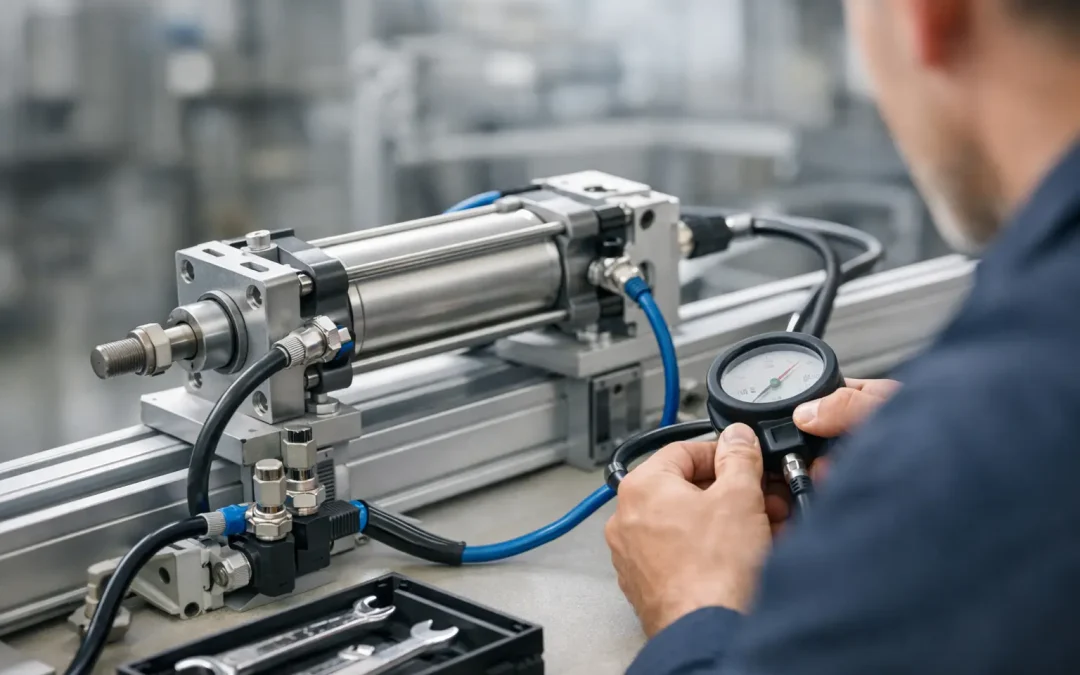
Static gauge readings can be misleading. Watch pressure while the machine cycles and while other pneumatic loads turn on. A regulator that looks stable at idle may droop significantly in production. If the holding side of a cylinder loses pressure because the supply side is undersized or unstable, the rod can creep without any defective seal being present.
This is especially relevant in multi-station systems with long tubing runs. Volume, distance, and shared demand all influence how well a cylinder holds. If drift worsens during peak machine activity, check supply sizing, regulator flow capacity, and any restrictive fittings that may be starving the circuit.
Mechanical and application factors that change the answer
Not every drifting actuator should be repaired the same way. A compact cylinder on a light stop gate may only need a new seal kit or replacement valve. A vertical load-holding axis may need a design correction. If the process cannot tolerate any position change, the right fix may be a locking device, guided assembly, or different actuator style rather than another round of seal replacement.
Cushion adjustments can also confuse the diagnosis. Overly aggressive cushioning near end of stroke may make the cylinder appear to settle or rebound. That is not always true drift, but it can trigger the same downstream problems with sensors and part placement. Reset cushions to a known baseline before deciding the cylinder is leaking.
Temperature matters too. Seals that perform acceptably cold may begin bypassing when the machine reaches operating temperature. Conversely, a sticky valve may improve once warm. When drift is intermittent, compare startup behavior to fully warmed production behavior before pulling components.
When to repair and when to replace
Repair makes sense when the cylinder is serviceable, the bore and rod are in good condition, and the application does not justify downtime risk from a heavily worn actuator. Replace when the rod is scored, the tube is damaged, the bearings are loose, or the actuator has simply reached the point where rebuild labor costs more than a new unit. The same logic applies to valves and air prep devices.
For OEMs and plant teams standardizing spare parts, it is often worth moving to higher-performance components if drift has become a recurring maintenance item. Better sealing, tighter manufacturing tolerances, and application-matched hardware can reduce repeat failures and shorten troubleshooting time across the whole line.
A disciplined troubleshooting process usually gets you to the cause quickly: confirm the load, isolate the cylinder, check external leaks, test for internal bypass, verify valve sealing, and then look upstream at air quality and pressure stability. That approach avoids unnecessary parts swapping and gets the machine back to repeatable motion faster. When a cylinder must hold position in a demanding application, design for holding from the start rather than expecting compressed air alone to do a locking device’s job.