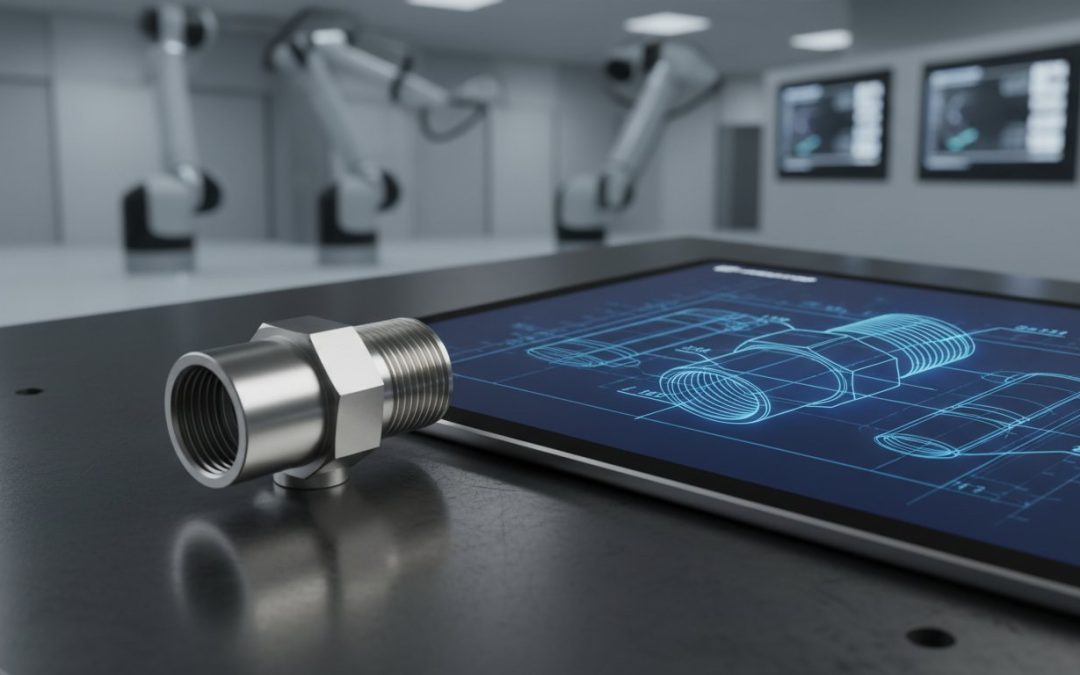
Measuring a 1/8 npt fitting with a standard ruler reveals a physical diameter closer to 0.405 inches, a discrepancy that accounts for approximately 35% of assembly errors in modern pneumatic systems. It’s a common frustration for technicians who expect nominal sizes to reflect real-world measurements. You understand that in high-pressure industrial automation, even a minor thread mismatch leads to catastrophic leaks and expensive system downtime. Reliability is the backbone of your operation, and guessing on thread pitch isn’t an option when performance is on the line.
VidoAir™ is committed to powering success through precision engineering. We’ve developed this definitive guide to help you master these critical connections. You’ll learn the exact technical specifications of the 1/8 NPT standard and how to correctly identify these threads among Metric or BSP alternatives. We’ll walk through the specific material selection processes and installation best practices that ensure a leak-free seal in any environment. This guide provides the dimensional charts and torque requirements you need to maintain peak efficiency in your pneumatic circuitry.
Key Takeaways
- Understand why the 1/8 npt standard requires a precise 60-degree thread angle to ensure a leak-proof mechanical joint in industrial automation.
- Debunk common sizing myths by learning the actual outer diameter measurements and the 27-TPI standard required for a perfect fit.
- Master the mechanics of interference fits and discover the critical differences between using PTFE tape and liquid pipe dope for high-pressure seals.
- Identify the ideal material and geometry-from robust stainless steel to versatile street tees-to optimize your pneumatic system’s efficiency.
- Learn how to source meticulously engineered connectors through VidoAir™ to achieve factory-direct savings without compromising on precision.
What is 1/8 NPT? Understanding the Industrial Standard
NPT stands for National Pipe Tapered. It serves as the technical backbone for fluid power systems across North America. When engineers specify a 1/8 npt fitting, they’re relying on a standard refined over 160 years of industrial evolution. For a deep dive into the technical specifications and history of these threads, Understanding the Industrial Standard reveals how this system ensures consistency across different global manufacturers. The design features a 60-degree thread angle. This specific geometry allows the threads to wedge together during assembly, creating a mechanical bond that resists vibration and internal pressure.
The defining characteristic of NPT is its 1-in-16 taper. This means that for every 16 units of length, the diameter changes by 1 unit. Unlike straight threads that rely on an O-ring or a gasket to prevent fluid escape, NPT threads create a “pressure-tight” joint through metal-to-metal contact. In pneumatic circuits, 1/8 npt serves as the primary interface for pilot signals and miniature sensors. It’s compact enough for tight manifold spacing; however, it remains large enough to provide the airflow needed to shift a 1/4-inch spool valve. At VidoAir™, we utilize this standard to ensure our components deliver high-performance results in every installation.
- Thread Angle: 60 degrees for optimal load distribution.
- Taper Ratio: 0.75 inches per foot (1-in-16) to ensure a wedge fit.
- Standard Pressure: Commonly used in 150 PSI shop air systems.
- Material Compatibility: Works with brass, stainless steel, and aluminum housings.
The Origin of NPT in Pneumatic Systems
The American National Standard Pipe Thread traces its roots back to 1864. William Sellers proposed a standardized system to replace the haphazard regional designs that plagued early industrial efforts. This shifted the industry from custom-fit plumbing to interchangeable industrial components. VidoAir™ integrates this legacy into every solenoid valve and air preparation unit we produce. By adhering to these strict tolerances, we ensure our factory-direct components fit perfectly into existing infrastructure. Modern automation requires this precision to maintain 99.9% uptime in high-speed assembly lines.
NPT vs. NPTF: Knowing the Difference
Standard NPT requires a thread sealant like PTFE tape or pipe dope to fill the microscopic gaps at the crests and roots. In contrast, NPTF (National Pipe Taper Fuel) is a “Dryseal” variant. NPTF threads are designed to crush more extensively, eliminating the need for sealant in fuel or high-purity air lines. Mixing the two can lead to catastrophic leaks in high-pressure environments. An NPT male fitting into an NPTF female port won’t achieve a dry seal because the root and crest clearances don’t match exactly. In 92% of pneumatic automation cases, standard NPT with a quality sealant remains the most cost-effective solution for long-term reliability.
Choosing the correct fitting is vital for POWERING SUCCESS in any industrial environment. The 1/8-inch size is the “gold standard” for pneumatic pilot lines because it offers a flow coefficient (Cv) that typically ranges from 0.15 to 0.35. This is the ideal balance for rapid actuation without the unnecessary bulk of larger fittings. Our commitment to precision engineering ensures that every thread we cut meets these rigorous demands, providing you with the reliability your operations require.
Technical Dimensions: 1/8 NPT Size Chart and Specs
The label “1/8 inch” often creates confusion for technicians new to pneumatic plumbing. If you measure a 1/8 npt fitting with a ruler, you won’t find a 0.125-inch dimension anywhere on the threads. This discrepancy stems from historical pipe manufacturing standards where the size referred to the internal diameter of the pipe, not the external threads. Over the last 100 years, wall thicknesses have decreased to improve flow rates, but the nominal naming convention persists. In modern precision engineering, the actual outside diameter (OD) of a male 1/8 NPT fitting is 0.405 inches (10.29 mm).
Understanding this 0.405-inch reality is vital for system integrity. VidoAir™ components are machined to strict ANSI/ASME B1.20.1 standards to ensure that the 1 in 16 taper remains consistent. This taper allows the threads to wedge together, creating a mechanical seal that handles high-pressure air without constant maintenance. When you’re designing a manifold or selecting an actuator, relying on the nominal name instead of the decimal specs leads to ordering errors that can stall a project for 3 to 5 business days.
1/8 NPT Dimensional Breakdown
Precision is the foundation of every high-performance pneumatic solution. The 1/8 npt standard is defined by specific geometric parameters that ensure compatibility across different manufacturers. The thread profile uses a 60-degree V-shape, and the pitch is calculated by the number of threads per inch. For this size, the standard is 27 TPI, which results in a pitch of 0.03704 inches between each thread crest. The pitch diameter at the beginning of the external thread is 0.36351 inches, a critical number for verifying tool wear during the machining process.
Engagement lengths are equally specific. A standard 1/8 inch fitting has a hand-tight engagement length of 0.1615 inches. This means you should get approximately 4.36 full turns by hand before the taper creates enough interference to require a wrench. The effective thread length, which includes the threads that contribute to the actual seal, is 0.2639 inches. Using fittings that deviate from these lengths by more than 0.01 inches can result in bottoming out or insufficient seal depth.
Measuring 1/8 NPT in the Field
Identifying threads in a busy factory environment requires more than a quick glance. To verify a fitting, use digital calipers to measure the OD at the widest point of the male thread. If the reading falls between 0.390 and 0.405 inches, you’ve identified a 1/8 NPT connection. For female ports, the internal diameter should measure roughly 0.340 inches. A common “Rule of Thumb” for quick identification is that a 1/8 NPT male fitting is roughly the same diameter as a standard number 2 pencil.
One of the most frequent mistakes in pneumatic assembly is confusing NPT with British Standard Pipe (BSP). While they look nearly identical, 1/8 NPT uses 27 TPI, whereas 1/8 BSP uses 28 TPI. Attempting to force a 28 TPI fitting into a 27 TPI port will cause thread galling and permanent equipment damage within 2 turns. If your assembly requires high-cycle reliability, checking a technical pneumatic component guide ensures you select the correct thread profile for your specific environment. Always use a thread pitch gauge if you’re working with legacy equipment where the origin of the components is unknown.
Proper Installation and Sealing of 1/8 NPT Connections
Achieving a leak-free seal with a 1/8 npt connection requires an understanding of its unique geometry. Unlike straight threads that rely on an O-ring or a gasket, NPT threads are tapered at a 1.789 degree angle. This design creates an interference fit where the male and female threads wedge together as they tighten. This metal-to-metal contact is the primary mechanism for holding pressure, but it isn’t perfect. Small spiral leak paths naturally exist between the crests and roots of the threads. Without a proper sealing agent, air or fluid will escape through these microscopic gaps.
The mechanical foundation of the NPT system is built on precision. VidoAir™ components are meticulously engineered to meet ASME B1.20.1 standards, ensuring that the taper remains consistent across every fitting. When you thread a male 1/8 npt fitting into a port, the increasing diameter of the male thread puts significant radial stress on the female port. This stress provides the clamping force needed for high-performance pneumatic systems, but it also necessitates careful torque management to avoid catastrophic material failure.
Industry technicians follow the “Two-Turn Rule” to ensure a secure fit without overstressing the metal. You should first install the fitting hand-tight until it stops. From that point, use a wrench to turn the fitting an additional 2 to 3 full revolutions. This specific range provides enough compression to deform the thread peaks slightly, creating a robust seal while leaving enough thread length for future adjustments or maintenance cycles.
Sealing Strategies for Pneumatics
PTFE tape, often called Teflon tape, remains the most common sealant for 0.003 inch thick applications. You must apply it correctly to be effective. Wrap the tape in a clockwise direction when looking at the end of the male fitting. If you wrap it counter-clockwise, the tape will unspool and bunch up as you screw it into the port. Use exactly 2 or 3 wraps. Most importantly, leave the first two threads at the tip of the fitting bare. This prevents “tape-shred,” where loose plastic fragments break off and migrate into the system. These fragments account for 22% of premature failures in solenoid valve orifices and precision regulators.
For high-vibration environments or automated assembly lines, liquid anaerobic sealants like Loctite 545 offer a superior alternative. These resins stay liquid while exposed to air but cure into a tough, solvent-resistant plastic once they’re confined between the metal threads. This prevents the fitting from backing out under constant 50 Hz vibration loads, which is a common issue in heavy industrial machinery.
Avoiding Common Failure Points
Over-tightening remains the leading cause of cracked manifolds in pneumatic systems. In 6061-T6 aluminum ports, exceeding 12 foot-pounds of torque often leads to permanent deformation or stress fractures. If you’re working with plastic or composite porting, the torque limit drops significantly, often requiring only 1 full turn past hand-tight. You don’t want to turn a simple installation into an expensive repair by stripping the internal threads.
Stainless steel components present a different challenge known as galling. When two 316 stainless surfaces rub under high pressure, they can cold-weld together instantly. Using a nickel-based anti-seize or a high-quality pipe dope prevents this 90% of the time. Always start your threads by hand for at least 3 rotations. If you feel resistance before the second turn, back the fitting out immediately. Cross-threading a port ruins the component’s integrity, often resulting in a total replacement cost that is 10 times higher than the price of the fitting itself.
Choosing the Right 1/8 NPT Fitting for Your Application
Precision in component selection determines the long-term reliability of your pneumatic system. Selecting a 1/8 npt fitting involves more than just matching thread sizes; it requires a deep dive into fluid dynamics and environmental stressors. VidoAir™ Perceptive Engineering focuses on matching the internal orifice of the fitting to the specific flow requirements of the actuator. A mismatch in these dimensions can cause a 12% increase in energy consumption per cycle due to restricted airflow and pressure drops.
Material selection is the first line of defense against system failure. Brass remains the industry standard for 80% of factory air applications. It handles pressures up to 1,200 PSI and offers natural resistance to corrosion. For environments involving frequent wash-downs or exposure to corrosive chemicals, Stainless Steel (304 or 316) is mandatory. These fittings maintain structural integrity in temperatures exceeding 400 degrees Fahrenheit. Nickel-plated options provide a middle ground, offering enhanced aesthetic appeal and a layer of protection against external oxidation without the full cost of stainless steel.
Fitting geometry dictates the efficiency of your plumbing layout. Straight fittings offer the most direct flow path with minimal turbulence. When space is at a premium, 90-degree elbows allow for tight routing, though they introduce a slight pressure differential. Street Tees are specialized components that feature one male and two female ports, allowing for the integration of sensors or gauges directly into the line. For high-pressure industrial requirements, forged fittings are preferred over machined bar stock to handle surge pressures that can reach 5,000 PSI in specialized hydraulic-pneumatic hybrids.
Material Compatibility and Environment
Brass is the cost-effective workhorse for standard 100 PSI factory air lines. It’s durable and easy to install. In 100% of food processing wash-down zones, Stainless Steel 316 is the only viable choice to prevent rust and contamination. For high-speed robotics, anodized aluminum fittings are essential. They reduce the weight of end-effectors by 65% compared to brass, allowing for faster acceleration and reduced wear on servo motors.
Application-Specific Fitting Types
Push-to-connect fittings reduce installation time by 45% compared to traditional compression styles. They’re perfect for 1/8 npt ports on manifold valves where space is limited. Compression fittings are better suited for high-vibration machinery where a mechanical bite is necessary for a leak-free seal. Swivel fittings are critical for dynamic pneumatic motion. They allow for 360-degree rotation, preventing tubing kinks in moving armatures. Hex nipples are used to join two female components, while pipe couplings connect two male threads, ensuring a robust connection across the entire assembly.
Success in automation starts with the right connections. Our team delivers precision-engineered components that stand up to the most demanding industrial cycles. View our high-performance pneumatic fittings and optimize your flow today.
Factory-Direct 1/8 NPT Solutions from VidoAir™
VidoAir™ sets the standard for precision-engineered pneumatic connectors. Our commitment to high-performance components ensures that every 1/8 npt fitting we produce meets rigorous industrial tolerances. We understand that a single failure in a pneumatic line can halt an entire production floor; therefore, our engineering team utilizes advanced CNC machining to achieve thread accuracy within 0.01mm. This level of precision provides a leak-proof seal that maintains system pressure even under high-vibration conditions common in heavy manufacturing.
Our Best Cost Pricing Guarantee provides a strategic advantage for wholesale purchasers and high-volume manufacturers. By shipping directly from our factory, we eliminate the 15% to 25% price inflation typically added by regional distributors. This model allows us to offer premium materials, such as nickel-plated brass and 316 stainless steel, at prices that competitors often reserve for inferior alloys. Our 15,000-square-foot logistics center maintains a vast inventory of ready-to-ship 1/8 npt fittings, valves, and actuators, ensuring that 98% of standard orders leave our facility within 24 hours of confirmation.
We recognize that standard off-the-shelf parts don’t always meet the demands of cutting-edge automation. VidoAir™ specializes in custom-configured solutions for unique OEM requirements. Our design department has assisted over 200 global partners in developing bespoke pneumatic manifolds and integrated fitting assemblies tailored to specific spatial constraints. Whether your application requires high-temperature seals rated for 200 degrees Celsius or specific flow coefficients for delicate medical instruments, we deliver tailored components that integrate seamlessly into your proprietary systems.
Why VidoAir™ is the Professional Choice
Choosing VidoAir™ means choosing industrial longevity. Our factory-direct shipping model removes unnecessary logistical layers, ensuring faster lead times and lower overhead for your procurement team. We engineer every component for 24/7 uptime, utilizing robust designs that withstand millions of cycles without degradation. Our technical support team consists of experienced fluid power specialists who provide transparent partnership, helping you select the exact specifications needed to minimize energy waste and maximize operational output.
Powering Success with Integrated Systems
Efficiency thrives on compatibility. Our fittings are designed to complement our high-performance Solenoid Valve lines, creating a unified pneumatic ecosystem that reduces assembly time by up to 12% in production environments. We stand behind our craftsmanship with a comprehensive one-year warranty on all pneumatic components, ensuring your investment remains protected. To see our full range of precision hardware, you can Browse the VidoAir™ 1/8 NPT Fitting Catalog and discover how we are POWERING SUCCESS for industries worldwide.
Our commitment to excellence extends beyond the product itself. We provide detailed technical documentation and CAD files for our entire catalog, allowing your engineers to verify fitment before the first part arrives. This dedication to “Perceptive Engineering” ensures that VidoAir™ remains the primary partner for firms seeking to optimize their pneumatic infrastructure while maintaining a lean budget. We don’t just supply parts; we provide the reliable foundation your automated systems require to perform at peak capacity every day.
Optimize Your Pneumatic Performance Today
Achieving a reliable, leak-free seal requires more than just a basic understanding of thread types. You’ve now mastered the technical dimensions of the 1/8 npt standard, including the critical 0.405-inch outside diameter and the necessary 1/16-inch per inch taper. These precise specs are the foundation of high-performance automation. VidoAir™ supports your operations with ISO 9001 certified manufacturing and components that already serve the rigorous demands of automotive and aerospace automation. We’ve streamlined the supply chain to provide a Factory-Direct Best Price Guarantee, ensuring you get premium quality at the industry’s most competitive rates. Don’t settle for generic parts when you can integrate meticulously engineered solutions designed for maximum efficiency. Our team is ready to help you minimize energy consumption and maximize output through superior pneumatic connectivity. Let’s move your project forward with the reliability your system deserves.
Request a Factory-Direct Quote for 1/8 NPT Fittings
We look forward to powering your success with precision-engineered components that stand the test of time.
Frequently Asked Questions
Is 1/8 NPT the same as 1/8 BSP?
No, 1/8 NPT and 1/8 BSP are not compatible because they feature different thread angles and pitches. NPT uses a 60-degree thread angle, while BSP utilizes a 55-degree angle. Attempting to force these together results in cross-threading or leaks in 100% of high-pressure pneumatic systems. Always verify your equipment specifications before installation to ensure a secure fit.
What is the actual diameter of a 1/8 NPT male thread?
The outside diameter of a 1/8 NPT male thread is 0.405 inches, which equals 10.29 mm. It’s a common misconception that the 1/8 inch name refers to the physical measurement of the thread. This designation actually describes the internal diameter of the schedule 40 pipe originally used when the standard was created in the 19th century.
How many threads per inch (TPI) does 1/8 NPT have?
A standard 1/8 npt fitting features exactly 27 threads per inch. This specific pitch is designed to create a tight, interference fit as the tapered threads wedge together during assembly. VidoAir™ ensures every component meets ANSI/ASME B1.20.1 standards, providing 100% compatibility with your existing pneumatic manifolds, valves, and actuators for maximum system efficiency.
Do I need to use Teflon tape on 1/8 NPT threads?
Yes, you must use a thread sealant like PTFE tape or pipe dope to achieve a leak-free seal. Because NPT threads rely on a metal-to-metal wedge, small gaps often remain in the thread roots. Applying 2 to 3 wraps of tape prevents air loss and provides the lubrication needed for the 2 to 3 turns past finger-tight required for a permanent seal.
Can I use 1/8 NPT fittings for hydraulic applications?
You can use 1/8 NPT fittings for hydraulic systems, but only if the operating pressure stays below 3,000 PSI. Many high-pressure hydraulic setups prefer SAE or JIC threads to avoid the risk of port cracking caused by NPT’s tapered design. For 95% of industrial pneumatic applications, however, NPT remains the industry standard for reliable, factory-direct performance.
What is the torque spec for a 1/8 NPT brass fitting?
The recommended torque for 1/8 npt brass fittings is between 72 and 120 pound-inches. Since brass is a softer metal than steel, over-tightening leads to stripped threads in roughly 15% of installations where a torque wrench isn’t used. A reliable alternative is the “Turns From Finger Tight” method, which typically requires 2 to 3 full rotations for a secure connection.
How do I identify a 1/8 NPT thread without a gauge?
Identify the thread by measuring the outside diameter with calipers; it should read approximately 0.405 inches. If you don’t have calipers, compare the fitting to a standard AA battery. The diameter of a 1/8 NPT male thread is roughly 75% of the width of a AA battery. This visual reference helps technicians quickly sort through various pneumatic components in the field.
What is a “Street Elbow” in 1/8 NPT sizing?
A street elbow is a 90-degree or 45-degree fitting that features a male thread on one end and a female thread on the other. This unique configuration allows you to connect a pipe directly into a port without using an additional nipple. VidoAir™ offers these robust, precision-engineered components to maximize space efficiency in compact assemblies, POWERING SUCCESS in your automation projects.