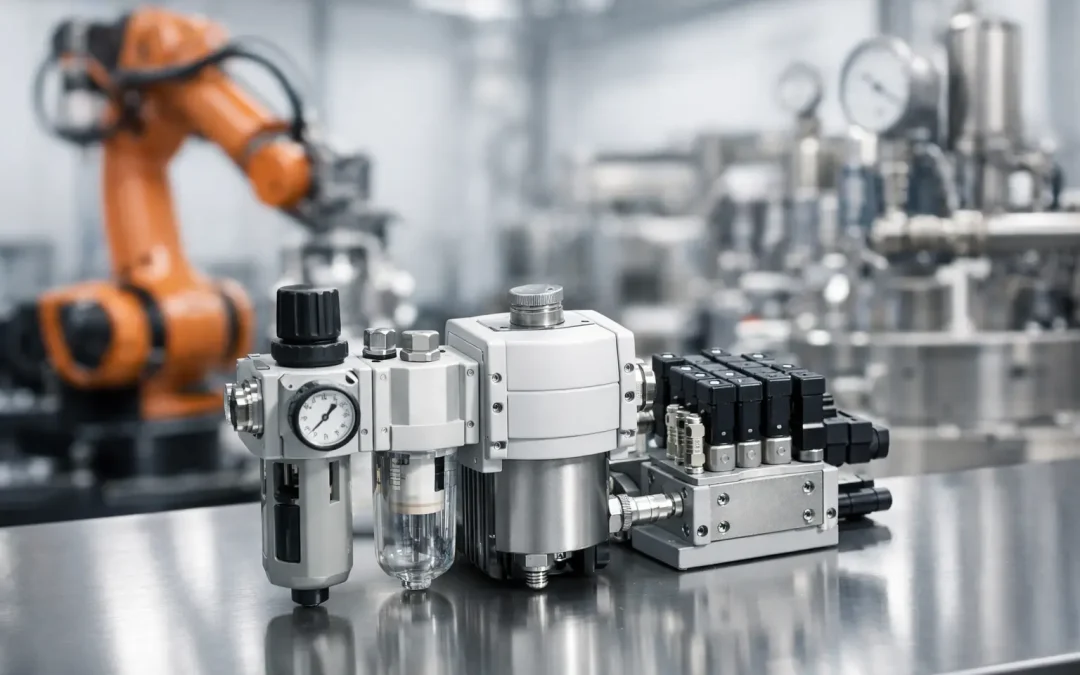
A cylinder that slows halfway through a shift, a valve bank that sticks after a weekend shutdown, or instrument air that suddenly carries water are rarely isolated component failures. In most cases, the root cause is upstream air quality or poor pressure control. This industrial air preparation system guide focuses on the specification decisions that prevent those failures in demanding OEM and plant applications.
Compressed air is a utility, but it is also a process input. It carries compressor oil, ambient humidity, pipe scale, condensate, and pressure variation directly toward actuators, solenoids, grippers, and sensitive electro-pneumatic controls. The correct preparation assembly protects those devices without creating a pressure-drop problem that limits machine performance.
Start With the Actual Point-of-Use Demand
Air preparation should be sized from the application, not from the port size already installed on a machine. A 1/2-inch connection does not automatically require a 1/2-inch filter-regulator-lubricator assembly, and a larger body does not automatically produce better system performance. Flow demand, pressure stability, contaminant tolerance, and maintenance access determine the right configuration.
Begin with peak air consumption, not average compressor capacity. Consider simultaneous cylinder movement, blowoff events, vacuum generation, gripper actuation, and the inrush demand created when a manifold energizes multiple valves. Then account for the pressure required at the actuator or valve island, plus the losses through tubing, fittings, filters, regulators, dryers, and distribution piping.
A common field issue is a machine set to 80 psi at the regulator that only sees 62 psi during its fastest cycle. The regulator may not be defective. Its flow capacity may simply be too low for peak demand, or the filter element may be loaded. Measure pressure downstream while the machine is cycling. Static gauge pressure is not a useful substitute for dynamic testing.
Pressure Drop Is a Performance Constraint
Every preparation device adds some restriction. Fine filtration captures smaller particles but generally causes more pressure drop than a coarse particulate filter. A compact regulator can fit a tight enclosure but may struggle with high intermittent flow. A dryer placed upstream can protect an entire line, while point-of-use filtration can deliver cleaner air only where it is needed.
The trade-off is application-specific. High-speed packaging equipment and large-bore cylinders often need generous flow margins. Low-flow instrumentation, laboratory automation, and precision proportional control may prioritize air cleanliness and pressure repeatability over maximum flow. Specify both the required outlet pressure and the acceptable pressure loss at peak flow.
Build the Industrial Air Preparation System in Stages
A preparation system is most reliable when each stage addresses a defined contaminant or control requirement. Trying to make one device solve every air-quality problem usually produces short element life, unstable flow, and difficult maintenance.
1. Remove Bulk Water and Pipe Contamination
The first job is separating liquid water, rust, scale, and larger debris before they reach precision components. A particulate filter with an automatic or manual drain is commonly used at the point of use, particularly when distribution piping is old or compressors are located in humid conditions.
Drainage deserves as much attention as filtration rating. A bowl can collect contaminants effectively, but it becomes a source of carryover if the drain is plugged, undersized, or never serviced. In unattended equipment, automatic drains can reduce maintenance dependence. They still require inspection because oily condensate and debris can interfere with drain operation.
Place air drops correctly as well. A drop leg taken from the top of a main line reduces the chance that condensate flows directly into the machine. Low points in the distribution system need drain provisions. No filter can compensate indefinitely for piping that continuously sends standing water downstream.
2. Match Filter Grade to the Component Being Protected
Particulate filters protect against solids. Coalescing filters capture fine liquid aerosols and oil mist. These functions are related but not interchangeable. If a system uses lubricated compressor air or oil-sensitive components, a coalescing stage may be necessary. If the requirement is dry, oil-free air for sensing, painting, food-related handling, or specialized vacuum work, the upstream compressor and dryer strategy must also support that standard.
Do not specify the finest element everywhere by default. Fine elements can load quickly in dirty air and impose unnecessary pressure loss on general-purpose pneumatic circuits. A staged approach often performs better: bulk separation first, then finer filtration only at the branches that need it.
Filter selection also depends on the materials in the downstream devices. Standard pneumatic components may tolerate general shop air better than precision regulators, proportional valves, vacuum generators, or compact grippers with small internal passages. Stainless steel air preparation devices are worth considering where washdown exposure, corrosion, or aggressive environments would shorten the service life of standard assemblies.
3. Regulate Pressure Where It Matters
A regulator should provide stable downstream pressure across the expected flow range. Its pressure range must fit the machine requirement, but range alone is not enough. Review flow curves, relieving versus non-relieving operation, gauge placement, adjustment security, and mounting orientation.
Relieving regulators vent excess downstream pressure when the setpoint is reduced. That behavior is useful for many machine circuits because it allows pressure to fall without waiting for air to bleed through downstream components. Non-relieving regulators retain trapped downstream pressure unless another path releases it. Either design can be correct, but the choice affects maintenance procedures and actuator behavior.
For repeatable force and motion, locate regulation close to the load. A regulator mounted far upstream can show the correct setpoint while long tubing runs and manifold demand create pressure variation at the cylinder. Dedicated regulators for separate machine zones also make troubleshooting faster. A clamp circuit, blowoff circuit, and precision slide table actuator rarely need identical pressure settings.
4. Decide Whether Lubrication Belongs in the Circuit
Lubricators are not a default requirement for modern pneumatic systems. Many current valves, cylinders, and actuators are pre-lubricated and designed for non-lubricated air. Adding oil to these circuits can contaminate sensors, exhaust silencers, vacuum components, and processes that require clean handling.
Where a manufacturer calls for air-line lubrication, use a controlled lubricator and keep it downstream of filters and regulators. Once a circuit is run with oil, removing the lubricator may accelerate wear because seals and internal surfaces have adapted to lubricated operation. Confirm the requirement for every component rather than applying one policy across an entire plant.
Drying Strategy Must Match the Failure Mode
Filters remove liquid water and aerosols, but they do not lower the dew point enough to prevent condensation in cold piping or outdoor equipment. That is a dryer’s role. Refrigerated dryers suit many general industrial systems where moderate dew point control is acceptable. Desiccant dryers are commonly used when very dry air is required for low-temperature exposure, sensitive instruments, or processes where moisture cannot be tolerated.
The right dryer location depends on the system. A central dryer protects the distribution network and reduces water-related failures across the facility. Point-of-use drying can be justified for a critical machine, remote equipment, or an application with a tighter dew point requirement than the rest of the plant.
Watch for a frequent mismatch: a plant installs excellent point-of-use filters but keeps wet air in long distribution lines. Water then condenses upstream, carries contaminants through the system, and overloads filters before air reaches the machine. Drying, piping design, and drainage must work as one strategy.
Installation Details That Affect Service Life
Air preparation assemblies need clear bowl access, readable gauges, and safe drain routing. Install them where technicians can inspect contamination without removing guards or reaching behind energized equipment. Use the manufacturer’s specified flow direction and mounting orientation. A reversed filter or regulator may still pass air, but its separation and control performance will not be predictable.
Protect polycarbonate bowls from solvents, chemical vapors, and direct impact. In harsh industrial environments, metal bowl guards or all-metal construction can reduce damage risk. If the assembly supports a critical machine, add a lockable shutoff and a safe downstream exhaust method so maintenance personnel can isolate and depressurize the circuit properly.
Keep gauges practical. A gauge that cannot be seen during normal operation provides little diagnostic value. For systems with remote monitoring, pressure sensors can reveal gradual filter loading or regulator instability before production is affected.
Set a Maintenance Trigger, Not Just a Calendar Date
Changing elements only on a fixed annual schedule is simple, but it can waste usable filters in clean service and miss overloaded elements in severe service. A better program combines scheduled inspections with differential pressure, observed flow loss, condensate volume, and machine symptoms.
If a cylinder loses speed, verify downstream pressure under load before replacing the actuator. If a solenoid valve sticks, inspect the air source for water and oil carryover before assuming the coil or spool is at fault. If bowl drains frequently overflow, investigate compressor performance, dryer capacity, drain operation, and distribution piping rather than repeatedly replacing local filters.
For OEMs, document the filter grade, regulator setting, drain method, replacement element number, and service interval in the machine manual. That small amount of documentation prevents incorrect replacements and gives maintenance teams a consistent baseline. VidoAir can support configured air preparation assemblies when standard catalog combinations do not match the required ports, flow, materials, or filtration stages.
A well-specified air preparation system is not an accessory at the edge of the pneumatic circuit. It is the condition that allows every downstream component to deliver its rated performance. Treat air quality and pressure stability as design inputs, then validate them at peak cycle demand before the machine reaches the production floor.