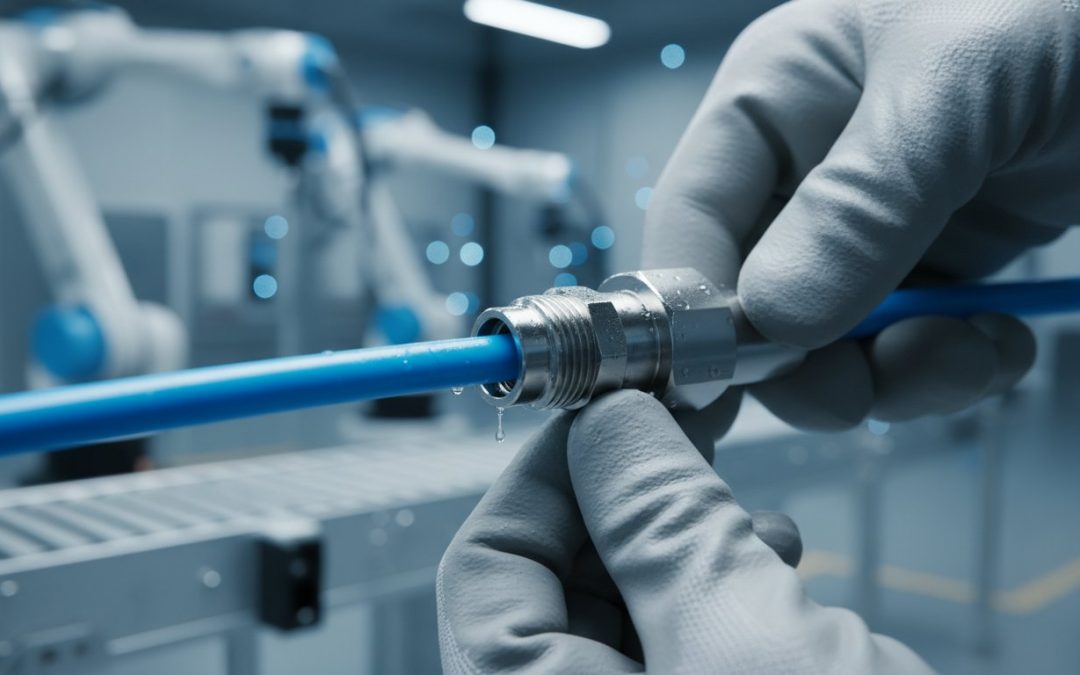
A single 2mm leak in a 100 PSI pneumatic line can bleed over $500 from your annual energy budget. While many facilities overlook these invisible costs, the real bottleneck often lies in outdated assembly methods. Traditional threaded connections slow down your technicians and increase the risk of human error during installation. Transitioning to high-performance push to connect fittings can slash your assembly time by 75% compared to manual compression alternatives.
At VidoAir™, we understand that precision engineering is the foundation of industrial reliability. You’re likely tired of system leaks causing unexpected downtime and struggling to find components that survive 200-degree environments or caustic chemical washes. We’ll help you master the mechanics and material selection needed to ensure a 100% leak-free pneumatic circuit. This guide breaks down the technical specifications of polymer, brass, and stainless steel options to help you choose the right fit for your specific operating environment.
Key Takeaways
- Discover how instant, tool-free assembly can drastically reduce your facility’s setup time compared to traditional NPT threaded or compression fittings.
- Master the internal anatomy of push to connect fittings to understand how precision-engineered collets and O-rings prevent blowouts under high industrial pressures.
- Identify the critical performance differences between composite, nickel-plated, and stainless steel materials to optimize your system’s longevity and corrosion resistance.
- Implement the “Square Cut” rule and “Double Click” insertion method to guarantee a perfect, leak-free seal every time you modify your pneumatic lines.
- Learn how VidoAir™ leverages factory-direct engineering to provide premium, high-performance components while maintaining a decisive best-cost pricing advantage.
What Are Push to Connect Fittings and Why Are They Essential in 2026?
Push to connect fittings are specialized pneumatic connectors designed for the instant, tool-free attachment of flexible tubing. Unlike traditional threaded components that require wrenches and manual sealing, these fittings utilize an internal gripping mechanism to secure the line with a simple manual insertion. In technical engineering documentation, you will often find these components classified as push-to-pull compression fittings. This technology relies on an internal O-ring for sealing and a stainless steel grab ring to lock the tube in place. In the high-speed manufacturing environment of 2026, where facility downtime costs an average of $9,000 per minute, the ability to swap a pneumatic line in three seconds rather than three minutes is a critical competitive advantage.
The core value proposition of push to connect fittings lies in the drastic reduction of assembly time. When compared to NPT threaded fittings or standard compression sleeves, push-ins eliminate the need for PTFE tape, liquid sealants, or calibrated torque wrenches. This efficiency isn’t just about speed; it’s about eliminating human error. Threaded connections often suffer from over-tightening or insufficient sealing, leading to micro-leaks. A 2025 industry report indicated that 25% of pneumatic system energy waste stems from poorly installed threaded joints. Push-in technology solves this by providing a tactile “click” or firm stop that confirms a secure, leak-free connection every time.
It’s vital to distinguish industrial pneumatic push-ins from residential “push-fit” plumbing variants found in home improvement stores. While they share a similar name, the engineering tolerances are worlds apart. Residential fittings are designed for static water pressure, usually capped at 80 PSI. In contrast, VidoAir™ industrial fittings are meticulously engineered to handle rapid pressure cycling up to 150 PSI and withstand the constant vibrations of high-speed robotic cells. Using the wrong variant in an automated environment can lead to catastrophic line blowouts and equipment damage.
The Evolution of Pneumatic Connections
The industry has moved away from heavy iron pipes and threaded brass toward lightweight, high-performance polymers and nickel-plated brass. This shift isn’t just aesthetic. Modern polymers offer a 40% weight reduction, which is essential for mobile automation units. At VidoAir™, the “Powering Success” mantra starts with these reliable connection points. By utilizing premium materials, we help facilities reduce air leaks that account for 30% of energy waste in older factory-scale installations. Switching to push-in technology has allowed our partners to see labor cost reductions of 70% during the initial assembly of complex manifolds.
Common Applications in Industrial Automation
Precision is the standard for 2026. These fittings integrate directly with solenoid valves and pneumatic actuators to provide exact motion control in assembly lines. They’re indispensable in robotic end-of-arm tooling (EOAT), where every gram of weight affects the robot’s acceleration and cycle time. You’ll also find them in air preparation units and manifold blocks, allowing for dense, organized tubing layouts within compact control cabinets. Whether it’s a pick-and-place robot or a 5-axis CNC machine, these fittings ensure the air stays where it belongs, powering the components that move the world forward.
Inside the Mechanism: How Push-to-Connect Fittings Create a Leak-Free Seal
A high-performance pneumatic system depends on the integrity of its connections. While traditional compression fittings require wrenches and significant torque, push to connect fittings utilize a sophisticated four-part internal architecture to achieve an instantaneous, airtight seal. This assembly consists of a nickel-plated brass or composite body, a release button, a gripping collet, and a high-grade O-ring. When a technician inserts a tube into the fitting, it passes through the collet and seats firmly against the O-ring, creating a dual-stage barrier against pressure loss.
The engineering behind these components is precise. The O-ring serves as the primary seal, encircling the outer diameter (OD) of the tubing. Because the seal occurs on the OD rather than the end of the tube, the quality of the cut matters. A clean, 90-degree cut ensures the tubing sits flush against the internal stop. This design is why modern push to connect fittings can maintain a vacuum rating of 29.5 inches of mercury and handle positive pressures up to 290 PSI in specific industrial configurations.
The Critical Role of the Gripping Collet
The collet is the “engine” of the fitting. It features a series of radial “teeth” that bite into the surface of the tubing. While some entry-level fittings use plastic retaining clips, VidoAir™ utilizes high-strength stainless steel collets. These metal teeth provide superior vibration resistance, which is essential for heavy machinery where constant oscillation could otherwise cause tubing to “walk” out of the socket. This grip is so secure that it meets the OSHA safety precautions for pneumatic tools regarding the prevention of accidental disconnection under load.
One major advantage of this collet design is the ability to accommodate 360-degree rotation. Because the collet floats within the body, the tubing can spin freely even after the system is pressurized. This eliminates the risk of torsional stress, which is a leading cause of premature failure in rigid piping systems. If you’re looking to upgrade your current setup, you can browse our high-performance pneumatic solutions to find the right collet material for your specific environment.
Sealing Technology: O-Rings and Fluid Compatibility
The O-ring’s material determines the fitting’s environmental limits. Standard Nitrile (NBR) seals are the industry workhorse, performing reliably between -20°C and 80°C. However, in automotive or chemical processing plants where temperatures frequently exceed 150°C, Viton (FKM) seals become mandatory. The position of the O-ring deep within the fitting body also serves a secondary purpose; it acts as a barrier that prevents external dust, oil, and debris from entering the air stream, protecting sensitive downstream valves and actuators.
To further streamline assembly, VidoAir™ fittings come with pre-applied Teflon (PTFE) sealant on the threaded ends. This eliminates the need for manual tape application, which reduces installation time by approximately 40% per joint. The physics of the “locking” mechanism is perhaps the most impressive feature. As internal pressure increases, it forces the collet against an internal tapered ramp. This action wedges the stainless steel teeth deeper into the tubing wall. Essentially, the harder the system works, the stronger the connection becomes, ensuring a blowout-proof seal during peak operation cycles.
Material Selection: Choosing Between Composite, Nickel-Plated, and Stainless Steel
Selecting the right material for push to connect fittings determines the lifecycle and safety of your pneumatic system. Material choice isn’t just about the initial purchase price; it’s about matching the component to the operational environment to prevent premature failure. Composite fittings, typically constructed from high-grade PBT (Polybutylene Terephthalate), represent the industry standard for 75% of indoor industrial air lines. These are lightweight, cost-effective, and provide reliable performance for standard factory air pressures up to 150 PSI. They’re the go-to solution for packaging lines and assembly stations where weight and cost are primary drivers.
For more demanding industrial applications, nickel-plated brass serves as a robust middle ground. The nickel plating provides a layer of protection against oxidation and light chemical exposure that would degrade bare brass. These fittings offer the mechanical strength required to withstand physical impacts in heavy machinery environments. When engineers specify components for high-pressure systems, they often look for the ISO 14743 standard for pneumatic connectors to ensure the fitting meets rigorous burst pressure and tube retention requirements. VidoAir™ ensures our metal components exceed these benchmarks to maintain a leak-free seal under vibration.
In specialized sectors like pharmaceutical or food processing, 316L stainless steel is the mandatory choice. This material is non-reactive and resists the harsh acids used in sterilization. While the cost is higher, the ROI comes from avoiding the 30% failure rate seen when using standard metals in corrosive environments. VidoAir™ recommends matching your fitting material to your tubing type. For instance, soft Polyurethane (PU) tubing pairs perfectly with composite fittings. However, if you’re using rigid Nylon 12 tubing for higher pressure, the harder metal teeth in a nickel-plated or stainless steel fitting provide a more secure bite to prevent tube blowouts.
Environmental Factors in Selection
Temperature limits act as a hard boundary for material selection. Composite bodies typically lose structural integrity and soften when ambient temperatures exceed 60°C (140°F). In high-heat zones near motors or ovens, metal bodies are required to prevent catastrophic air loss. UV resistance is another critical factor. Standard plastics degrade and become brittle within 18 months of direct sunlight exposure. For outdoor pneumatic systems, VidoAir™ provides UV-stabilized composites or full metal options to ensure your “POWERING SUCCESS” mantra isn’t interrupted by environmental wear.
Thread Types: NPT, BSPP, and BSPT
Thread mismatch accounts for approximately 15% of all pneumatic system leaks during initial setup. Identifying your thread type is essential for a precision fit. NPT (National Pipe Taper) is the standard in North America, using a tapered design to create a seal. However, many global OEMs utilize BSPT (British Standard Pipe Taper) or BSPP (British Standard Pipe Parallel). VidoAir™ offers custom-configured thread options to ensure compatibility with international machinery. Our G-thread (BSPP) fittings are particularly efficient; they feature an integrated O-ring that allows for flush mounting and a mechanical seal. This design eliminates the need for thread sealant or Teflon tape, reducing installation time by 40% for high-volume assembly teams.
Installation and Maintenance: Ensuring Peak Performance
Precision starts with the preparation of the pneumatic line. A common mistake in the field is using a standard utility knife or shears for cutting tubing. This often results in an angled cut or a flattened tube profile that compromises the internal seal. For a 100% leak-free connection, the “Square Cut” rule is mandatory. Any deviation greater than 5 degrees from a perfect 90-degree angle increases the risk of O-ring bypass by 40%. You must use a specialized tube cutter to ensure the edge is clean, burr-free, and perfectly circular.
The insertion process requires a specific tactile response to confirm a secure seat. When you push the tube into push to connect fittings, you’ll feel an initial resistance as the tube passes through the stainless steel collet. You aren’t finished yet. Continue pushing until you feel a definitive “double click.” This second click indicates the tube has cleared the internal O-ring and seated firmly against the internal stop. If you stop after the first click, the tube is held mechanically but isn’t sealed pneumatically, leading to immediate failure under pressure.
Testing the connection is the final step in a professional installation. Perform a “tug test” by pulling back firmly on the tube; it should remain locked in place by the collet teeth. For critical systems, apply a soap-water solution to the joint while the system is under a standard 80 PSI load. The absence of bubbles confirms a meticulous seal. When you need to disassemble the circuit, press the release button uniformly against the fitting body. This retracts the collet teeth. Pulling the tube without fully depressing the button will score the tubing and can permanently bend the teeth, ruining the fitting’s internal geometry.
Troubleshooting Common Leak Points
Scratched tubing causes 90% of slow leaks in industrial pneumatic systems. Even a microscopic 0.1mm scratch on the outer diameter of the tube creates a channel for air to escape past the O-ring. If a fitting refuses to release the tube, check for residual pressure. A system holding as little as 5 PSI can create a pressure-lock that prevents the collet from retracting. Bleed the line entirely before attempting removal. While O-rings can be replaced in specialized manifolds, replacing the entire fitting is usually the most cost-effective path for standard 1/4 inch or 6mm components to ensure long-term reliability.
Reusability and Lifecycle Management
High-performance push to connect fittings are designed for multiple uses, but they have a finite lifespan. In high-cycle automation environments, we recommend a limit of 5 to 7 reinsertions per fitting. Beyond this point, the stainless steel collet teeth may lose their tension, or the O-ring may exhibit compression set. Inspect the plastic release buttons for whitening or hairline fractures, which indicate material fatigue from UV exposure or chemical stress. Implementing a preventive maintenance schedule every 12 months prevents unexpected downtime and maintains the “Powering Success” standard VidoAir™ clients expect.
Reliable pneumatic systems depend on the quality of every connection point. View the VidoAir™ catalog of precision-engineered fittings to upgrade your system’s durability.
Optimizing Your Supply Chain with VidoAir™ Factory-Direct Fittings
VidoAir™ delivers premium engineering directly from our manufacturing floor to your facility. We’ve removed the layers of distribution that typically inflate industrial costs by 20% to 35%. This factory-direct model ensures you receive high-performance push to connect fittings without the markup of a third-party vendor. By maintaining full control over the entire production cycle, we provide “best cost pricing” while upholding rigorous quality standards that exceed ISO 9001:2015 requirements. Our team doesn’t just manufacture parts; we engineer solutions that integrate into your existing workflows.
Our facility manages a vast inventory of 25,000+ ready-to-ship components. This logistical strength is vital for urgent maintenance, repair, and operations (MRO) needs. When a pneumatic line fails, every hour of downtime can cost a facility upwards of $10,000 in lost productivity. VidoAir™ mitigates this risk by offering rapid shipping on standard configurations. We understand that a robust supply chain isn’t just about having parts; it’s about having the right parts exactly when you need them. Our logistics team prioritizes speed to ensure your facility stays operational 24/7.
For original equipment manufacturers (OEMs), we offer custom-configured fittings that go beyond off-the-shelf options. Whether your application requires specialized chemical-resistant polymers or non-standard thread sizes for a specific machine build, our engineers adapt our production lines to your specs. This flexibility allows you to streamline your own assembly process. By sourcing custom push to connect fittings directly from the maker, you eliminate compatibility issues and reduce the number of vendors in your procurement system. It’s a strategic approach that simplifies your inventory management while boosting machine reliability.
Transparent Partnership and Technical Support
Our “Perceptive Engineering” approach focuses on getting the right component into your hands the first time. We eliminate technical guesswork by providing instant access to downloadable 3D CAD models and comprehensive data sheets. This allows your design team to integrate VidoAir™ components into system schematics with 100% accuracy before a single part is ordered. Every pneumatic component we ship is backed by a secure one-year warranty. This commitment provides a level of accountability that traditional middleman distributors simply can’t offer. You’re partnering with the people who actually built the product.
Powering Success Through Precision
Global manufacturers in the automotive, food processing, and packaging sectors rely on VidoAir™ to sustain their critical infrastructure. Precision-machined fittings are the backbone of modern automation. Even a minor 2% leak in a pneumatic system can lead to thousands of dollars in wasted energy costs over a fiscal year. Our high-performance fittings minimize these losses and allow you to scale production with confidence. We provide the technical durability required for high-cycle industrial environments. Take the next step in optimizing your pneumatic systems by exploring our full range of solutions. View the VidoAir™ Pneumatic Fittings Catalog.
Maximize Your System Reliability for 2026
Integrating high-performance components isn’t just a maintenance task; it’s a strategic move to hit your 2026 production targets. Selecting the right push to connect fittings ensures a leak-free seal that minimizes energy waste and prevents costly downtime. Whether you choose lightweight composite materials or industrial-grade 316 stainless steel for corrosive environments, your selection directly impacts your system’s long-term durability. Precision engineering at the connection point is the foundation of every efficient pneumatic circuit.
VidoAir™ eliminates the middleman to provide factory-direct pricing that often reduces component costs by 25% or more compared to standard retail distributors. Our ready-to-ship global inventory means you won’t face the 4-week lead times common in the current market. We’re committed to powering your success through robust hardware and a transparent partnership. Don’t let a minor fitting become a major failure point in your automation line.
Browse High-Performance Pneumatic Fittings at VidoAir™
We look forward to helping you build a more efficient and powerful operation.
Frequently Asked Questions
Can I use push to connect fittings for water or oil?
You can use push to connect fittings for water or oil if the internal O-ring and body material are compatible. Standard pneumatic models use NBR seals, but water applications require EPDM or Viton seals to prevent degradation. VidoAir™ offers 316 stainless steel options that handle liquids up to 150 PSI. Always verify that your specific fluid doesn’t exceed the 140 degree Fahrenheit limit for standard polymer housings.
How do I remove a tube from a push to connect fitting?
To remove a tube, push the release sleeve firmly against the fitting body while pulling the tubing away. This action disengages the internal stainless steel gripping claws. You’ll need to apply even pressure across the 360 degree circumference of the collet. Ensure the system is fully depressurized to 0 PSI before attempting removal to avoid injury or component damage. It’s a simple, five second process.
What is the maximum pressure rating for industrial push-in fittings?
Most industrial push to connect fittings carry a maximum pressure rating of 145 PSI or 1.0 MPa. High performance versions engineered by VidoAir™ can sustain pressures up to 290 PSI in specific configurations. These ratings apply at a standard temperature of 68 degrees Fahrenheit. Pressure capacity typically drops by 20 percent when operating at the upper limit of 140 degrees Fahrenheit.
Are push to connect fittings reusable?
These fittings are reusable for over 1,000 connection cycles if you maintain the tubing properly. You must ensure the tube end is cut at a perfect 90 degree angle using a dedicated tube cutter. If the tube shows 0.5mm deep scratches from previous use, trim 10mm off the end. This creates a fresh surface for the internal O-ring to seal against, maintaining a leak-free connection for your system.
Why is my push to connect fitting leaking air?
Air leaks usually occur because the tube wasn’t inserted past the internal O-ring or the cut isn’t square. Approximately 85 percent of pneumatic leaks result from uneven tube ends that don’t seat correctly. Check for debris or 1mm shards inside the fitting. VidoAir™ designs utilize a dual-seal approach to minimize these risks, but a clean, perpendicular cut remains essential for a 100 percent airtight seal.
What is the difference between NPT and BSP threads on these fittings?
NPT threads use a 60 degree thread angle and a 1:16 taper, while BSP threads utilize a 55 degree angle. NPT is the standard in North America. BSP includes both tapered (BSPT) and parallel (BSPP) varieties common in European and Asian machinery. You can’t cross-thread these types without causing permanent damage to the 0.75 inch or 0.5 inch ports. Proper identification prevents 100 percent of thread failure issues.
Do I need to use Teflon tape on push-to-connect threads?
You don’t need Teflon tape if the fitting has a factory-applied sealant or an integrated O-ring. VidoAir™ products often come with a pre-applied white sealant on tapered threads to ensure a fast, factory direct installation. Using extra tape on these pre-treated threads can actually cause 15 percent more stress on the housing. This potentially leads to cracks in the fitting body during high-torque installation.
Can these fittings be used in vacuum applications?
Most push-in components work perfectly in vacuum applications. They’re typically rated for a vacuum level of -29.5 inches of mercury or 750 mmHg. The internal design uses the vacuum pressure to pull the tube tighter against the seal. This makes them a reliable choice for 99 percent of automated pick and place systems that rely on suction for material handling. It’s a proven solution for precision automation.