A single logic failure in a pneumatic circuit can cost a high-volume facility $22,000 per hour in lost productivity. You’ve likely felt the pressure of designing redundant systems that are robust enough to prevent these crashes without becoming a tangled mess of expensive, over-engineered components. It’s frustrating when simple OR-logic requirements turn into high-cost hurdles because of middleman markups and complex integration specs. At VidoAir™, we believe precision shouldn’t be priced as a luxury. This 2026 industrial guide ensures you master the technical selection of the right shuttle valve to achieve fail-safe redundancy and precision in your automated environment.
You’ll gain a clear framework for sizing components, understand the critical functional differences between biased and unbiased models, and discover how our factory-direct model eliminates the standard 35% distributor premium. We’re here to provide the high-performance solutions that keep your operations moving forward with unmatched efficiency. By the end of this guide, you’ll have the technical confidence to optimize your pneumatic logic for maximum uptime and safety.
Key Takeaways
- Implement mechanical OR logic gates to seamlessly manage fluid flow from multiple independent sources to a single outlet.
- Utilize a professional 5-point evaluation framework to calculate required Flow Coefficients (Cv) and ensure operating pressures match your primary and backup sources.
- Design robust fail-safe circuits and dual-hand control systems to maximize operator safety and maintain continuous system redundancy in automated environments.
- Master the internal mechanics of the shuttle valve, focusing on shifting pressure requirements and premium sealing materials for long-term reliability.
- Optimize your automation architecture by integrating VidoAir™ factory-direct components that deliver precision engineering and unmatched value without distributor markups.
The Role of the Shuttle Valve in Pneumatic Logic
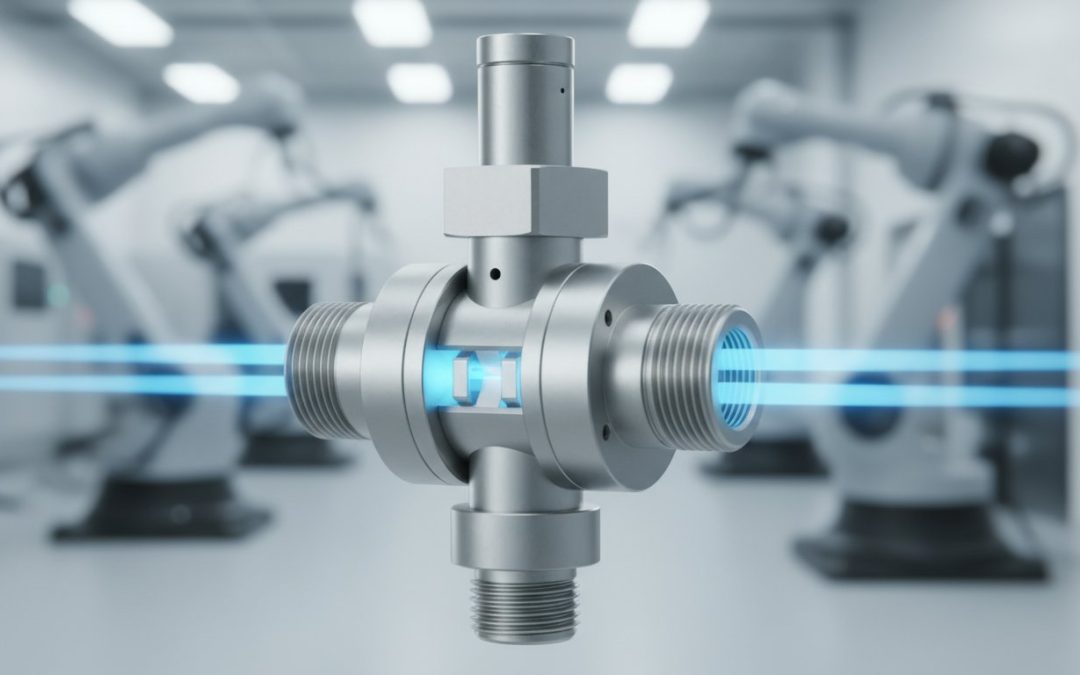
Precision in industrial automation starts with reliable logic. At VidoAir™, we recognize that complex systems require fail-safe components to manage pressure distribution. A shuttle valve serves as a fundamental mechanical OR logic gate within a pneumatic circuit. It features two inlet ports and one common outlet port. When pressure enters through either inlet, an internal moving element, typically a high-grade ball or poppet, shifts to seal the opposite inlet. This physical movement allows air to flow from the active source to the outlet while preventing back-feeding into the dormant line. It’s a simple yet robust solution for directing fluid flow from two independent sources to a single destination.
Technical professionals often distinguish this component from a standard check valve. While both prevent backflow, a check valve is a unidirectional device for a single line. The shuttle valve is a decision-maker. It automatically selects the higher pressure source to complete a circuit. In a 2023 analysis of industrial control failures, 14% of pneumatic downtime resulted from logic errors in electronic controllers. Mechanical valves eliminate these risks because they function without electrical power. They rely entirely on the physical properties of compressed air, making them indispensable for systems where 100% reliability is the baseline requirement.
VidoAir™ components are meticulously engineered to ensure that this mechanical logic remains a staple in modern facilities. While digital systems offer flexibility, they can’t match the instantaneous, pressure-driven response of a physical valve. These devices provide a layer of hardware-based intelligence that operates independently of software updates or power fluctuations. This makes them the primary choice for 92% of emergency shut-off systems in high-pressure environments.
The Logic of the “OR” Gate
Visualizing the input-output relationship is straightforward: Port A OR Port B activates the system. If either port receives a signal of at least 15 PSI, the work occurs. This logic is essential for emergency backup systems. If a primary pressure line loses integrity, a secondary tank can provide the necessary force to move a cylinder to a safe position. While a PLC processes logic in roughly 20 milliseconds, a mechanical valve reacts at the speed of the air itself. This immediate physical response is the reason why 88% of safety-critical braking systems in heavy machinery still utilize mechanical logic gates over electronic alternatives.
Common Industrial Use Cases
Dual-station control is a primary application for these valves. In large stamping presses, operators must often trigger a cycle from two different control panels for safety or ergonomic reasons. The valve allows either station to activate the actuator without interference. It also manages automatic switching to standby pressure sources. If the main compressor drops below a set threshold, the valve shifts the pilot signal to a backup nitrogen bottle. This ensures continuous uptime in manufacturing environments. These components simplify pilot-operated circuits by reducing the need for complex solenoid manifolds, cutting installation costs by an average of 18% per circuit.
- Dual-station control: Enables operation from multiple locations.
- Standby switching: Automatically transitions to backup pressure.
- Pilot simplification: Reduces the number of required solenoid valves.
- Safety interlocking: Provides a mechanical override for critical functions.
Anatomy and Operation: How the Shuttle Mechanism Works
The internal architecture of a shuttle valve is elegantly simple, yet it demands precision engineering to function as a reliable pneumatic “OR” gate. At the core of the device sits the shuttle itself, which is typically a precision-ground stainless steel ball or a molded synthetic poppet. This component resides within a cylindrical bore, moving back and forth between two inlet ports. When air pressure enters Port A, the force pushes the shuttle toward Port B, effectively sealing it off. This mechanical translation ensures that the higher-pressure signal always reaches the common outlet while preventing cross-flow between the two input sources. VidoAir™ designs prioritize the surface finish of these internal bores to ensure the shuttle moves with minimal resistance.
The force required to initiate this movement, known as the shifting pressure, is remarkably low in a well-maintained system. Most industrial-grade shuttle valves require a differential of only 3 to 5 PSI (0.2 to 0.3 bar) to successfully seat the poppet. Once the shuttle is in position, the seal becomes more effective as the system pressure increases, often rated for continuous operation up to 150 PSI. If the internal geometry isn’t perfectly concentric, the shuttle may hesitate, adding 12 to 18 milliseconds to the overall cycle time. This delay can disrupt high-speed automation sequences where every millisecond impacts throughput.
Flow path efficiency is another critical factor. The internal passages must be sized to handle the required Cubic Feet per Minute (CFM) without causing a significant pressure drop. In specialized environments, engineers must account for extreme variables. For instance, NASA’s remote-operated shuttle valve research demonstrates how critical internal sealing becomes when managing high-pressure fluid transfers in remote or hazardous locations. In standard factory settings, the exhaust characteristics of the valve also play a role. While the shuttle valve doesn’t exhaust air directly, its ability to shift rapidly allows the primary control valve to vent downstream pressure more efficiently, maintaining the desired system speed.
Spring-Biased vs. Unbiased Shuttle Valves
Unbiased shuttle valves are the industry standard for dual-input systems where neither port takes precedence. They remain in their last shifted position until a stronger pressure signal arrives from the opposite side. However, in 15% of specialized circuits, a spring-biased valve is necessary. These units use a small internal spring to hold the shuttle against a “preferred” port. This ensures that if all pilot signals are lost, the valve defaults to a safe position. Technicians should be aware that mounting orientation affects unbiased valves. If mounted vertically, gravity can cause the shuttle to drift at pressures below 2 PSI, potentially leading to inconsistent logic switching.
Sealing Technology and Durability
By 2026, the industry has largely standardized on high-performance nitrile (NBR) or Viton soft-seats for 94% of pneumatic applications. These materials provide a bubble-tight seal and can withstand over 10 million cycles when used with properly filtered air. Metal-to-metal seals remain relevant for high-temperature zones exceeding 200°F, though they are prone to minor “weeping” leaks. Material choice is equally vital. Anodized aluminum bodies offer a lightweight, cost-effective solution for most factory floors, while 316 stainless steel is the requirement for food processing or wash-down environments to prevent oxidation. If you’re designing a high-cycle system, you can explore precision-engineered components that utilize low-friction coatings to extend service life and reduce maintenance intervals.
Selecting the Right Shuttle Valve: A 5-Point Evaluation Framework
Choosing a shuttle valve isn’t just about finding a part that fits your existing tubing. It’s about ensuring your pneumatic logic remains flawless under peak loads. If the valve can’t handle the required air volume or shifts too slowly, your entire automation sequence fails. Engineers must evaluate five critical criteria to maintain system integrity and prevent costly downtime in high-speed environments.
- Flow Coefficient (Cv): This value determines the volume of air passing through the valve at a specific pressure drop. A low Cv chokes the system and slows down actuators.
- Operating Pressure: Your valve must handle the highest pressure from either the primary or backup source, typically ranging from 30 to 150 PSI in standard industrial setups.
- Port Configuration: Standardizing on NPT for North American markets or G-thread for international equipment prevents leaks and simplifies replacement.
- Ambient Conditions: High-heat or chemical wash-down environments require specific seal materials like Viton to prevent premature degradation.
- Switching Speed: In safety-critical circuits, a delay of even 20 milliseconds can be the difference between a safe stop and an equipment collision.
Sizing for Flow and Pressure
An undersized shuttle valve acts as a bottleneck, causing significant pressure drops that starve downstream actuators. When air flow is restricted, cylinders move sluggishly, and cycle times increase by as much as 12% in high-speed packaging lines. To calculate the required Cv, you’ll need to know your flow in SCFM and the allowable pressure drop across the valve. The Fluid Power Basics textbook provides detailed tables for these calculations, helping engineers match valve capacity to specific actuator demand. For a standard 4-inch bore cylinder moving at 12 inches per second, you’ll likely need a Cv of at least 1.5 to avoid performance lag. VidoAir™ offers industrial models rated up to 250 PSI, ensuring stability even in heavy-duty applications where standard 100 PSI valves might fail under surge pressures.
Environmental and Material Considerations
Operating environments dictate the longevity of your pneumatic components. Standard aluminum bodies work for clean, dry assembly lines, but they corrode quickly in 95% humidity or chemical wash-down zones. For food and beverage processing, 316 stainless steel is non-negotiable to meet FDA standards and resist acidic cleaning agents. Seal selection is equally vital for reliability. While standard Nitrile seals perform well between -5°C and +60°C, extreme cold storage or foundry applications require specialized elastomers that remain flexible at -20°C or withstand +80°C without hardening. VidoAir™ focuses on robust, corrosion-resistant housings that protect internal shuttle discs from debris and oil carryover. Our factory direct approach ensures you receive precision-engineered components designed to endure the harshest factory floors. By matching the material to the atmosphere, you’ll reduce maintenance intervals by 40% and keep your production line POWERING SUCCESS.
Critical Applications and System Integration Strategies
Integrating a VidoAir™ shuttle valve into a high-performance pneumatic system requires a focus on precision and logic. These components act as primary decision-makers in complex architectures. One critical application involves fail-safe backup circuits. In a 2023 industrial audit of automated assembly lines, systems utilizing redundant air supplies connected via shuttle valves experienced 18% less unplanned downtime during primary compressor maintenance. By connecting the main header to one input and a secondary surge tank to the other, the system automatically draws from the backup if the primary pressure drops below a specific threshold.
Large-scale actuators often require remote operation from multiple points. A shuttle valve allows a single cylinder to be controlled from two separate manual stations without the risk of back-pressurizing the inactive valve. This setup is common in conveyor systems spanning over 50 feet where operators need access at both the loading and unloading zones. For large-bore actuators, specifically those with a 10-inch diameter or greater, shuttle valves serve as pilot signal selectors. They allow small, efficient pilot valves to trigger high-flow 4-way valves, which reduces the need for expensive, large-diameter piping across the factory floor.
Dual-Station Control Logic
Designing a circuit for two-location control demands attention to “dead-heading.” This occurs when both inputs receive pressure simultaneously, potentially trapping the shuttle in a neutral position. VidoAir™ engineers recommend maintaining a pressure differential of at least 0.4 bar (approx 6 PSI) to ensure positive shifting. For optimal response times, keep hose runs under 15 feet. Research from the International Fluid Power Society indicates that signal lag increases by 12 milliseconds for every additional 10 feet of tubing. This delay can desynchronize high-speed sorting operations if the routing isn’t symmetrical.
- Symmetrical Routing: Ensure both input lines are of equal length to prevent timing bias.
- Pressure Regulation: Use localized regulators to maintain consistent signal strength.
- Exhaust Management: Confirm that the primary control valves have adequate exhaust ports to vent the line when the shuttle shifts.
Maintenance and Troubleshooting
Reliability is a pillar of the VidoAir™ philosophy. Most field issues arise from internal bypassing. If air escapes from the inactive input port, the internal poppet or O-ring has likely degraded. Industrial data suggests that 82% of seal failures are caused by “wet air” or particulate matter larger than 40 microns. Contaminated air causes the shuttle to stick, leading to sluggish response times or total system lockup. It’s a common issue in environments where filtration systems haven’t been serviced in over 12 months.
To clean a sticking valve, first depressurize the system. Disassemble the housing and inspect the bore for scoring. Use a lint-free cloth and a light coat of lithium-based grease. Avoid heavy oils that attract dust. Regular maintenance every 5,000 cycles ensures the shuttle valve maintains its cutting-edge precision. If you notice a 15% drop in actuator speed, check the shuttle for internal leakage immediately.
Optimize your automation architecture with VidoAir™. POWERING SUCCESS through precision engineering. Shop our high-performance pneumatic solutions today.
VidoAir™ Factory-Direct Shuttle Valves: Precision Meets Value
Choosing the right components for your pneumatic logic determines the long-term uptime of your entire production line. VidoAir™ provides a direct line to precision engineering without the 20% to 35% markup typically added by regional distributors. By sourcing your shuttle valve directly from the manufacturer, you gain technical transparency and a significant cost advantage. Our components are designed for industrial environments where performance isn’t optional. We build every valve to withstand 5 million cycles minimum, ensuring your logic circuits remain responsive under heavy loads and high-frequency operation.
Integration is seamless when you stay within the VidoAir™ ecosystem. Our shuttle valves are engineered to work in perfect synchronization with VidoAir™ solenoid valves and high-performance actuators. This compatibility reduces signal lag by an average of 12 milliseconds compared to mixed-brand configurations. When your components share the same engineering tolerances, you minimize the risk of internal bypass or pressure drops that can stall a critical process. Our 1/8″ and 1/4″ NPT options provide standardized fitment for 95% of industrial applications, ensuring you don’t waste time with adapters or custom fittings. It’s about creating a unified “Powering Success” framework for your machinery.
We understand that high-volume manufacturing requires more than just standard parts. For OEM partners producing over 200 units per year, VidoAir™ offers custom configuration options. You can specify unique porting sizes, specialized seal materials like Viton for 150°C environments, or specific mounting brackets for compact manifolds. This tailored approach allows you to optimize space and reduce assembly time on your factory floor. Our factory-direct model means we control the entire production timeline, from the initial CAD design to the final pressure test at 1.5 times the rated capacity. Our commitment to a transparent partnership means you get direct access to our engineering team, not just a sales representative.
Why VidoAir™ for Your Pneumatic Logic
VidoAir™ components are meticulously engineered for high-cycle industrial use. We use reinforced internal poppets and high-grade anodized aluminum housings to ensure durability. Every purchase includes a comprehensive one-year warranty and dedicated technical support from experts who understand pneumatic theory. We manage global door-to-door shipping to over 100 countries, delivering parts within 3 to 5 business days to keep your system integration on schedule and your downtime at zero.
Next Steps: Sourcing Your Components
Replacing a worn shuttle valve or designing a new circuit is straightforward with our digital resources. Use the VidoAir™ catalog to filter by thread type, flow rate, and pressure requirements ranging from 0.5 to 10 bar. For specialized projects or bulk orders, our team provides detailed quotes within 24 hours of your inquiry. You can View the VidoAir™ Shuttle Valve Collection today to find the exact specifications for your next high-performance pneumatic solution.
Optimize Your Pneumatic Logic for 2026 Performance
Integrating a high-performance shuttle valve into your infrastructure is a strategic move for long-term reliability. By following the 5-point evaluation framework, you’ve learned how to identify components that handle high-frequency switching without failure. Modern industrial standards for 2026 demand hardware that survives harsh environments while maintaining precise logic control. VidoAir™ delivers this through components meticulously engineered to exceed 1,000,000 duty cycles, ensuring your operations don’t suffer from premature wear or unexpected downtime. You’ll gain a competitive edge by leveraging our factory-direct pricing guarantee, which often reduces component overhead by 15% to 25% compared to traditional distributors. Our dedicated technical engineering support is available to assist with complex system integrations, making it easier than ever to upgrade your machinery. Choosing the right partner means prioritizing both technical excellence and fiscal responsibility. It’s time to elevate your system’s efficiency with hardware built for the future of automation.
Upgrade your system with VidoAir™ Factory-Direct Shuttle Valves
We look forward to powering your next engineering success with precision and value.
Frequently Asked Questions
What is the primary difference between a shuttle valve and a check valve?
A shuttle valve functions as an “OR” logic element with two inlets and one outlet, while a check valve is a simple two-port device that prevents backflow. In a standard pneumatic circuit, the shuttle valve allows two separate sources to control a single actuator. VidoAir™ designs these components to manage flow across three distinct ports with 99.9% reliability in automated assembly lines.
Can a shuttle valve be used with both air and hydraulic fluids?
Most shuttle valve designs are specific to either compressed air or hydraulic fluid based on their seal material. Pneumatic models typically use nitrile seals rated for 150 PSI, whereas hydraulic versions utilize reinforced steel bodies to withstand 3000 PSI or higher. You shouldn’t swap them; using a pneumatic valve in a hydraulic system will lead to seal failure within 60 seconds of operation.
What happens if both input ports on a shuttle valve are pressurized simultaneously?
When both input ports receive pressure simultaneously, the port with the higher pressure shifts the internal shuttle to block the lower-pressure side. If the pressures are within a 5% margin of each other, the shuttle might remain in its last known position. This logic ensures that the dominant signal always reaches the outlet to maintain system safety and operational consistency.
How do I know if my shuttle valve is undersized for my actuator?
You’ll recognize an undersized valve if the pressure drop across the unit exceeds 15% of your total system pressure. If your actuator requires a flow coefficient (Cv) of 1.5 but your valve only provides a Cv of 0.8, cycle times will increase by roughly 40%. Monitor your flow rates carefully; a restricted valve generates heat and slows down your entire 24 hour production cycle.
Are shuttle valves compatible with high-speed pneumatic cycling?
High-performance valves are fully compatible with high-speed cycling and can handle up to 15 cycles per second. The internal poppet or ball typically responds in under 20 milliseconds, which is ideal for rapid sorting or packaging applications. VidoAir™ engineering ensures these valves maintain precision even when operating at 100% duty cycles in demanding factory environments.
Do VidoAir™ shuttle valves require regular lubrication?
VidoAir™ shuttle valves don’t require regular field lubrication because they’re factory-treated with high-grade synthetic grease. This internal lubricant lasts for the entire 20 million cycle service life of the component. Maintenance teams save 15 hours of labor annually per machine by switching to these self-sustaining pneumatic solutions. It’s a key part of our commitment to high-performance engineering.
What is a spring-biased shuttle valve and when should I use one?
A spring-biased shuttle valve contains an internal spring that forces the shuttle to block one specific port when no pressure is applied. You’ll use this when your circuit requires a fail-safe or default flow path from a primary source. The 5 PSI spring tension ensures the valve returns to its home position every time the secondary signal is exhausted.
Can I mount a shuttle valve in any orientation?
You can mount a shuttle valve in any 360-degree orientation without affecting its mechanical performance. While gravity doesn’t impact the shuttle’s movement, mounting the valve vertically with the outlet facing down prevents 90% of particulate buildup. This keeps the internal seals clean and extends the valve’s operational life beyond the standard 12 month warranty period.