A conveyor stops without warning, a valve opens half a second late, or an air cylinder misses position at the end of a cycle. On a plant floor, those small failures quickly become scrap, downtime, and missed output. That is why the question what is industrial control systems matters to engineers, maintenance teams, and industrial buyers. Industrial control systems, usually shortened to ICS, are the hardware and software used to monitor, command, and stabilize machines and industrial processes.
What is industrial control systems in practical terms?
In plain language, an industrial control system is the decision-making layer between field devices and production results. It takes inputs from sensors, switches, encoders, pressure transmitters, and other devices, processes that information according to programmed logic, and then sends commands to outputs such as valves, solenoids, motors, relays, actuators, and alarms.
If a photoeye detects a part, the system may trigger a pneumatic slide to advance. If pressure drops below a threshold, it may close a valve or stop a cycle. If a tank temperature rises too high, it may start cooling equipment and notify an operator through an HMI. The control system is what turns component-level actions into coordinated machine behavior.
That broad definition covers a wide range of architectures. A single packaging machine with a compact PLC is an industrial control system. So is a refinery process controlled through a distributed system across multiple areas. The scale changes, but the job stays the same – keep operations running within defined parameters.
The core components of an industrial control system
Every ICS is built from a few functional layers. The exact mix depends on the application, but the structure is consistent across most industrial environments.
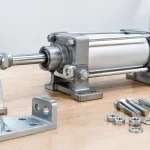
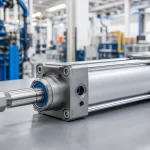
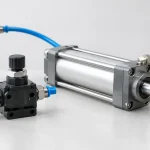
At the field level, you have sensing and actuation. Sensors detect position, temperature, pressure, flow, level, or presence. Actuators create movement or process change through electric, pneumatic, hydraulic, or mixed technologies. Solenoid valves, air preparation units, cylinders, vacuum generators, and motor starters all live here. This is the physical edge of the system where control logic meets real-world motion and media.
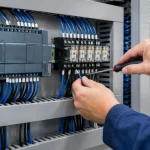
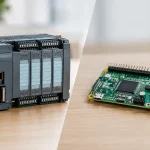
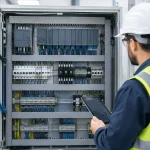
Above that sits the controller. In many machine-level applications, this is a PLC. The PLC reads input signals, executes the logic program, and updates outputs in a repeating scan cycle. For higher-speed or motion-heavy systems, that controller may include dedicated motion hardware or servo control. In process plants, the controller may be part of a DCS or a remote terminal unit in a larger SCADA network.
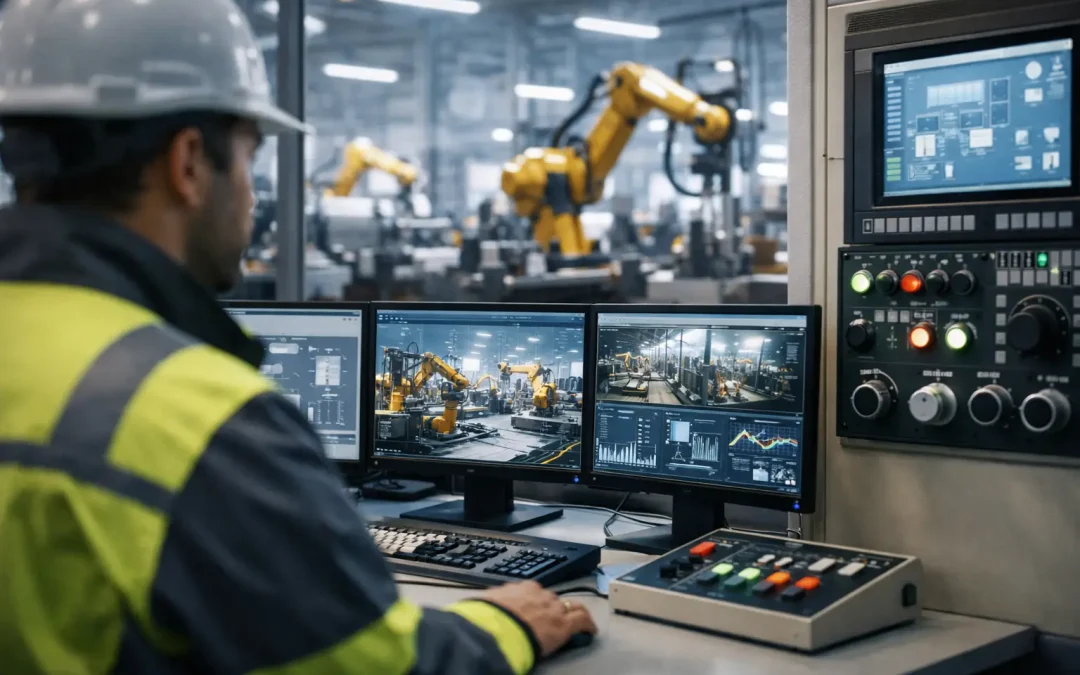
Operators interact through an HMI, industrial PC, or supervisory interface. This layer shows machine status, alarms, trends, recipe settings, and manual control options. A strong HMI reduces troubleshooting time because maintenance can see what the system thinks is happening, not just what the machine appears to be doing.
Communication networks tie the system together. Ethernet-based industrial protocols, serial communication, and fieldbus networks connect sensors, valve manifolds, drives, remote I/O, and supervisory systems. Better connectivity can simplify diagnostics and data collection, but it also adds configuration requirements and compatibility decisions.
Where ICS shows up on the plant floor
Industrial control systems are not limited to one industry or one machine type. They are used anywhere repeatable control, safety, and production consistency matter.
In discrete manufacturing, ICS runs assembly lines, pick-and-place systems, conveyor zones, robotic cells, and packaging equipment. In these systems, timing, position feedback, and coordinated actuation are critical. Pneumatic circuits often work alongside electrical controls to deliver fast, repeatable motion at a practical cost.
In process industries, ICS manages temperature, pressure, level, and flow across continuous operations. Think refrigeration systems, batching, chemical dosing, water treatment, or thermal management. Here, stable control matters as much as speed. The system must hold process variables within an acceptable band while responding to disturbances.
Heavy equipment and mobile industrial systems also use control architectures, though the environment can be harsher and integration choices may differ. Dust, vibration, washdown, and extreme temperatures all affect component selection.
Common types of industrial control systems
The term ICS is an umbrella category, not one specific product. Most industrial buyers will encounter three common types.
PLC-based systems
PLC-based control is the standard for many machine and cell-level applications. PLCs are valued for reliability, straightforward programming, deterministic behavior, and industrial durability. They are especially common where inputs and outputs must react predictably and maintenance teams need practical troubleshooting access.
For OEM machinery and factory automation, PLCs are often the best fit because they scale from simple standalone equipment to fairly complex integrated systems. They also work well with electro-pneumatic devices such as solenoid valves, pressure switches, and air handling components.
SCADA systems
SCADA stands for supervisory control and data acquisition. These systems are used to monitor and supervise geographically distributed or multi-area operations. They collect data from controllers or remote units, display system status, log trends, and allow operators to manage the process at a higher level.
SCADA is less about direct millisecond-level control and more about visibility, coordination, and centralized oversight. Water systems, utilities, and large infrastructure environments often rely on SCADA.
DCS systems
A distributed control system is typically used in large, continuous process environments where many control loops operate together. DCS platforms are common in chemical processing, oil and gas, power generation, and similar applications where process stability and plant-wide coordination are essential.
Compared with many PLC systems, a DCS often offers tighter integration across control loops, operator interfaces, and process management tools. The trade-off is that it can be more specialized and less economical for smaller machine-based applications.
Why industrial control systems matter to uptime
A control system does more than switch outputs on and off. It protects repeatability. When properly specified, it improves cycle consistency, reduces operator dependence, and makes faults easier to isolate.
That matters because downtime rarely comes from one dramatic failure. More often, it comes from small control problems stacking up: a contaminated air line causing sticky valve response, a poorly chosen sensor creating false triggers, an undersized manifold restricting flow, or logic that does not account for pressure loss during peak demand. The control system sits at the center of these interactions.
This is also why component quality matters. A PLC program can only do so much if the connected hardware is inconsistent. Precision-engineered valves, stable air preparation, reliable tubing and fittings, and properly matched actuators all support control accuracy at the machine level. Good control starts with sound architecture, but it depends on dependable components.
The trade-offs behind ICS design
There is no universal best industrial control system. The right design depends on process speed, operating environment, safety requirements, maintenance capability, network complexity, and budget.
A highly networked system with smart devices can provide better diagnostics and more flexibility, but it may require stronger in-house integration skills. A simpler hardwired design can be easier to maintain in some facilities, though it may limit data visibility and future expansion. Pneumatic actuation can offer cost-effective force and speed for many applications, but precise closed-loop electric motion may be better when position control is extremely tight.
Buyers also need to think about serviceability. The lowest initial cost is not always the lowest operating cost if replacement parts are difficult to source or lead times are unpredictable. In demanding applications, the best system is usually the one that balances performance, maintainability, and supply continuity.
What to look for when specifying industrial control components
For engineers and procurement teams, the practical question is often not just what is industrial control systems, but what makes one reliable in actual production. Start with the application conditions. Media, pressure range, duty cycle, speed, contamination risk, washdown exposure, and temperature all shape the right component choice.
Then look at integration. Will the valve bank communicate over the network in use? Does the actuator fit the required stroke and load? Is the air prep sized for peak demand rather than average demand? Can maintenance replace the part quickly without redesigning the machine?
Technical support also matters more than many teams expect. Fast answers on sizing, compatibility, and configuration can prevent expensive field fixes later. That is one reason many manufacturers prefer working with suppliers that understand both the control layer and the motion hardware connected to it. For applications using electro-pneumatic control, air management, and machine automation hardware, that overlap can shorten design cycles and reduce integration friction.
Industrial control systems are the operating backbone of modern machinery and process equipment. When they are designed well, they do not call attention to themselves. They just keep production moving, cycle after cycle, shift after shift. If you are evaluating a machine, a retrofit, or a replacement component, the better question is not only what the control system is, but how well it will hold up when uptime is on the line.