A packaging line that misses one registration mark every few hundred cycles does not have a PLC problem until proven otherwise. More often, the issue starts at the field level, where the sensors used in industrial automation decide what the controller believes is true. If that signal is late, noisy, drifting, or simply the wrong sensing method for the target, the rest of the system spends its time reacting to bad information.
For engineers, technicians, and OEM teams, sensor selection is less about checking a box labeled photoeye or proximity switch and more about matching physics to process conditions. Material, surface finish, speed, contamination, mounting constraints, electrical noise, and required repeatability all change what works in the real world. The best-performing machine is usually the one that uses the simplest sensor that can survive the application with margin.
Where sensors used in industrial automation create or lose performance
In most automated equipment, sensors do three jobs at once. They confirm position, verify process state, and protect the machine from operating at the wrong time. On a pneumatic axis, that might mean confirming end-of-stroke before a gripper closes. In a material handling cell, it might mean checking product presence before transfer. In a process skid, it could mean monitoring pressure, flow, or temperature so the system stays inside operating limits.
The trade-off is straightforward. A low-cost sensor that works well in a clean test environment can become a recurring maintenance event in coolant mist, washdown, vibration, or dust. On the other hand, specifying a more complex sensing technology than the application needs can add cost, setup time, and sourcing headaches without improving machine output. Good sensor selection is not about buying the most advanced device. It is about buying enough performance, enough durability, and enough diagnostic clarity.
The core sensor types used in industrial automation
Proximity sensors
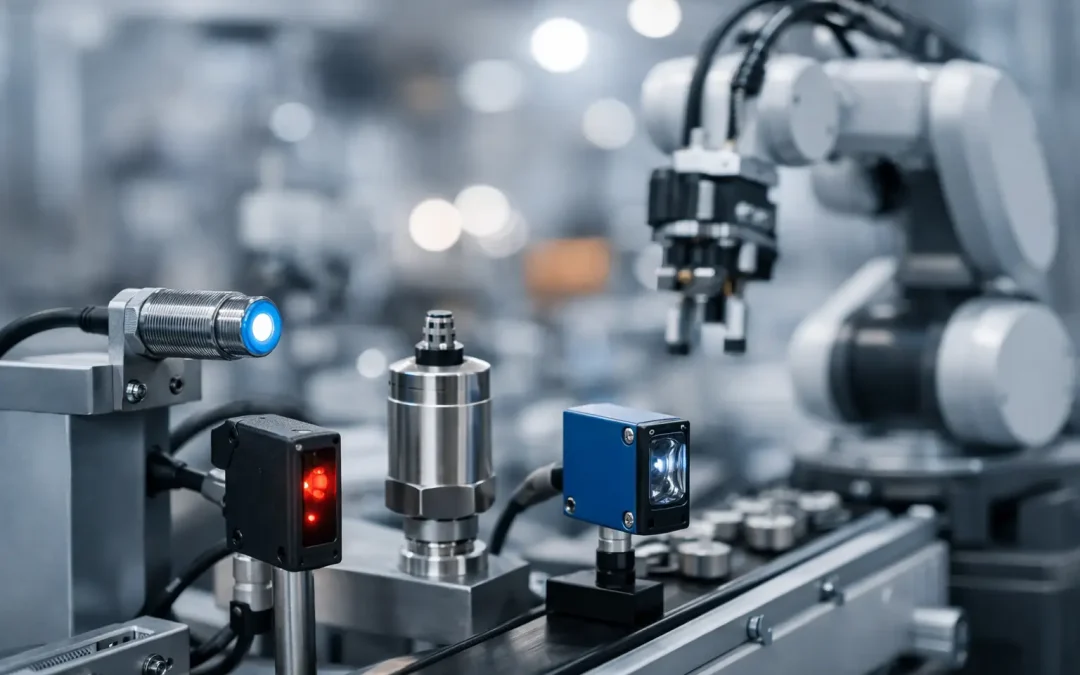
Inductive proximity sensors remain one of the most dependable choices for metal target detection. They are common on pneumatic cylinders, slide tables, transfer stations, and guarding systems because they handle contamination well and offer predictable switching. If the target is metallic and the sensing distance is acceptable, inductive is often the first place to start.
Capacitive proximity sensors extend detection to non-metallic materials such as plastics, powders, liquids, and some bulk solids. They solve problems inductive sensors cannot, but they also demand more care. Moisture, buildup, and product variation can affect sensitivity, so they are useful in the right process and frustrating in the wrong one.
Magnetic sensors are another key category, especially around pneumatic actuators. Reed and solid-state cylinder switches provide compact position feedback without external target hardware. They simplify installation, but magnetic field strength, mounting alignment, and nearby metal can still affect performance. In fast-cycle machinery, solid-state versions usually offer better life and switching consistency than reed designs.
Photoelectric sensors
Photoelectric sensing covers a wide range of applications because it can detect almost any material if configured correctly. Through-beam sensors offer the longest range and strongest excess gain, which makes them a strong choice in dirty environments. Retroreflective units reduce wiring on one side of the machine, while diffuse sensors simplify installation when separate reflectors or receivers are impractical.
This is also where many avoidable problems start. Shiny targets, transparent packaging, inconsistent background conditions, and product color changes can cause unstable detection if the wrong mode is selected. A diffuse sensor that looks fine during setup may lose margin when ambient light changes or dust coats the lens. For high-speed packaging, labeling, or conveying, response time and contrast capability matter just as much as sensing range.
Pressure, vacuum, and flow sensors
In pneumatic automation, pressure feedback is not optional when process stability matters. Pressure switches can verify clamp force, detect loss of supply, or confirm that an actuator has reached a load condition. Pressure transducers go further by giving the PLC analog data for tighter control, trending, and alarms.
Vacuum sensors play a similar role in pick-and-place systems. They help confirm part pickup, identify leaks, and reduce dropped products before they become scrap or downtime. A vacuum cup that technically picks the part is not enough if the system has no reliable way to verify hold strength.
Flow sensors are valuable when compressed air consumption, coolant delivery, or media movement must be monitored. They can expose restrictions, leaks, and gradual degradation that operators would otherwise treat as random machine behavior. In plants chasing energy efficiency, air flow monitoring often reveals expensive waste that is hiding in plain sight.
Position and motion sensors
Encoders, linear position sensors, and limit sensors support applications where simple presence detection is not enough. Rotary encoders track speed and position in conveyors, servo axes, and indexing mechanisms. Linear transducers help when stroke position must be measured continuously rather than just at the ends.
There is a clear trade-off here between precision and complexity. A hard stop with two end-of-travel sensors may be more reliable and easier to maintain than continuous feedback if the process does not need intermediate position data. But if product quality depends on exact placement, trying to save money on sensing usually just shifts cost to rejects and troubleshooting.
Temperature and level sensors
These are easy to overlook in discrete automation until they cause production drift. Temperature sensors help protect valves, coils, cabinets, and process media from operating outside intended conditions. Level sensors support fluid management, chemical feed, condensate handling, and bulk material systems.
Selection depends heavily on media and environment. A float switch may be perfectly adequate in one tank and completely wrong in another with foaming, turbulence, or contamination. Non-contact methods reduce maintenance in some setups, but they can struggle with vapor, dust, or unusual surface conditions.
How to choose sensors used in industrial automation without creating future downtime
Start with the target and the environment, not the catalog category. Ask what the sensor is actually detecting, how consistent that target will be, and what contamination is unavoidable. Oil mist, washdown chemicals, weld spatter, vibration, and temperature swings all narrow the right choices fast.
Then look at switching performance. Required sensing distance, repeatability, hysteresis, and response time are not paperwork details. They determine whether the sensor keeps up with the machine at production speed. A sensor that works during manual jog mode can still fail under real cycle timing.
Electrical integration matters just as much. PNP versus NPN, analog output type, supply voltage range, short-circuit protection, and connector style all affect installation time and field reliability. If maintenance has to rebuild cables often, a molded quick-disconnect option may save more than it costs.
Diagnostics are another separator between acceptable and high-performance systems. LED status indicators, teach-in feedback, analog scaling clarity, and IO-Link capability can reduce troubleshooting time dramatically. In demanding applications, a sensor that tells technicians why it failed is worth more than one that simply goes dark.
Common failure points engineers see in the field
Most sensor problems are specification mistakes, installation mistakes, or maintenance oversights rather than product defects. Sensors are mounted too far from target, aimed at unstable surfaces, routed next to noisy motor cables, or exposed to contaminants their housing was never meant to handle.
Another common issue is false confidence from bench testing. A sensor may detect a clean sample part perfectly, then struggle when the actual product arrives warped, dusty, wet, or slightly misaligned. The wider the process variation, the more detection margin the application needs.
Pneumatic systems add their own layer. Cylinder-mounted sensors can shift during maintenance, pressure switches can be set too close to normal fluctuation, and vacuum verification can be ignored until dropped parts become a quality problem. In these systems, sensing should be treated as part of motion control, not as an accessory.
Why sensor standardization usually pays off
Plants that standardize a manageable set of sensor families tend to see faster repairs, simpler spare parts inventory, and fewer commissioning surprises. That does not mean forcing one sensor into every application. It means narrowing around proven technologies, connector styles, mounting methods, and electrical conventions where practical.
For OEMs and integrators, standardization also improves documentation and support. It is easier to train teams, easier to stock replacements, and easier to maintain machine-to-machine consistency. VidoAir sees this same pattern across pneumatic and electro-pneumatic hardware – component consistency reduces downtime because technicians spend less time decoding one-off design decisions.
The best sensor strategy is rarely the cheapest line item on a bill of materials. It is the one that gives the machine stable detection, clear diagnostics, and enough durability to stay out of the maintenance queue. When a system starts acting unpredictable, the fastest path to a fix is often not in the software at all. It is at the sensor, where the machine first decides what is real.