A leaking push-to-connect at the end of a long shift usually is not a fitting problem alone. It is a selection problem that started earlier – when thread type, tube tolerance, pressure spikes, or chemical exposure were treated as minor details. If you need to know how to choose pneumatic fittings for reliable production, start by looking at the application, not the catalog page.
In industrial air systems, fittings do more than join tube to valve or cylinder. They set the tone for the whole circuit. The wrong fitting creates chronic leaks, cracked threads, slow assembly, difficult maintenance, and premature tube failure. The right one supports pressure stability, fast installation, repeatable service work, and long operating life in demanding applications.
How to choose pneumatic fittings by application first
The fastest way to make a bad selection is to choose by shape alone. A straight connector, elbow, tee, or manifold adapter only tells you routing. It does not tell you whether the fitting matches the mechanical load, media, temperature, vibration level, or maintenance needs of the machine.
Start with the job the fitting has to do. Is it part of a compact automation cell with frequent changeovers, or a fixed installation that rarely gets touched? Is it feeding standard compressed air, vacuum, water, or a specialty fluid? Is the tube exposed to abrasion, heat, washdown, or repetitive motion? In a clean, stationary indoor assembly line, a standard nickel-plated brass push-in fitting may perform well for years. In a high-vibration mobile machine or an aggressive washdown environment, the same fitting may become the weak point.
This is where experienced engineers save time. They do not ask only, “What port size do I need?” They ask what will happen to this connection after six months of production.
Match fitting style to service conditions
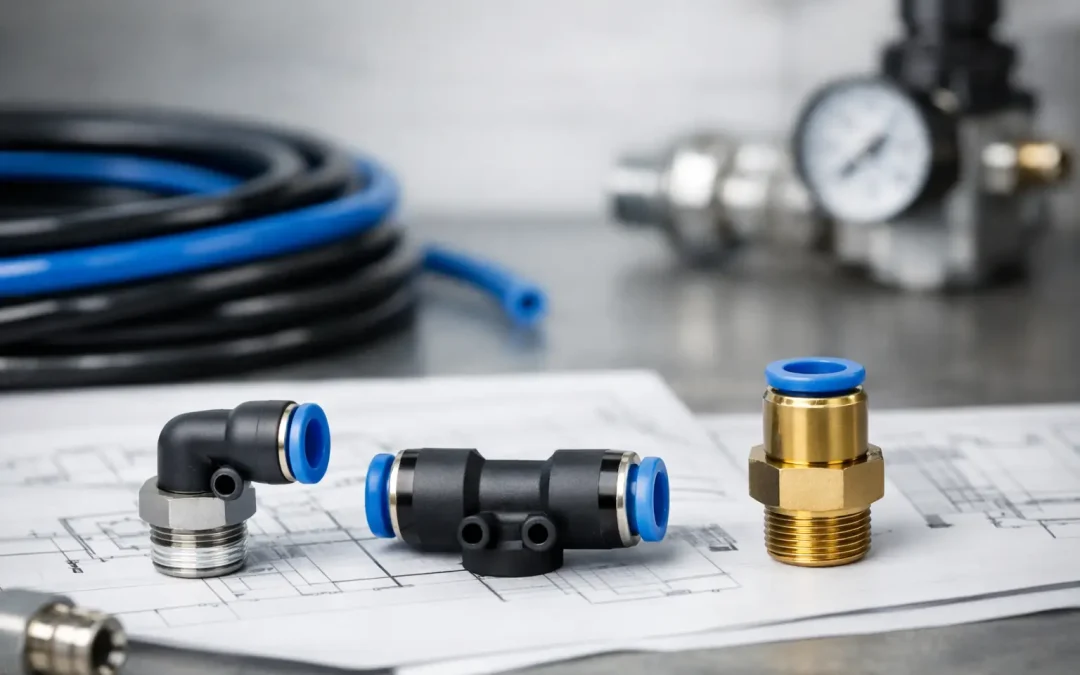
Push-to-connect fittings are popular for a reason. They install quickly, reduce assembly labor, and simplify tube replacement. For most general pneumatic automation systems, they are the practical first choice. But they are not automatically the best choice for every line.
Compression fittings can make more sense where pull-out resistance, higher temperature tolerance, or media compatibility matter more than installation speed. Barbed fittings may be suitable with flexible hose in lower-pressure or specialty setups, especially where clamping is preferred. Threaded metal fittings remain common when rigidity and mechanical durability matter most.
The trade-off is straightforward. Push-in fittings favor speed and serviceability. Compression and threaded options often favor retention strength and environmental resilience. If a line is routinely disconnected for maintenance, ease of rework matters. If it is buried in a machine frame and expected to stay untouched, long-term mechanical security may matter more.
Pressure, vacuum, and surge loads matter more than nominal rating
A common mistake is checking only the listed maximum working pressure and moving on. Real systems do not always operate at a perfectly stable number. They cycle, pulse, shock, and occasionally overshoot. Cylinder deceleration, valve switching speed, compressor behavior, and downstream restrictions can all create transient conditions that stress fittings beyond the nominal line pressure.
Choose a fitting with margin, not one that barely clears the spec. If the system runs at 120 psi, do not think only about 120 psi. Think about startup conditions, pressure spikes, and what happens if the regulator drifts or the circuit is modified later. The same logic applies to vacuum circuits. Not every pneumatic fitting handles vacuum equally well, especially when tubing stiffness or seal quality varies.
In demanding applications, pressure capability should be evaluated together with temperature. Higher temperatures can reduce allowable pressure, change seal performance, and accelerate material aging.
Thread type is where many selection errors begin
Thread mismatch is one of the most expensive small mistakes in pneumatics. NPT, BSPT, BSPP, and metric threads can look close enough to tempt a rushed installer, but close is not compatible. Forced assembly damages ports, creates spiral leak paths, and often turns a simple fitting swap into manifold or valve replacement.
When deciding how to choose pneumatic fittings, verify thread standard, size, and sealing method before you specify body style. NPT relies on tapered threads for sealing. BSPP often seals with an O-ring or bonded washer at the face. Metric threads can require different sealing geometries depending on the design. If your team sources components globally, this matters even more because imported equipment may combine thread systems across subassemblies.
Good practice is to confirm the mating port from the component drawing, not from visual inspection alone. Thread gauges and dimensional checks are cheaper than replacing a damaged valve bank.
Tube size, tube material, and tolerance all affect seal quality
A fitting can be perfectly rated and still leak if the tubing is wrong. Outside diameter must match exactly, and tube material must be suitable for the grip and seal design of the fitting. Polyurethane, nylon, polyethylene, PTFE, and other tubing materials behave differently under heat, bending load, pressure, and repeated insertion.
Softer tubing may be easier to route in tight spaces but can be more vulnerable to deformation in some gripping designs. Stiffer tubing may improve retention and dimensional stability but can increase strain at the fitting if routing is poor. Tube tolerance matters as well. If OD consistency is loose, seal reliability drops fast.
This is one reason catalog-driven selection works best when tubing and fittings are considered as a system. Mixing unknown tubing with a quality fitting often leads to blame falling on the wrong component.
Material selection should reflect the plant environment
Nickel-plated brass fits a wide range of industrial pneumatic applications because it balances durability, corrosion resistance, and cost. For more aggressive environments, stainless steel may be the better answer, particularly in washdown areas, corrosive atmospheres, food-related equipment, or where long service life justifies the higher upfront price.
Engineered polymer fittings can reduce weight and cost, and in some applications they perform very well. But they should be selected carefully where impact, elevated temperatures, UV exposure, or aggressive chemicals are present. Seal material also deserves attention. Buna, EPDM, and FKM each have different strengths depending on air quality, lubrication, temperature, and media compatibility.
If the plant uses lubricated air in one area and dry instrument air in another, do not assume the same fitting and seal combination belongs in both. Material compatibility is rarely the most visible part of a fitting, but it often decides lifespan.
Installation realities should shape the selection
The best fitting on paper can become a maintenance headache in a crowded machine. Consider wrench access, tube release clearance, swivel needs, and routing strain before finalizing the part. Elbows and banjo styles can reduce tube stress in tight envelopes. Swivel fittings help align tubing without twisting. Compact bodies can be useful in dense manifolds, but only if technicians can still service them.
Think about who will touch the assembly next. If maintenance teams need to swap valves quickly, tool-free tube release can save meaningful downtime. If the machine sees frequent vibration, a fitting that resists loosening and tube walkout may justify a heavier-duty design.
This is where factory-direct technical support adds value. A supplier that understands cylinders, valves, air prep, tubing, and fittings as a complete system can often spot an assembly problem before it turns into a recurring field issue.
Common failure patterns to screen out early
Most fitting failures are predictable. Leaks at the thread usually point to thread mismatch, poor sealing practice, or over-tightening. Leaks at the tube interface often trace back to damaged tube ends, wrong OD, poor tube quality, or side load on the connection. Cracked bodies usually involve overtightening, impact, incompatible chemicals, or temperature outside the design range.
If a fitting repeatedly fails in the same machine location, stop replacing it with the same part and expecting a different result. Review motion, vibration, tubing support, regulator setting, and environmental exposure. In many cases, the fix is not a better version of the same fitting. It is a different fitting style, material, or routing approach.
A practical spec path for faster, better selection
For most industrial buyers, the cleanest selection path is to lock down six variables in order: media, pressure and temperature range, port thread, tube OD and material, fitting body material, and installation constraints. Once those are confirmed, choosing shape and configuration becomes much easier.
That approach reduces costly backtracking. It also helps procurement teams compare options correctly. A lower-priced fitting that creates rework, leak chasing, and short replacement intervals is not a lower-cost solution. In high-cycle automation, installed cost and uptime matter more than piece price.
For OEMs and integrators, standardizing fitting families where possible also improves spares management and field service consistency. That does not mean forcing one fitting into every application. It means narrowing choices intelligently around known performance requirements.
When you are deciding how to choose pneumatic fittings, think beyond connection size. Think about pressure behavior, environmental exposure, thread integrity, tubing quality, service access, and the real cost of a leak on a running machine. The right fitting is a small component with an outsized effect on uptime, efficiency, and maintenance labor. Choose it with the same discipline you apply to valves, cylinders, and controls – and the whole system tends to run better for longer.