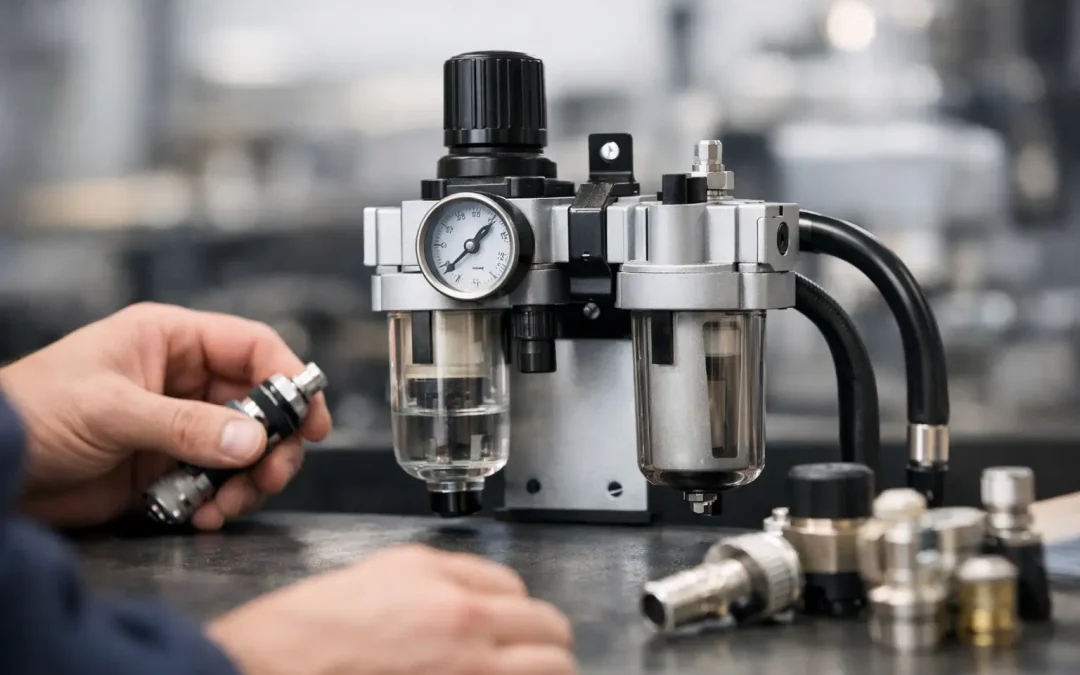
A cylinder that drifts, a valve that sticks, and a tool that loses torque mid-shift often point to the same upstream problem: the air prep package was sized or specified too loosely. If you are working out how to select air preparation units, the right answer is rarely just pick a filter-regulator-lubricator that matches the port size. Air quality, pressure stability, flow demand, drain strategy, and installation conditions all shape whether the assembly protects the system or becomes the restriction.
How to select air preparation units without undersizing the system
In real production environments, air preparation units are expected to do several jobs at once. They need to remove contaminants, hold pressure steady under changing demand, and fit into a machine layout that may already be crowded. That means selection should start with the application, not the catalog page.
The most common mistake is treating the unit as a commodity. A low-cost assembly that looks correct on paper can still create pressure drop, poor moisture management, or maintenance headaches if the actual operating conditions are harsher than assumed. Engineers and maintenance teams usually feel that mistake later through inconsistent actuator speed, premature seal wear, and unnecessary service calls.
Start with the maximum real flow requirement, not the average. Pneumatic systems often cycle in bursts, and regulators that seem adequate at nominal flow may struggle during peak demand. If multiple actuators shift at once or a blow-off circuit creates a sudden consumption spike, the air prep unit has to support that event without a large downstream pressure dip.
Size by flow first, port second
Port size is useful, but it is not the primary sizing method. The better approach is to review required flow at the intended operating pressure and then compare that against the manufacturer flow curves for the filter, regulator, and lubricator if used. Two units with the same port threads can perform very differently once pressure drop is factored in.
If the unit is too small, you get unstable regulation and lost energy through operators increasing supply pressure to compensate. If it is too large, you may spend more than needed and lose some sensitivity at low flow conditions. In most industrial applications, slightly conservative flow sizing is the safer choice, especially where machine cycles are fast or future expansion is likely.
Check pressure range and regulation accuracy
Regulator selection should match the required downstream pressure window, but accuracy matters just as much as range. A simple utility air station feeding hand tools has different needs than a precision automation cell where repeatable cylinder force affects product quality.
Look at how tightly the regulator holds set pressure as inlet pressure changes and downstream demand rises. Some applications tolerate modest droop. Others do not. If a pick-and-place or clamping function is sensitive to pressure variation, a higher-performance regulator is usually worth the added cost because it reduces process variability and operator adjustment.
Match filtration to the contamination risk
Compressed air is never just air. It carries water, pipe scale, compressor oil, and debris from the distribution system. Filtration level should reflect what the downstream devices can tolerate, not what happens to be common on the shelf.
A standard particulate filter may be enough for general pneumatic actuation, but it may not be enough for fine valve internals, instrumentation, or equipment exposed to oily carryover. In those cases, a coalescing stage may be needed to remove smaller aerosols and oil mist. That added protection improves component life, but it also introduces extra pressure drop, so the system has to be sized around it.
Know when finer filtration helps and when it hurts
Finer filtration is not automatically better. A very fine element traps smaller contaminants, but it can load faster and increase differential pressure if maintenance is neglected. In dirty plant air systems, that can become a hidden source of performance loss.
The better decision is application-specific. For general cylinders and valves, practical particulate filtration may be all that is required. For air logic, precision regulators, or sensitive proportional control, cleaner air usually pays off. The key is balancing protection against service interval and pressure loss.
Moisture removal needs more than a bowl and drain
If condensate is a recurring issue, the problem may be upstream of the point-of-use unit. A local filter can capture liquid water, but it cannot replace proper drying strategy when dew point matters. Outdoor lines, cold rooms, washdown spaces, and long distribution runs often create conditions where moisture reappears after compression and primary treatment.
That is where selection gets more nuanced. Point-of-use air prep should be coordinated with the compressor room setup, including dryers and receiver capacity. If the plant air is wet, adding a better FRL at the machine may reduce symptoms without fixing the cause.
Decide whether lubrication belongs in the assembly
Many newer pneumatic components are designed to run without lubricated air, and once lubrication is introduced, downstream devices usually need it continuously. That is why the lubricator should never be included by default.
If the downstream tooling, cylinders, or legacy valves require lubrication, then a correctly adjusted lubricator can reduce wear and extend service life. If the equipment is designed for non-lube service, adding oil can attract contaminants, complicate maintenance, and create compatibility issues with certain materials or processes.
Mixed systems deserve special attention. If one branch needs lubricated air and another does not, split the circuit downstream rather than oiling the entire machine supply. That approach protects sensitive components and keeps the specification cleaner.
Installation conditions change the right choice
How to select air preparation units is also a question of where and how they will operate. Ambient temperature, washdown exposure, chemical contact, vibration, and mounting space all influence the best configuration.
In corrosive or hygienic environments, standard housings may not last. Stainless steel air prep units or corrosion-resistant components are often the better long-term choice for food-related equipment, outdoor installations, or aggressive process areas. In heavy vibration environments, bowl retention, bracket strength, and gauge durability matter more than they do in a protected control cabinet.
Service access is another practical issue engineers sometimes hand off to maintenance after the design is frozen. Bowl clearance, drain visibility, and element replacement space should be considered early. A well-specified unit that cannot be serviced easily will often be serviced late.
Manual drains versus automatic drains
Drain strategy is not a minor accessory decision. Manual drains are simple and cost-effective, but they depend on disciplined maintenance. Automatic drains reduce that burden and help where condensate volumes vary or access is limited.
The trade-off is application-specific. In clean, stable indoor systems, manual drains may be perfectly adequate. In high-moisture environments or unattended equipment, automatic drains usually make more operational sense. What matters is aligning the drain method with actual plant behavior, not ideal maintenance schedules.
Single unit or modular assembly?
A compact combination unit saves space and simplifies ordering, which is useful for standard machinery and common replacement scenarios. Modular assemblies offer more flexibility when different filtration stages, soft-start valves, lockout valves, pressure switches, or branch-specific regulation are required.
For OEM machine builders and integrators, modularity often creates a better long-term package because it supports custom configuration without forcing a one-size-fits-all layout. For maintenance teams replacing a standard station, an integrated package may reduce downtime and simplify stocking. Neither approach is universally better. The right choice depends on whether the priority is compact standardization or application-specific control.
Selection questions that prevent rework
Before releasing a part number, pressure-test the decision with a few blunt questions. What is the peak flow, not just the nominal flow? What pressure drop is acceptable at that peak? What contaminants are actually present in the plant air? Does downstream equipment require lubrication, prohibit it, or vary by branch? Will the unit be easy to drain, inspect, and replace under normal maintenance conditions?
Those questions catch most specification problems before they become startup issues. They also help procurement avoid comparing assemblies only by thread size, bowl material, or unit price.
For demanding applications, technical support matters because catalog data does not always capture every field condition. A factory-direct supplier with configured-to-order options can help align filtration grade, regulator performance, materials, and accessories to the machine rather than forcing the machine to adapt to stock limitations.
The best air preparation unit is not the one with the longest feature list. It is the one that delivers clean, stable, maintainable air under the exact conditions your system sees every day. Get that part right, and a lot of downstream problems never get the chance to start.