Space problems rarely show up on the first concept drawing. They show up when the guarding gets tighter, the sensor block grows, the cable track shifts, and the end effector suddenly has no room left to travel. That is usually when engineers start looking for the best compact actuators for automation – not because smaller is better on paper, but because machine density, cycle time, and service access all start competing for the same few inches.
Compact actuators earn their place when they solve a packaging problem without creating a performance problem somewhere else. In high-density automation cells, the right actuator has to do more than fit. It has to maintain repeatability, survive side loading within reason, integrate with existing valves and controls, and arrive fast enough to keep a build or maintenance schedule on track.
What actually makes the best compact actuators for automation
The phrase gets used loosely, but compact does not just mean short overall length. In industrial automation, a compact actuator is defined by how efficiently it converts installed space into usable motion. That usually means a short body, a low-profile mounting envelope, and a design that minimizes dead length at each end of stroke.
The best options also reduce secondary design penalties. If a compact cylinder needs an oversized bracket, demands a difficult sensor setup, or sacrifices bearing support to save a little body length, the real machine footprint may not improve much. Good compact actuator selection starts with installed geometry, not catalog width alone.
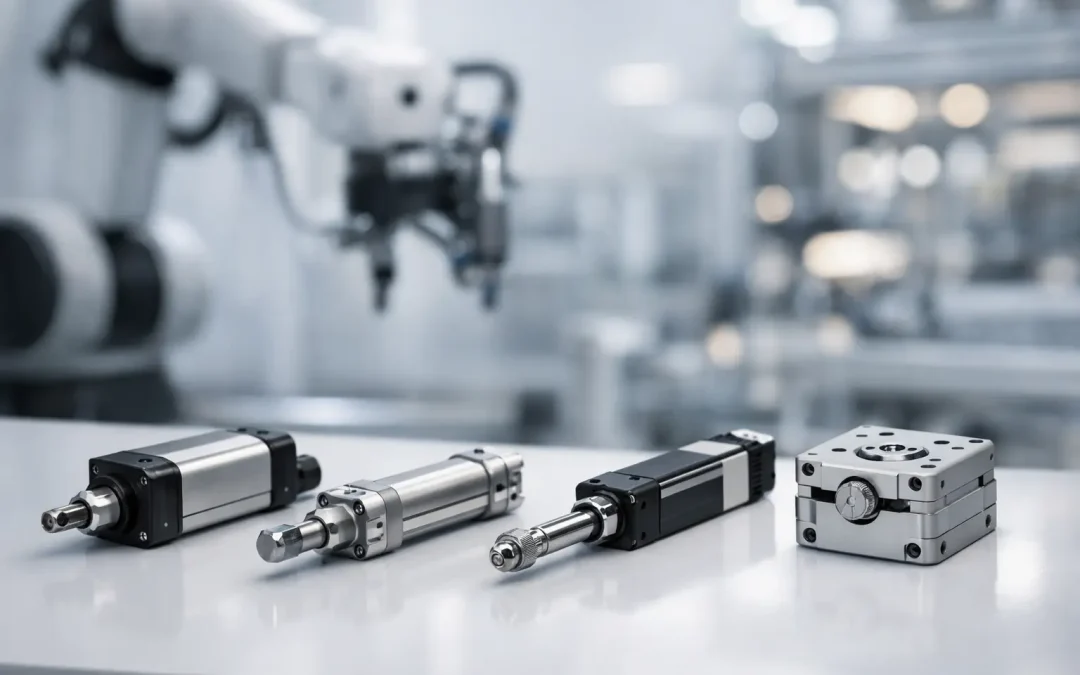
For most buyers, the strongest candidates fall into three categories: compact pneumatic cylinders, guided or slide table actuators, and specialty compact actuators designed for constrained or application-specific motion. Each has a clear place. The wrong choice usually comes from expecting one style to handle every load case.
Compact pneumatic cylinders for fast linear motion
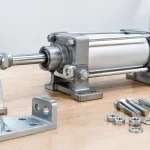
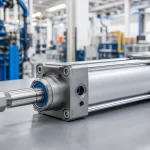
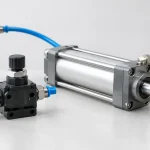
If the job is straightforward push-pull motion in a tight space, compact pneumatic cylinders are often the first place to look. They are a strong fit for clamping, part stops, gates, eject functions, light press operations, and short-stroke transfer tasks where machine builders want simple integration and fast cycling.
Their main advantage is density. A well-designed compact cylinder gives you useful force from a short body length, especially in applications where stroke is modest and side load is controlled externally. They are also easier to source, easier to replace, and usually more cost-efficient than more elaborate actuator assemblies.
The trade-off is equally clear. A compact cylinder is not automatically a guided solution. If the rod sees moment loading, off-center force, or carriage-style motion, service life can drop quickly unless the load is supported elsewhere. Engineers sometimes choose a compact cylinder to save space, then add external rails, brackets, and stop hardware that erase the original advantage.
That said, for clean axial motion with good alignment, compact pneumatic cylinders remain one of the best compact actuators for automation because they combine force, speed, and installation efficiency in a proven format.
Where compact cylinders perform best
They tend to be the right answer when stroke lengths are short, cycle rates are high, and the machine design already controls the tooling path. They also work well when maintenance teams want familiar pneumatic hardware with standard valve and air prep support.
In plants where uptime matters more than theoretical flexibility, that simplicity has value. Fewer moving interfaces usually means easier troubleshooting and faster replacement.
Slide table and guided actuators when load control matters
When the load cannot stay perfectly centered, a guided compact actuator often outperforms a basic cylinder even if the unit costs more upfront. Slide table actuators and guided cylinders are built for applications where the payload needs support through the stroke, not just actuation force.
This matters in pick-and-place tooling, sensor positioning, part transfer, escapements, and compact assembly stations where the actuator carriage directly carries the workpiece or tooling. In those cases, bearing support is not an accessory. It is the difference between stable motion and premature wear.
A compact slide table actuator typically offers tighter motion control in a shorter package than a separate cylinder-and-rail assembly. That can simplify mounting, reduce stacked tolerances, and improve repeatability. It can also shorten commissioning time because the guidance and actuation are already matched as a unit.
The trade-off is that guided units must still be sized carefully. Compact does not mean indestructible. If acceleration is aggressive, if hard stops are frequent, or if the payload creates large overturning moments, the actuator needs to be selected around those real conditions, not just static load numbers from a catalog table.
When a slide table is the better compact choice
A slide table is often the better choice when the actuator itself supports the tooling, when precision positioning between endpoints matters, or when there is no room for external guidance. It is also a strong option when machine builders want a more integrated mechanical package with fewer alignment variables.
For OEMs and integrators trying to shrink machine footprints, that integration can be more valuable than the raw component price difference.
Specialty compact actuators for constrained layouts
Some applications simply do not fit standard cylinder geometry. That is where specialty compact actuators stand out. These may include low-profile guided units, rodless compact designs, rotary actuators, or application-specific variants engineered for unusual mounting conditions, washdown environments, or tight envelope restrictions.
Rotary compact actuators, for example, can eliminate the need for linkages in indexing, diverting, and door-control applications. A low-profile specialty unit can help where vertical clearance is limited but lateral space is available. In end-of-arm tooling, a purpose-built compact actuator may reduce mass and improve cycle time at the robot wrist.
The advantage of specialty hardware is packaging efficiency. The risk is over-specialization. A custom or niche actuator may solve one geometry problem while introducing procurement complexity, replacement delays, or spare part exposure. For production equipment with strict uptime targets, that is a real selection factor.
This is where supplier breadth matters. A manufacturer-focused source with standard and configured-to-order options can help teams avoid forcing a standard cylinder into an application it should not handle, while still keeping lead times and replacement support practical.
How to compare the best compact actuators for automation
Engineers usually start with bore, stroke, and force. That is necessary, but it is not enough. The best compact actuator for one machine may be the wrong one for another with the same stroke and payload because the surrounding system changes the requirement.
Start with installed space, including fittings, sensor grooves, shock absorbers if used, and service clearance. Then look at real load direction. Is the force axial, offset, or moment-loaded? Is the actuator moving tooling, stopping product, or carrying a guided slide? Those answers determine whether a simple compact cylinder is efficient or risky.
Next, evaluate speed and duty cycle together. A compact actuator that looks strong at static pressure may still underperform if the application demands high-frequency cycling, fast cushioning recovery, or repeated shock loading. Heat, seal wear, and air consumption all become more relevant as cycle count climbs.
Mounting style also deserves more attention than it usually gets. A good compact actuator can lose repeatability if the mounting arrangement flexes under load. In dense automation equipment, installers sometimes compromise on mounting access, and that compromise shows up later as misalignment or vibration.
Finally, think about maintainability. Sensor access, replacement compatibility, standard porting, and available inventory all affect lifecycle cost. For production lines, the best actuator is not just the one that fits today. It is the one maintenance can support under pressure.
Common selection mistakes in compact automation designs
The most common mistake is choosing the shortest unit in the catalog before checking load support. That works fine for pure axial tasks and fails quickly when the payload hangs off-center. Another mistake is ignoring the full installed envelope. Elbows, sensor cables, and bracket offsets often matter more than body length.
Undersized cushioning is another issue in fast systems. Compact actuators are often used to save space in high-speed cells, but higher speed increases impact energy. If deceleration is not managed correctly, the machine may cycle for a while and then start showing stop-position drift, hardware loosening, or shortened seal life.
There is also a purchasing mistake that experienced teams try to avoid – selecting a hard-to-replace specialty unit for a routine motion task. If a standard compact cylinder or guided actuator can handle the job cleanly, that usually gives operations more flexibility down the road.
Choosing for uptime, not just footprint
The best compact actuators for automation are the ones that reduce machine size without reducing reliability. Sometimes that is a basic compact pneumatic cylinder with the right bore and stroke. Sometimes it is a guided slide table actuator because the payload demands better support. Sometimes it is a specialty actuator because the machine layout leaves no other practical option.
What separates a strong selection from a costly one is discipline. Match the actuator to the real load case, the actual installed envelope, the target cycle rate, and the maintenance reality of the plant. That is where precision engineering and fast availability matter most. If you are specifying for a tight build window or replacing a failure-prone motion component, suppliers like VidoAir that support both standard and application-specific actuator requirements can shorten that path.
A compact actuator should make the machine easier to build and easier to keep running. If it only saves space on the drawing, keep looking.