Anti-Static PU Tubing for Semiconductor Manufacturing: What It Is and Why It Matters
Semiconductor fabs run on cleanliness and control — not just of particles, but of static charge. A single electrostatic discharge (ESD) event can destroy a chip that took weeks to process. That’s where anti-static polyurethane (PU) tubing comes in: a pneumatic component that looks like ordinary tubing but plays a critical role in protecting sensitive electronics from static-related failure.

What Is Anti-Static PU Tubing?
Standard polyurethane tubing is prized in pneumatic systems for its flexibility, abrasion resistance, and kink resistance. But standard PU is also a strong insulator — and insulators are exactly what you don’t want near static-sensitive components, because they let charge build up rather than bleed away.
Anti-static (or static-dissipative) PU tubing solves this by compounding the polymer with conductive or dissipative additives — typically carbon-based fillers or specialty conductive compounds — that lower the material’s surface and volume resistivity into the static-dissipative range, generally between 10^6 and 10^9 ohms. This allows any accumulated charge to dissipate safely to ground rather than discharging suddenly into a nearby component.
Why Static Control Matters in Semiconductor Manufacturing
Modern semiconductor devices operate at feature sizes measured in nanometers, and many components — MOSFETs, integrated circuits, sensors — are highly sensitive to ESD. Compressed air and vacuum lines run throughout a fab: to wafer handling equipment, robotic end-effectors, pick-and-place tooling, and cleanroom automation. If the tubing carrying that air is a static generator, it becomes a liability rather than a utility.
A few reasons static control is non-negotiable in this environment:
- ESD damage is often latent. A chip can be weakened by a discharge event without failing immediately, only to fail later in the field — making it far more costly than an in-process reject.
- Particle attraction. Charged surfaces attract airborne particulates, undermining cleanroom particle counts and contaminating wafers.
- Automation proximity. Robotic arms and pneumatic actuators often route tubing in close proximity to bare die and populated boards, increasing discharge risk.
Key Properties to Look for in Anti-Static PU Tubing
When specifying tubing for fab or cleanroom use, a few technical characteristics matter most:
Surface Resistivity
Look for tubing rated in the static-dissipative range (commonly 10^6–10^9 Ω). This is distinct from fully conductive tubing (below 10^5 Ω), which is used in different applications like explosive-atmosphere environments.
Low Outgassing / Cleanroom Compatibility
Fab-grade tubing should have low volatile organic compound (VOC) emission and be compatible with cleanroom classifications (ISO Class 1–5), since outgassing can contaminate sensitive processes even if static isn’t an issue.
Flexibility and Bend Radius
Tubing routed through robotic and automated handling systems needs to withstand repeated flexing without cracking or losing its conductive properties over time.
Chemical and Abrasion Resistance
Fabs use a range of process chemicals; tubing should resist swelling, degradation, and abrasion from routing through cable carriers and moving assemblies.
Dimensional Consistency
Because semiconductor pneumatic systems often use metric push-to-connect fittings, tight OD/ID tolerances matter for a reliable, leak-free seal — an area where ISO-interchangeable metric tubing (matching Festo, SMC, and Parker standards) simplifies sourcing and replacement.
Common Applications in Semiconductor Fabs
- Wafer handling robots and end-effector actuation
- Pick-and-place and die-bonding equipment
- Cleanroom pneumatic automation and valve manifolds
- Vacuum pickup tooling for wafers and substrates
- Test handler and inspection equipment air lines
Choosing a Supplier
Because anti-static tubing is a safety-critical component in ESD-sensitive environments, sourcing matters as much as spec. Buyers should confirm:
- Documented resistivity testing (not just a datasheet claim)
- Consistent metric or imperial sizing matched to existing fittings
- Batch traceability, especially for regulated or audited fabs
- Compatibility with existing push-to-connect fitting systems
Get Anti-Static PU Tubing Direct From the Factory
VidoAir Pneumatics supplies ISO-interchangeable anti-static and static-dissipative PU tubing built for cleanroom and semiconductor environments — shipped factory-direct, delivered all-in with no distributor markup.





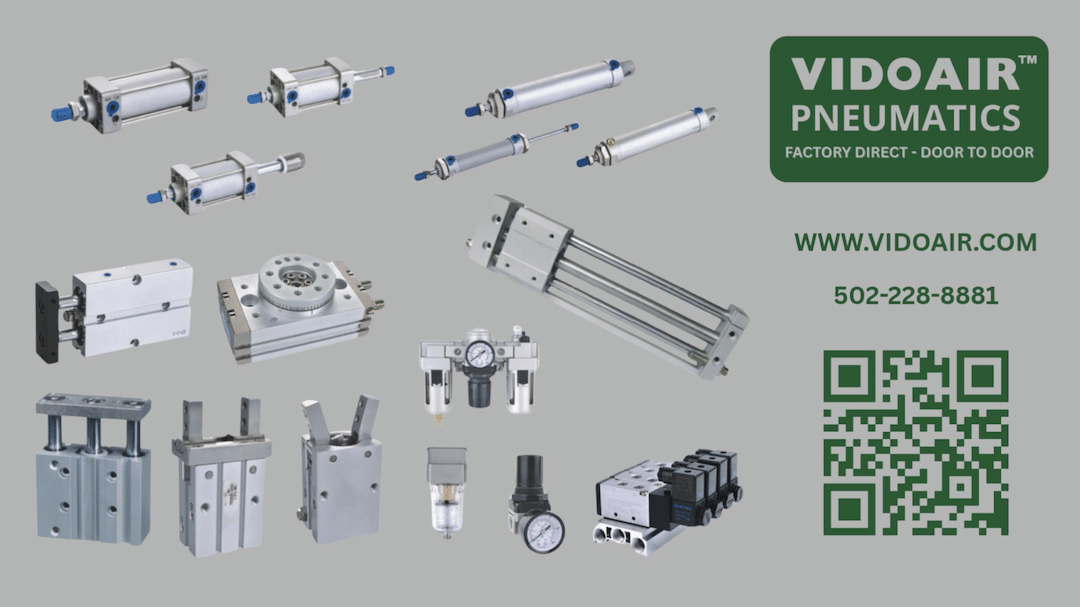
At VidoAir™, we pride ourselves on delivering complete, high-quality pneumatic solutions tailored to your needs. All of our products are engineered for durability, efficiency, and ease of use, ensuring your operations run smoothly. Whether you’re upgrading an existing system or building a new one, VidoAir’s pneumatic components are designed to deliver top performance.