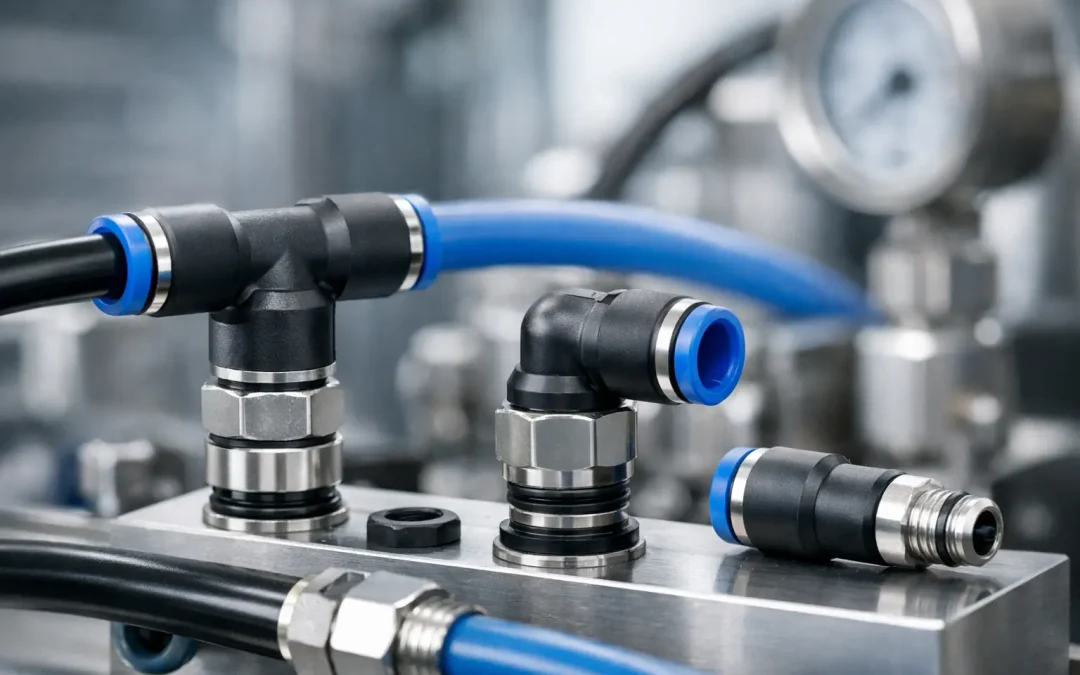
A pneumatic system can lose performance in places that rarely get much attention. One of the most common is the connection point. Industrial push in fittings look simple on the surface, but in high-cycle automation, harsh washdown areas, and fast-paced maintenance environments, the wrong fitting choice can turn into leaks, tubing damage, nuisance downtime, and repeat service calls.
For engineers and maintenance teams, the real question is not whether push-in fittings are convenient. It is whether they will stay sealed, hold tubing consistently, and survive the application without becoming the weak point in the circuit. That depends on material selection, geometry, tube compatibility, media conditions, and installation discipline.
Where industrial push in fittings earn their keep
In most modern pneumatic assemblies, push-in fittings are chosen because they reduce install time and simplify service. They let technicians route tubing quickly, make changes without cutting threads into every connection point, and replace lines with less labor. On OEM equipment, that speed matters on the production floor. In maintenance, it matters even more when a line has to be restored fast.
The bigger advantage is consistency when the fitting is correctly matched to the system. A well-designed push-in connection grips the tube evenly, seals without excessive force, and tolerates normal vibration and movement. That makes it a strong fit for machine automation, packaging, material handling, robotics, and general compressed air distribution.
But there is a limit to that convenience. Push-in fittings are not interchangeable by default, and they are not equally suited for every environment. A clean indoor assembly line has very different demands than a mobile machine exposed to grit, oil mist, temperature swings, or frequent hose movement.
Why some push-in fittings fail early
Most fitting failures are not dramatic. They show up as slow leaks, tubing pullout, cracked bodies, or difficult rework after repeated service. In many cases, the root cause is not the fitting alone. It is the combination of fitting, tube, pressure, temperature, and handling.
Tube mismatch is a common starting point
Industrial push in fittings depend on the outside diameter and surface condition of the tube. If the tube tolerance is loose, out of round, too soft, or cut poorly, the collet may not grip correctly and the seal may not seat as intended. Teams sometimes blame the fitting when the actual problem is tubing quality or tube material that was never suited for the fitting design.
Polyurethane, nylon, and other common pneumatic tubing options behave differently under pressure, heat, and bending. Soft tube can be useful in tight routing, but it may deform more easily under the grip mechanism. Harder tube often provides better retention, but it may be less forgiving in motion-heavy layouts. There is no universal best choice. The fitting and tube need to be treated as a matched system.
Thread sealing problems get misdiagnosed
When air loss appears near a fitting, the leak may be at the thread rather than the tube connection. Over-tightening tapered threads can distort the port or crack polymer bodies. Under-tightening creates an obvious leak path. Thread sealant choice also matters, especially when systems are assembled quickly across multiple shifts or vendors.
This is one reason standardization pays off. If a plant uses mixed fitting styles, thread types, and sealing practices, troubleshooting gets slower and repeatability drops.
Motion and vibration change the equation
A fitting that performs well in a static panel can struggle on moving tooling or end effectors. Repeated flexing near the fitting stresses the tube at the grip point. Vibration can also work against retention over time, especially when tube routing leaves side load on the connection. In these cases, the issue is often layout rather than fitting quality alone.
Proper support, bend radius control, and minimizing constant side pull can extend fitting life significantly. If movement is unavoidable, the better answer may be a different fitting orientation, a swivel option, or a change in tube specification.
Choosing industrial push in fittings for demanding applications
If the application is critical, selection should start with conditions rather than price alone. Fittings are low-cost components, but the downtime from a poor choice is not.
Material selection matters more than many buyers expect
Composite and engineered polymer fittings are common for good reason. They are lightweight, corrosion resistant, and efficient for a wide range of pneumatic duty. In clean, dry, standard-pressure environments, they can be the right balance of performance and cost.
Metal fittings, including nickel-plated brass and stainless options, become more attractive when the environment is aggressive or the mechanical demands are higher. If the system sees chemical exposure, washdown, higher ambient heat, impact risk, or stricter durability expectations, stepping up material grade can prevent recurring failures. Stainless is not necessary everywhere, but where corrosion is active, it can quickly justify itself.
Port style and geometry affect serviceability
Straight fittings are simple, but they are not always the best packaging choice. Elbows, tees, unions, bulkhead styles, and flow control combinations can all improve tubing routing and reduce stress at the connection point. A cleaner tube path usually means fewer leaks and easier replacement.
This is where catalog depth helps. Engineers often know the pressure and tube size, but the fitting geometry determines whether the assembly stays maintainable once it is installed inside a machine frame or panel.
Application media and environment cannot be ignored
Most pneumatic push-in fittings are intended for compressed air or compatible gases. If the system involves vacuum, pulsing demand, oil carryover, moisture exposure, or nonstandard media, the fitting specification needs a closer review. Temperature range is another frequent oversight. A fitting that performs well at room temperature may become less reliable near heat sources or in cold-start environments.
For food-adjacent, washdown, or outdoor applications, ingress, corrosion, and cleaning chemicals can shorten life fast. In those cases, the connection point should be selected with the same discipline used for valves and actuators.
Installation practices that protect uptime
Even premium fittings can underperform if installation quality is inconsistent. The basics are not glamorous, but they are what keep leak rates down.
Tubing should be cut square with a proper cutter, not crushed with side cutters or left with a ragged edge. The tube should be fully inserted to the internal stop. If a line is removed and reinstalled multiple times, the end should be inspected and often trimmed before reuse. Damaged tube ends create sealing problems that show up later as intermittent leaks.
Threaded connections need controlled torque. Too much force is one of the fastest ways to damage ports and create hidden reliability issues. On maintenance teams with multiple technicians, a simple installation standard can prevent a surprising amount of rework.
It also helps to pressure-test sections after assembly instead of waiting for full machine startup. Catching one bad connection during build is cheaper than finding it during commissioning or after the equipment ships.
When push-in fittings are the wrong choice
Push-in fittings are highly effective, but they are not the answer to every connection problem. Extremely high vibration, severe hose movement, abusive mechanical contact, or specialty media may call for compression fittings, barbed connections, or other retention methods.
That does not mean push-in technology is limited. It means the application should lead the decision. In many systems, the best outcome is a mix of connection styles based on actual duty rather than a one-style-fits-all standard.
What buyers should ask before standardizing
Before locking in a plant standard or releasing a new machine design, it is worth asking a few practical questions. Will the tube material stay consistent across suppliers? Is the fitting body material right for the environment? How often will lines be disconnected during service? Is there side load or motion at the connection? Does the fitting need to support washdown, vacuum, or elevated temperature?
Those questions sound basic, but they drive long-term performance. Factory-direct suppliers with broad pneumatic catalogs and technical support can usually help narrow the right combination faster, especially when a standard fitting keeps failing for reasons that are not obvious from pressure rating alone.
For OEMs and plant teams, industrial push in fittings should be treated as performance components, not commodity afterthoughts. The connection is only small until it starts leaking during production. Choose for the real environment, install with discipline, and the fitting will do exactly what it should – disappear into the system and keep it running.