A pick-and-place cell can meet its cycle-time target during commissioning and still become a source of downtime six months later. The usual cause is not the robot. It is end-of-arm tooling selected around an ideal part, clean conditions, and a perfect presentation. In the vacuum cups vs mechanical grippers decision, the right choice comes down to how the part behaves when conditions stop being ideal.
Vacuum cups provide fast, simple contact for many flat and nonporous products. Mechanical grippers provide controlled retention when surface condition, porosity, geometry, or process forces make vacuum uncertain. Neither is universally better. The best tool is the one that holds the full range of parts safely, confirms a successful pick, and releases consistently at production speed.
Start With the Part, Not the Gripper
End-of-arm tooling should be specified from the actual handling condition, not only the CAD model. Engineers should account for part weight, center of gravity, temperature, surface finish, allowable contact area, orientation during transfer, and acceleration. A thin steel blank handled horizontally has very different requirements from the same blank lifted vertically, rotated, and placed into a fixture.
Part variation matters just as much. A vacuum cup may perform well on a smooth panel but lose capacity on a slightly warped, oily, textured, or perforated version. A parallel gripper may locate a rigid molded component precisely but struggle when flash, dimensional variation, or a changing gate location affects its grasping surfaces. Production tooling must tolerate the normal variation created by upstream processes.
Also consider what happens after the pick. If the robot travels through a weld cell, paint booth, washdown area, or high-temperature zone, the end effector must withstand contamination and thermal exposure without changing its grip behavior. A short cycle time does not compensate for dropped parts, rejected assemblies, or frequent cup replacement.
Vacuum Cups vs Mechanical Grippers: Core Trade-Offs
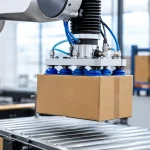
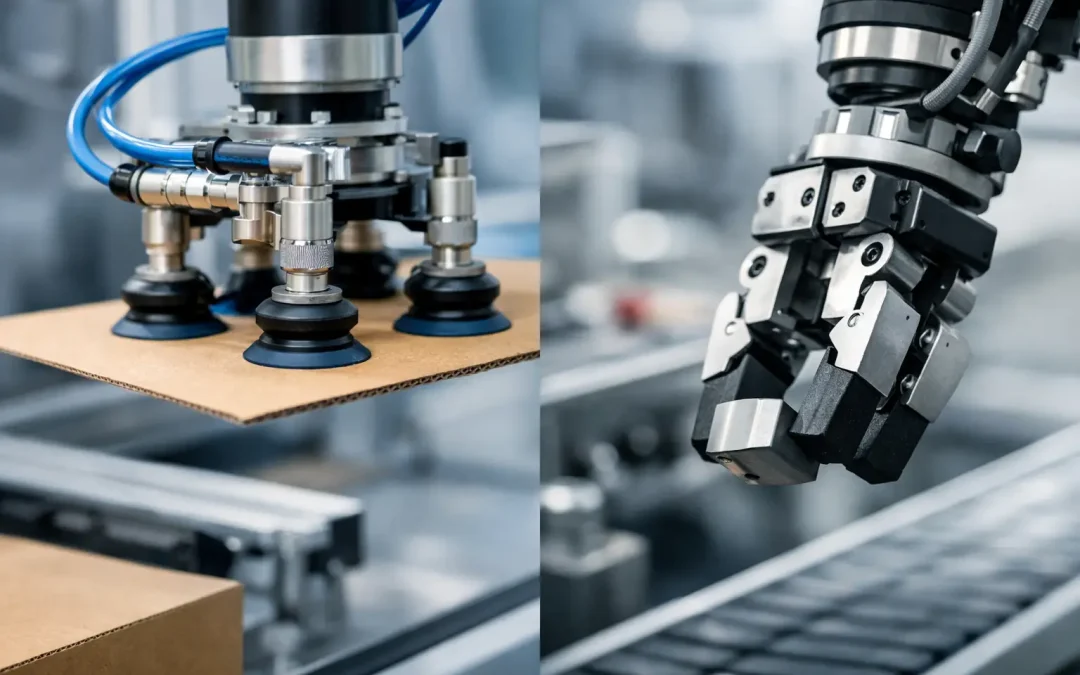
Vacuum cups generate holding force from the pressure difference between the cup and the surrounding atmosphere. Their greatest advantage is broad surface engagement with minimal part-side geometry. A cup can pick a carton, sheet, lid, glass panel, pouch, or formed plastic part without requiring a dedicated gripping flange or undercut.
Mechanical grippers retain a part through jaw contact, internal expansion, external clamping, or specialized fingers. Their advantage is positive mechanical engagement. Once the jaws are correctly designed and actuated, they can retain parts with porous, rough, oily, perforated, or curved surfaces that would be difficult for vacuum to seal.
The practical distinction is simple: vacuum depends on maintaining a seal, while a mechanical gripper depends on maintaining enough contact force and geometry to resist motion. Both methods can fail, but they fail for different reasons.
Where vacuum cups have the advantage
Vacuum is often the most efficient solution when parts have a relatively smooth, nonporous surface and can tolerate contact at the pickup location. It is especially effective for sheet goods, packaging, appliance panels, electronics housings, glazing, and many formed products. Multi-cup tooling can spread the load across a large part, reducing deflection and helping stabilize wide panels during transfer.
Vacuum tooling is also adaptable. A well-designed manifold can use independently valved cups to accommodate missing parts or multiple product sizes. Spring level compensators can absorb height variation. Bellows cups can conform to lightly curved surfaces. For high-mix packaging and material handling, this flexibility can reduce changeover complexity.
Cycle time can favor vacuum because the contact action is direct. The robot approaches, establishes a seal, verifies vacuum, and moves. There are no jaws that need to clear the part and close around a gripping feature. However, this advantage only holds when evacuation time is controlled. Long tubing, undersized vacuum generators, leaks, and excessive cup volume can turn a supposedly fast pick into a delayed and inconsistent one.
Where mechanical grippers have the advantage
Mechanical grippers are the stronger choice when a part cannot form a dependable vacuum seal. This includes castings, woven materials, foam, corrugated surfaces, perforated components, heavily textured molded parts, oily stampings, and parts with irregular curvature. They are also useful when the part must be held through high robot acceleration, aggressive orientation changes, or external process forces.
Positive gripping is particularly valuable in machine tending. A pneumatic parallel gripper with hardened or application-specific fingers can load a CNC machine, remove a hot workpiece, and maintain controlled placement into a fixture. The fingers can also support repeatable datum contact, which is difficult to achieve with a flexible vacuum cup alone.
Mechanical grippers can provide better retention during a loss of pneumatic or electrical control when paired with spring-closing or mechanically locking designs. That does not eliminate the need for system safety analysis, but it can reduce risk in applications where a dropped component would damage equipment or create a hazard.
Their trade-off is integration effort. Fingers must be designed around the part, jaw stroke must cover tolerance variation, and grip force must be high enough to resist inertial loads without deforming the part. A gripper that is oversized for force can crush plastic housings, mar finished surfaces, or distort thin-wall components.
Calculate Force for the Real Robot Path
Holding force should never be based on part weight alone. A vertical lift is only the starting point. The tooling must resist gravity plus acceleration, deceleration, rotation, vibration, hose drag, and any off-center moment created by the part’s center of gravity.
For vacuum, theoretical holding force is vacuum differential multiplied by effective cup area. Real capacity is lower because cups rarely see perfect sealing conditions. Side loading is especially critical. A cup can have ample vertical lifting force yet allow a panel to slide during a fast horizontal move. Use a conservative safety factor, account for friction, and evaluate the weakest expected surface condition rather than the best sample from the lab.
For mechanical gripping, calculate the force required to prevent slip at the jaw contact points. Friction, jaw material, contact angle, and the direction of robot acceleration all affect the result. If fingers grip a cylindrical part externally, opening force and part ejection risk must be considered. If they grip an internal bore, verify that the bore can tolerate expansion without damage.
In both cases, test the complete path. A static pull test is useful, but it does not replicate a robot’s maximum acceleration or an emergency stop. Production validation should include worn cups or pads, normal contamination levels, part tolerances, and the fastest programmed motion.
Utilities, Controls, and Failure Detection
Vacuum systems require more than cups. They need a vacuum source, filtration, tubing, valves, and controls sized for the required evacuation and release times. Central vacuum systems can be efficient for high-volume cells, while ejector-based systems can simplify distributed tooling. The correct architecture depends on air cost, distance from the source, response time, and maintenance access.
Vacuum sensing is not optional in applications where a missed pick affects downstream equipment. A vacuum switch or analog sensor can confirm that the target vacuum level has been reached before robot motion begins. It can also identify gradual leakage before it becomes a drop event. Still, a vacuum reading confirms system pressure, not necessarily perfect part position. Multi-zone tooling may require individual sensing or logic that identifies which zones are active.
Mechanical grippers need equally deliberate feedback. End-of-stroke sensors confirm jaw position, but they do not always prove that a part is present. A gripper can close fully when no part is loaded. Depending on the process, combine jaw sensors with part-present sensing, pressure monitoring, vision, or fixture confirmation.
Maintenance patterns differ. Vacuum cups wear, harden, crack, and collect dust or oil. Filters clog and small leaks consume compressed air continuously. Mechanical grippers need clean, regulated air, proper lubrication where specified, and periodic inspection of jaw fingers, pivots, fasteners, and guides. In dirty metalworking environments, chip protection and finger design are often more decisive than the gripper body itself.
Use Hybrid Tooling When One Method Is Not Enough
Some of the most reliable end effectors do not treat vacuum and mechanical gripping as competing options. Hybrid tooling can use vacuum to lift a broad panel while mechanical supports control edge position. A gripper can secure a formed part while a small vacuum cup stabilizes a flexible feature. For delicate products, soft robotic grippers can distribute contact across irregular shapes where rigid jaws would damage the part and vacuum would be inconsistent.
Hybrid systems add components, but they can reduce the cost of rejects and recovery events. They are worth considering when a part has both a usable vacuum surface and a critical feature requiring positional control.
A Practical Specification Check
Before releasing tooling for production, ask whether the design can pick the worst acceptable part, at the highest programmed acceleration, after normal contamination has accumulated. Confirm that it can detect a missed pick before motion causes damage, that replacement wear items are accessible, and that the air and vacuum circuits meet required response times.
For standard automation hardware or configured pneumatic handling components, VidoAir supports manufacturers and integrators with factory-direct options built for demanding applications. The right end effector is not the one with the highest stated force. It is the one that keeps every shift moving when surfaces vary, cycle rates rise, and production cannot wait for a manual recovery.