A packaging line needs thousands of fast, repeatable strokes per shift. A press fixture needs to hold a load without drifting. Both require linear motion, but specifying the same actuator for both jobs can create unnecessary cost, poor cycle performance, or a recurring maintenance problem. The air cylinders vs hydraulic cylinders decision is not simply about which actuator produces more force. It is about matching the motion system to the load, duty cycle, control requirement, plant utilities, and consequences of downtime.
For most factory automation tasks, pneumatic cylinders deliver the best combination of speed, simplicity, and serviceability. Hydraulic cylinders take over when high force, controlled heavy loads, and stiffness matter more than clean, rapid cycling. The right choice becomes clearer when the application is evaluated as a complete system rather than an actuator alone.
Air Cylinders vs Hydraulic Cylinders: Core Differences
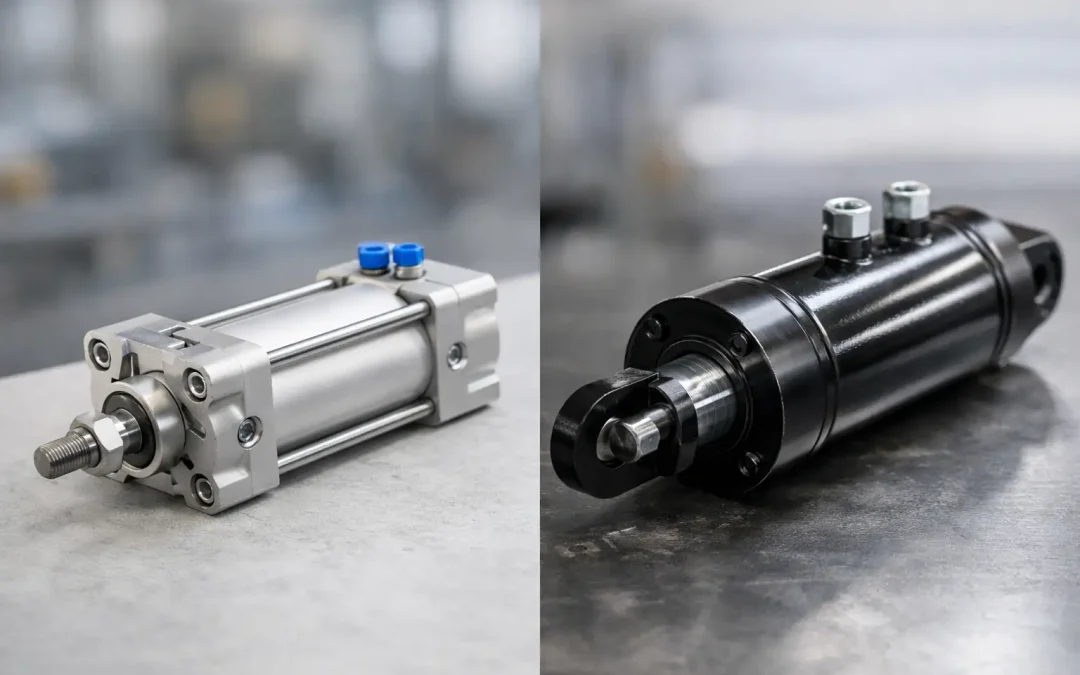
Pneumatic cylinders use compressed air to extend and retract a piston. Because air is compressible, a pneumatic system is responsive and well suited to quick end-to-end movement, but it has less inherent stiffness than a fluid-powered system. Typical industrial systems operate around 80 to 120 psi, though the usable pressure must account for pressure drop, regulator setting, and fluctuations caused by other equipment drawing from the air supply.
Hydraulic cylinders use pressurized oil or another hydraulic fluid. Hydraulic systems commonly run at pressures far above pneumatic systems, often in the thousands of psi. That pressure difference allows a relatively compact hydraulic cylinder to generate substantial linear force. Since hydraulic fluid is nearly incompressible, the system also provides more rigid motion and stronger resistance to changing loads.
Force is the first calculation, but not the final decision. Cylinder force is approximately pressure multiplied by effective piston area. A larger-bore pneumatic cylinder can supply meaningful force, yet increasing bore also increases air consumption, valve size requirements, and moving mass. A hydraulic cylinder can achieve the same force in a smaller package, but requires a power unit, reservoir, filtration, hoses, valves, and fluid-management discipline.
Where Pneumatic Cylinders Deliver Better Value
Air cylinders are the practical choice for high-cycle automation where force demands are moderate and fast movement is more valuable than extreme positioning accuracy. Pick-and-place equipment, carton handling, part ejection, clamping, gate control, light assembly fixtures, and robotic end effectors are common examples.
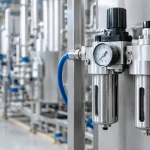
A pneumatic system is usually easier to install in an existing plant because compressed air is already available. The supporting hardware is straightforward: air preparation, directional control valves, tubing, fittings, flow controls, and cylinder-mounted sensors. With clean, dry, properly regulated air, these systems can run for long service intervals and are simple for maintenance teams to troubleshoot.
Pneumatics also fit environments where a fluid leak would create a product-quality or cleanup concern. Food-adjacent handling, electronics assembly, packaging, and general manufacturing often benefit from avoiding hydraulic oil near the process. For corrosive washdown zones, material selection still matters. Stainless steel air preparation components, compatible seals, and appropriate cylinder construction help maintain reliability where standard hardware would degrade.
Speed is another major advantage. Pneumatic cylinders can cycle quickly because the system does not need a large hydraulic power unit or long fluid warm-up period. However, fast does not mean uncontrolled. Properly sized flow controls, cushioning, shock absorbers, and guided actuators prevent hard end-of-stroke impacts that damage rods, mounts, tooling, and product.
The limitation is air compressibility. If a cylinder is pushing against a changing load, its position can vary as pressure changes. Standard pneumatics are excellent for end-position tasks, but they are not the default answer for a ram that must hold a precise intermediate position under varying force. When the application needs tighter pneumatic control, consider rod locks, guided slide tables, proportional controls, or mechanical stops. The best solution may still be pneumatic, but it should be engineered around the requirement rather than assumed from the start.
When Hydraulic Cylinders Are the Better Tool
Hydraulics earn their place in heavy industrial equipment. Pressing, forming, lifting, compacting, heavy material handling, mobile equipment, die actuation, and high-load fixtures often need force levels that would make a pneumatic design oversized and inefficient.
The defining benefit is force density. A compact hydraulic cylinder can move or hold loads that would require a much larger pneumatic bore. This matters where installation space is limited or the load cannot tolerate a bulky actuator. Hydraulic systems also offer better stiffness for holding, pressing, and resisting external force. A vertical load, for example, may need controlled lowering and reliable load holding that a basic pneumatic circuit cannot provide on its own.
Hydraulic motion can be controlled with high precision when the power unit, valving, feedback devices, and fluid condition are properly specified. But precision has a system cost. Fluid temperature affects viscosity, leakage can reduce performance and create contamination risks, and poor filtration can quickly damage valves and seals. A hydraulic cylinder is not a stand-alone component purchase. Its reliability depends on the condition and design of the entire hydraulic circuit.
Hydraulics are also often slower to deploy in a clean factory automation cell. The equipment footprint is larger, installation is more involved, and maintenance requires trained personnel who understand fluid cleanliness, pressure hazards, hose routing, and safe lockout procedures. For a light clamping operation, that added infrastructure may be difficult to justify.
Specify by the Motion Problem, Not the Available Actuator
A common mistake is choosing pneumatic motion because the plant has air or choosing hydraulics because the load is heavy. Both shortcuts miss critical details. Start with the actual load and operating condition: required push and pull force, stroke length, side load, travel speed, cycle rate, orientation, and whether the actuator must stop or hold at intermediate positions.
Then account for real-world losses. Pneumatic cylinder force should include a margin for pressure drop, friction, seal breakaway, misalignment, and variations in supply pressure. Hydraulic systems require allowance for pressure losses, dynamic loading, temperature effects, and the maximum safe working pressure of every component in the circuit.
Mounting deserves the same attention as bore size. A cylinder rod is designed primarily for axial load. Side loading caused by an unsupported fixture, a poorly aligned slide, or a cantilevered tool accelerates bushing and rod wear in either technology. Guided cylinders, slide table actuators, external linear rails, or properly designed pivots can protect the actuator and improve repeatability.
For long strokes under compression, check rod buckling. A cylinder can have sufficient theoretical force and still fail mechanically if a slender rod is asked to push a poorly supported load. For vertical axes, also evaluate what happens during a loss of air, pressure, or electrical power. Counterbalance valves, rod locks, mechanical brakes, or external safety supports may be necessary depending on the hazard and load.
Cost, Energy, and Maintenance Trade-Offs
Initial component cost frequently favors pneumatic systems for ordinary automation. A cylinder, valve, air preparation unit, tubing, and fittings can be configured quickly, and replacement parts are familiar to most maintenance departments. The trade-off is ongoing compressed-air consumption. Leaks, excessive pressure settings, and oversized cylinders turn a simple pneumatic circuit into a persistent operating cost.
Hydraulic systems can be more energy-efficient for sustained high-force duties, particularly where the application is designed around a well-managed power unit. Yet they carry higher installation complexity and a heavier maintenance burden. Fluid analysis, filter changes, seal inspections, leak correction, and thermal management are not optional details in demanding hydraulic service.
The best lifecycle decision depends on duty cycle. A pneumatic cylinder that fires briefly every few minutes may be highly economical. A large pneumatic actuator that continuously presses against a high load can consume significant compressed air and may be a poor fit. Conversely, installing a hydraulic power unit to operate one small clamp a few times per hour is often excessive.
Build Reliability Into the Supporting System
Many cylinder failures begin outside the cylinder. Pneumatic stiction, inconsistent speed, weak force, and early seal wear often trace back to contaminated air, inadequate flow capacity, incorrect lubrication practices, or poorly adjusted cushions. Confirm that filters remove the contaminants present in the plant, regulators maintain pressure under peak demand, and tubing and valves are sized for the required cylinder speed.
Hydraulic failures follow similar patterns at a higher consequence level. Contaminated fluid, overheated oil, incorrectly set relief valves, and damaged hoses can reduce actuator life and create unsafe behavior. Treat filtration, temperature control, and pressure protection as core performance components, not accessories.
For OEMs and plant teams working under delivery pressure, component availability matters as much as the specification. Standardize where possible, then reserve custom cylinder configurations for the dimensions, materials, mounting, sensing, or environmental requirements that truly demand them. VidoAir supports this approach with factory-direct pneumatic components and configured solutions for applications that cannot be solved with a catalog cylinder alone.
Choose pneumatics when rapid cycling, clean operation, modest force, and simple maintenance drive the project. Choose hydraulics when compact high force, rigid load control, and heavy-duty motion justify the added system infrastructure. The strongest designs do not force one technology into every job – they make the actuator earn its place in the machine.