
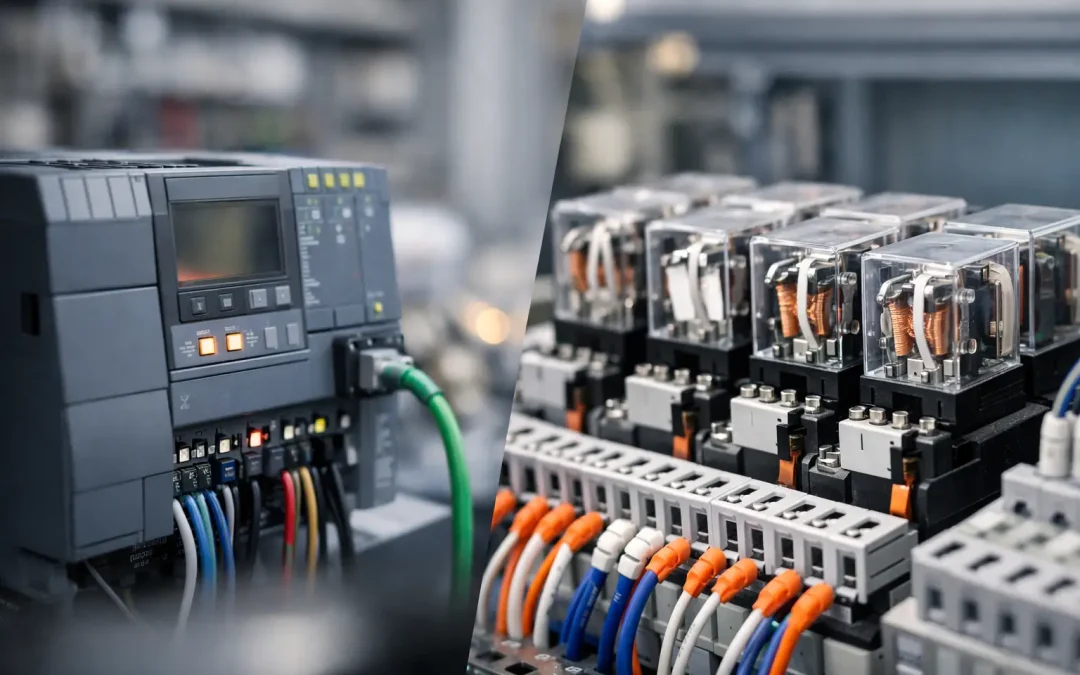
A machine that starts fine on Monday and turns into a wiring chase by Thursday usually tells you something about its control architecture. In the real-world PLC vs relay control decision, the right answer is rarely about which technology is newer. It is about how much logic the machine needs, how fast you need to troubleshoot it, and what downtime actually costs your operation.
For OEMs, integrators, and plant teams, this choice affects panel space, changeover flexibility, spare parts strategy, and long-term maintenance burden. A simple conveyor interlock and a multi-station pneumatic assembly system do not deserve the same control approach. Treating them as if they do is where cost and reliability problems start.
PLC vs relay control in actual machine builds
Relay control still earns its place in industrial panels. It is direct, visible, and easy to understand for basic on-off logic. If your sequence is fixed, your I/O count is low, and your technicians want to trace control power through physical contacts, relays can be a practical fit.
A PLC changes the equation when logic expands beyond a handful of interlocks. The moment you add timers, counters, recipe changes, safety coordination, HMI interaction, or future expansion, relay logic gets expensive in ways that are not obvious on the first quote. What looks cheaper at build stage can become harder to modify, document, and support once the machine is on the floor.
That is why experienced engineering teams usually frame PLC vs relay control as a lifecycle decision, not just a component cost comparison. Hardware price matters, but service time, commissioning speed, and repeatability matter more in demanding applications.
Where relay control still makes sense
Relay-based control is often the better answer for very simple machines and utility functions. A basic air-operated fixture, a straightforward pump starter circuit, or a single-purpose refrigeration solenoid control loop may not benefit from a PLC at all. In those cases, a relay panel can be compact, familiar, and effective.
Relays also appeal in environments where maintenance teams are strongly electrical but not programming-oriented. A failed relay can be swapped quickly. A contact sequence can be traced with a meter. For small systems with stable requirements, that simplicity has real value.
There is also an argument for relay control where deterministic hardwired action is preferred for a narrow task. If the machine logic is unlikely to change for years, a relay design can remain reliable and serviceable without introducing software management.
The limitation appears when the machine stops being simple. Add another actuator, another sensor, a manual mode, fault handling, or remote status, and the relay panel grows fast. So does troubleshooting time.
The hidden cost of relay complexity
One relay is simple. Thirty relays with nested interlocks, timer relays, and undocumented field changes are not. As relay logic expands, wiring density increases, drawing revisions become harder to maintain, and fault isolation slows down.
In pneumatic systems, this matters more than many teams expect. A sequence involving solenoid valves, end-of-stroke sensing, pressure switches, and operator permissives can become difficult to diagnose when every logic step is hardwired. A single loose terminal or failed contact can look like a valve problem, a cylinder problem, or a sensor problem until someone spends time tracing every rung physically.
Where PLC control pulls ahead
PLCs are built for machine logic that needs flexibility, diagnostics, and repeatable performance. If your application includes multiple cylinders, timed sequences, part-present checks, alarm handling, or communication with other devices, a PLC usually gives you a cleaner and more scalable solution.
The biggest advantage is not just programmability. It is visibility. A technician can see input status, output status, timer states, fault conditions, and sequence steps without pulling half the panel apart. That reduces mean time to repair and cuts guesswork during startup.
For electro-pneumatic systems, PLC control is especially useful because it organizes motion logic in a way that is easier to test and modify. If a cylinder extend delay needs to change, or a vacuum confirmation step must be added, that adjustment happens in logic rather than through additional relays, timer modules, and rewiring.
This is where high-performance machine builders save money over time. Faster commissioning and easier changes often offset the higher upfront hardware cost quickly.
PLCs support better diagnostics and cleaner changes
A relay system tells you what is energized. A PLC can tell you why the sequence stopped. That difference matters when uptime is on the line.
With a PLC, you can add fault messaging, cycle counters, maintenance flags, and interlock status that help technicians solve the actual problem instead of replacing parts until the machine runs again. You also gain consistency across builds. For OEMs producing multiple versions of a machine, standardized PLC logic reduces variation between panels and makes service support more manageable.
That does not mean PLCs are always easier for every shop. They require programming skill, version control discipline, and better documentation practices. If those are missing, a PLC can be underused or poorly supported. The technology is stronger, but only if the organization uses it correctly.
Cost is not just the panel BOM
The most common mistake in plc vs relay control decisions is comparing only hardware line items. Relays may look cheaper at first because the unit cost is familiar and the programming line is minimal or absent. But the panel BOM is only one piece of the total cost picture.
Design labor, panel assembly time, debug hours, field modification effort, future expansion, spare part management, and downtime response all affect the true cost. Relay panels usually become more labor-heavy as logic complexity rises. PLC systems usually shift cost toward components and programming while reducing wiring and change effort.
For a simple fixed-function machine, relay control can absolutely win on cost. For a machine platform that may evolve across customers or product lines, PLCs often deliver better economics over the service life of the equipment.
That trade-off becomes even sharper when downtime is expensive. If an hour of lost production costs more than the difference between control methods, diagnostic speed becomes a financial issue, not just a maintenance preference.
Panel space, documentation, and serviceability
Relay logic consumes physical space fast. Terminal strips, interposing relays, timer relays, wire management, and labeling add up. On small machines, this may not matter. On denser automated equipment, panel real estate is expensive and service access matters.
PLCs usually reduce wiring congestion because the logic lives in software rather than across dozens of physical devices. That can lead to cleaner layouts and easier documentation when handled well. It can also simplify future I/O additions.
Serviceability depends on the team. Some technicians prefer relays because the logic is tangible. Others prefer PLCs because status is visible in software. The best answer often comes down to what your maintenance organization can support at 2 a.m. during a production issue, not what looks elegant in the design review.
Choosing the right control method for pneumatic automation
In pneumatic automation, the control method affects more than switching outputs. It shapes how the machine handles sequencing, sensor verification, pressure-dependent conditions, and fault recovery.
A relay approach can work well for simple clamp-and-release operations, basic valve actuation, or standalone utility panels. But as soon as the system includes multiple actuators, coordinated motion, vacuum sensing, timed dwell periods, or recipe-based product changes, PLC control becomes far easier to manage.
This is especially true when machines need to support modifications after installation. A hardwired relay system resists change. A PLC-based system absorbs change more efficiently, assuming the I/O architecture and documentation were designed with expansion in mind.
For manufacturers sourcing valves, sensors, air prep, tubing, and control hardware together, the practical question is not whether PLCs are better in theory. It is whether the control strategy matches the performance demands of the application. VidoAir supports that kind of component-level decision every day because the wrong mix of control hardware and pneumatic devices usually shows up later as startup delays, nuisance faults, or maintenance-heavy panels.
So which one fits better?
If the machine is simple, fixed, and unlikely to change, relay control can still be the right industrial choice. It is proven, understandable, and cost-effective in narrow applications.
If the machine needs scalability, better diagnostics, cleaner sequencing, or faster service response, PLC control is usually the stronger investment. It reduces wiring complexity, improves visibility, and gives engineering teams far more room to refine performance without rebuilding the panel.
The better question is not PLC or relay as a blanket rule. It is how much complexity your machine really has today, how much change it will face tomorrow, and how expensive it is when troubleshooting takes too long. Start there, and the right control architecture usually becomes clear.