How to Reduce Pneumatic System Noise on the Plant Floor
Noise on the Plant Floor. Walk through almost any facility running compressed air — packaging lines, robotic cells, material handling, machine tools — and you’ll hear it before you see it: the sharp hiss and pop of air exhausting from valves and cylinders. That noise isn’t just background nuisance. It’s a signal of how well (or poorly) a pneumatic system is managing exhaust airflow, and it’s one of the most overlooked variables in system design.
Pneumatic mufflers and exhaust throttle valves are small, inexpensive components. But get them wrong, and the effects show up in noise complaints, inconsistent cylinder speed, premature wear on seals and valves, and even OSHA-relevant workplace noise exposure. Get them right, and a pneumatic system runs quieter, more predictably, and with less contamination risk. Here’s what’s actually happening at the exhaust port, and why it deserves more attention during design and maintenance.
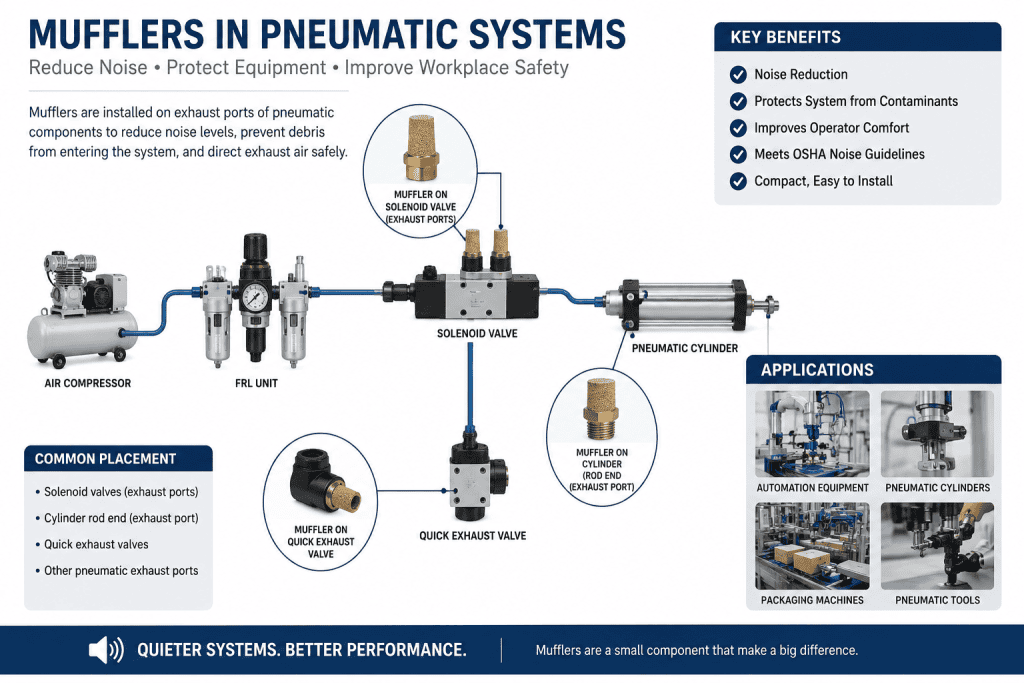
What a Pneumatic Muffler Actually Does
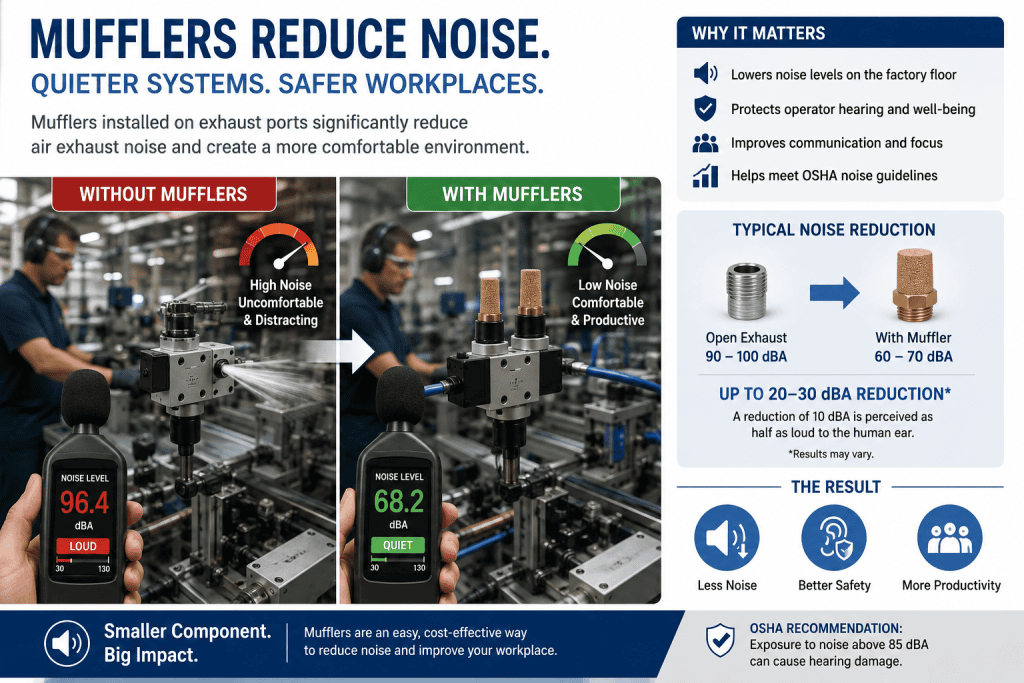
Every time a directional control valve shifts or a cylinder cycles, compressed air that was doing work has to go somewhere. That exhaust air is typically released to atmosphere through the valve’s exhaust port, often at high velocity and volume in a very short burst. Without any restriction, that burst of air expanding rapidly into open atmosphere creates turbulence — and turbulence is noise, frequently in the 80–100+ dB range depending on line size, pressure, and cycle rate.
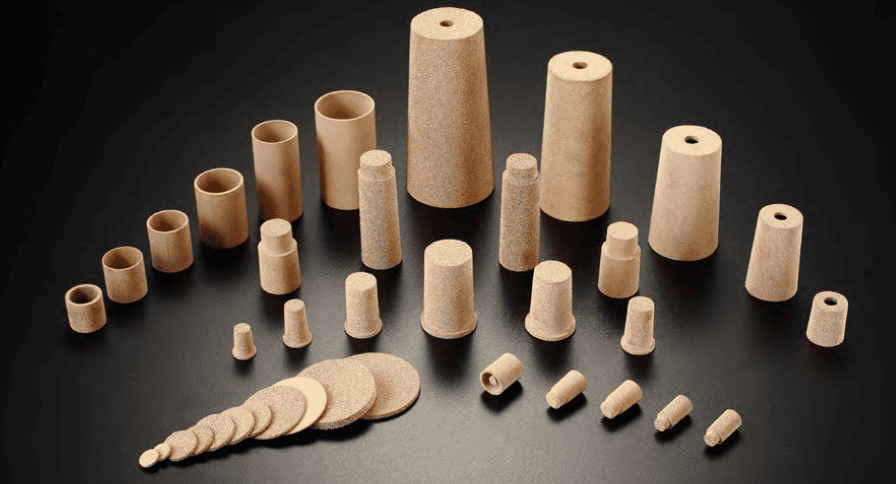
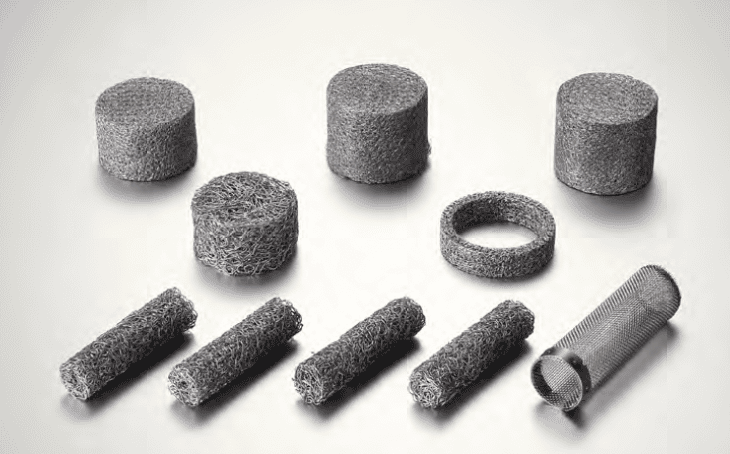
A pneumatic muffler doesn’t stop the exhaust; it slows and diffuses it. Internally, most mufflers use a porous element — sintered bronze, stainless mesh, or plastic media — that breaks the exhaust stream into many smaller, lower-velocity paths before it reaches open air. The result is a meaningful drop in perceived noise, often 10–20 dB depending on the design and application, without adding meaningful backpressure to the system if the muffler is sized correctly.
Where Exhaust Throttle Valves Come In
A standard muffler manages noise. An exhaust throttle valve — sometimes called an exhaust muffling throttle valve or flow control muffler — manages noise and airflow at the same time. These combine a muffler with an adjustable orifice, letting a technician meter how quickly air exits the system.
That matters because cylinder speed is often controlled more effectively by metering exhaust air (meter-out control) than by metering supply air. Meter-out throttle valves at the exhaust port give smoother, more stable actuator motion — particularly important in applications like case erecting, pick-and-place, or clamping stations where a cylinder that “chatters” or overshoots can damage product or tooling. One-way and non-return throttle valve variants add a check function, allowing free flow in one direction and controlled flow in the other, which is common in applications needing rapid extend but controlled retract (or vice versa).
The Advantages, Practically Speaking
Noise reduction and compliance. Compressed air exhaust is one of the most common sources of high-frequency noise on a plant floor. Properly muffled exhaust ports are a low-cost way to bring individual machines — and cumulative floor noise — down toward safer, more comfortable levels.
Contamination control. An open exhaust port isn’t just loud — it’s an entry point. Dust, moisture, and airborne particulate can migrate back into a valve or cylinder through an unprotected exhaust when the system is idle or during pressure fluctuations. Mufflers with filter elements add a layer of protection against ingress, which matters in food-grade, cleanroom, or dusty industrial environments.
Process consistency. Uncontrolled exhaust flow can cause a cylinder to slam at end of stroke, bounce, or cycle inconsistently from one run to the next. Throttle valves let engineers dial in a repeatable, controlled motion profile — which translates to less mechanical shock, longer seal life, and fewer unplanned stops.
Component protection. Reducing exhaust shock and backpressure spikes also reduces stress on valve seals, cylinder cushions, and fittings downstream. Over thousands of cycles, that adds up to measurably longer service intervals.
Design flexibility. Because mufflers and throttle valves come in a wide range of materials — brass, stainless steel, plastic, aluminum — and connection styles, from M5 and 1/8″ up through 2″ ports, they can be matched to the environment rather than forcing every application into a generic part. A washdown application calls for a different material than a lightweight electronics assembly cell or an outdoor hydraulic-adjacent installation.
Selecting the Right Component toReduce Noise On The Plant Floor
In practice, muffler and throttle valve selection comes down to a handful of variables: connection size and thread type, operating pressure and flow requirements, ambient conditions (moisture, temperature, chemical exposure), available installation space, and whether flow control is actually needed or noise reduction alone is sufficient.
Getting these details right up front avoids a common and costly mistake — undersizing a muffler for the flow it needs to pass, which reintroduces backpressure and defeats the purpose of adding the component at all.
A Component Worth Specifying Carefully
Pneumatic mufflers and exhaust throttle valves rarely get the design attention that cylinders, actuators, or valve manifolds do — but their impact on noise, consistency, and component life is disproportionate to their size and cost. For engineers and maintenance teams looking to quiet down a line, smooth out cylinder motion, or protect a system from contamination ingress, the exhaust side of the circuit is worth a second look.
VidoAir™ offers a full factory-direct line of pneumatic mufflers and exhaust throttle valves in brass, stainless steel, plastic, and aluminum, across common metric and inch connection sizes, with filter and filter-element options for applications that need extra ingress protection.
Explore the complete muffler and exhaust valve line
https://vidoair.com/pneumatic-mufflers-exhaust-valves/
Have an application in mind? Send us your thread size, pressure, and flow requirements and we’ll help identify the right configuration.
READY TO AUTOMATE?
Vidoair’s application engineers are ready to help you select the right pneumatic and vacuum solutions for your next robotic integration project.