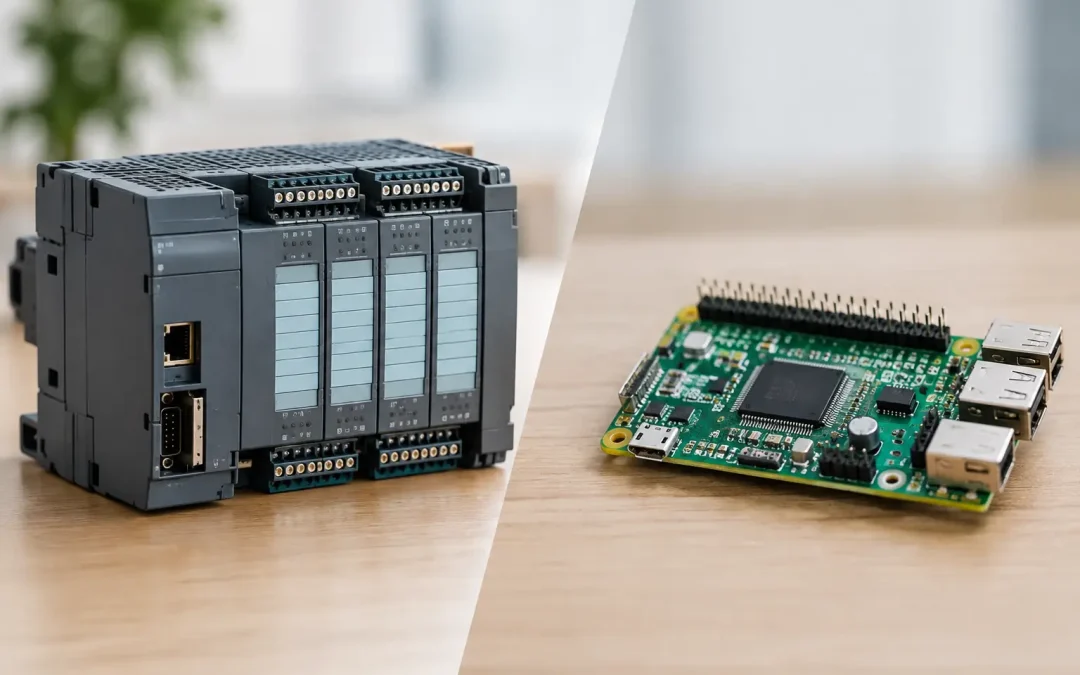
A carton erector that loses a photoeye signal cannot wait for a developer to attach a debugger. It needs a controller that keeps the sequence safe, shows the fault clearly, and can be returned to service by the next shift. That practical requirement is where the programmable logic controller vs microcontroller decision becomes more than a component comparison. It becomes an uptime, commissioning, and lifecycle decision.
Both controller types can read sensors, drive solenoids, communicate with equipment, and execute machine logic. The right choice depends on where the controller sits in the system, who will support it, and what failure costs once the equipment is running.
Start With the Machine Boundary
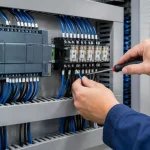
A programmable logic controller, or PLC, is built to be the control center of industrial equipment. Its value is not simply that it executes ladder logic or structured text. It is the complete industrial package: 24 VDC-compatible I/O, electrical isolation, expandable modules, communication options, diagnostic indicators, and programming workflows familiar to automation technicians.
That package matters on a machine with pneumatic valves, pressure switches, cylinder sensors, safety interfaces, conveyors, and operator controls. A PLC can make the signal path visible from field device to program tag. When an actuator fails to extend, maintenance can quickly determine whether the issue is air supply, a blocked flow control, a failed solenoid, a broken sensor cable, or missing PLC output.
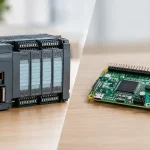
A microcontroller is a compact programmable computer integrated into a product or circuit board. It is highly capable and often the better choice for dedicated embedded functions. It can process a sensor signal at high speed, control a compact motor drive, manage a communications protocol, or run proprietary product logic at a very low unit cost.
The distinction is not that PLCs are industrial and microcontrollers are not. A properly designed microcontroller assembly can operate in demanding equipment. The difference is how much industrial hardening, I/O conditioning, diagnostics, and maintainability must be engineered around it.
Programmable Logic Controller vs Microcontroller: The Real Trade-Offs
I/O is more than a pin count
Microcontroller data sheets may advertise dozens of GPIO pins, analog inputs, timers, and serial interfaces. Those pins are not automatically ready for a 24 VDC inductive proximity sensor, a solenoid coil, or a noisy cabinet environment. The design still needs power regulation, opto-isolation or other isolation methods, protection circuitry, output drivers, fusing, terminal connections, grounding strategy, and electrical noise control.
A PLC starts much closer to the machine. Standard discrete inputs accept field-level signals, while output modules are designed to command relays, contactors, valve manifolds, and other loads within their ratings. Analog modules simplify the integration of pressure transducers, flow sensors, position feedback, and proportional valves.
For an OEM producing thousands of identical compact devices, the microcontroller approach can justify custom electronics. For a one-off automated cell or a configurable production machine, the PLC’s ready-to-wire I/O architecture typically reduces engineering hours and commissioning risk.
Deterministic control depends on the complete design
PLCs use a predictable scan cycle: read inputs, execute logic, update outputs, then repeat. For sequencing cylinders, interlocks, alarms, and conveyor control, this model is simple to understand and effective. Modern PLCs also support high-speed counters, motion functions, industrial Ethernet, and faster task scheduling when applications require it.
Microcontrollers can be extremely fast and can provide highly deterministic interrupt-based control. They are often superior for tasks such as encoder processing, custom signal conditioning, battery-powered devices, or tightly integrated electromechanical products. But performance on a bench does not automatically create a reliable machine controller. Developers must manage timing conflicts, watchdog behavior, memory limits, startup states, communication faults, and recovery behavior deliberately.
If a missed event could damage tooling, create a hazardous motion condition, or stop production, evaluate the full fault-response design rather than comparing processor clock speeds.
Maintenance access changes the value equation
A PLC is generally easier to support over a long machine life. The program is stored in an environment that controls engineers and technicians already recognize. Online monitoring can show which permissive is missing, whether a sensor changes state, and whether an output command is present. A replacement controller can often be loaded, configured, and validated without redesigning a circuit board.
With a microcontroller, field service may require specialized firmware tools, a programming connector, version control discipline, and a technician who understands the product’s internal architecture. None of these are reasons to avoid microcontrollers. They are reasons to budget for embedded support from the start.
This matters especially when a machine is likely to change hands or operate for 10 to 20 years. A low initial electronics cost can become expensive if no one can diagnose the controller after the original development team moves on.
Environmental durability is a system responsibility
PLCs are generally designed for industrial cabinets, vibration, temperature variation, electrical transients, and electromagnetic interference. That does not make them invulnerable. Poor grounding, inadequate surge suppression, undersized power supplies, and unprotected coil loads can still create intermittent faults.
A microcontroller-based design can meet the same environmental demands, but the enclosure, PCB layout, power supply design, filtering, isolation, and validation testing carry more of the burden. For products that must fit in a very small enclosure, that engineering investment may be justified. For general machine control, a PLC often delivers a more direct path to dependable operation.
Purchase price is not the installed cost
At the board level, a microcontroller is usually less expensive than a PLC CPU and a set of I/O modules. That advantage is meaningful at volume. It can be the difference between a viable and nonviable OEM product.
For lower-volume machinery, however, installed cost includes panel design, wiring, custom PCB development, firmware development, electrical testing, documentation, spare-part strategy, technician training, and time spent troubleshooting. A PLC may cost more on the purchase order while costing less across engineering, startup, and service.
Where Each Controller Fits Best
A PLC is usually the stronger choice for a packaging machine, assembly fixture, material-handling station, process skid, or pneumatic workcell. These systems commonly use distributed sensors and actuators, require visible diagnostics, and need periodic modifications. A technician should be able to trace why a clamp cylinder will not retract without opening a custom firmware project.
A microcontroller is often the better fit inside a smart pneumatic accessory, portable diagnostic device, compact valve controller, sensor product, or high-volume OEM subsystem. It is particularly attractive when board space, power consumption, unit cost, or custom product behavior is the controlling requirement.
Many high-performance machines use both. The PLC manages the overall sequence, safety interfaces, operator commands, alarms, and plant communications. A microcontroller manages a specialized subsystem, such as a custom gripper, high-speed sensing module, or proprietary actuator controller. The PLC does not need to know every internal calculation. It needs reliable status, commands, and fault feedback at the subsystem boundary.
Specify the Architecture Before Selecting Hardware
Avoid selecting a PLC because it is familiar or selecting a microcontroller because its unit price is attractive. Start with the operating requirements. The following questions expose the right architecture quickly:
- How many 24 VDC discrete, analog, and safety-related signals must be managed now and after future expansion?
- Who will diagnose faults at 2 a.m., and what tools can that person reasonably access?
- Does the machine need standard industrial communications, operator diagnostics, recipe control, or integration with upstream equipment?
- Is this a configurable machine built in small quantities, or a repeatable product built in high volume?
- What must happen during power loss, communication failure, sensor disagreement, or a stuck pneumatic actuator?
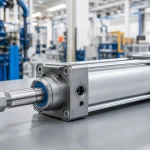
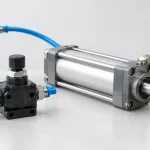
For pneumatic automation, also separate control faults from air-side faults. A PLC can confirm that it has energized a valve output, but it cannot compensate for insufficient supply pressure, contamination, a pinched tube, excessive cylinder side load, or a blocked exhaust. Build feedback into the machine where it protects uptime: pressure monitoring, cylinder position sensing, valve diagnostics, and clear alarm logic turn a vague “motion fault” into a serviceable condition.
Choose the Controller That Keeps the Machine Serviceable
The best control platform is the one that supports the machine’s required performance without creating a maintenance burden the operation cannot sustain. A microcontroller can be the precise, cost-efficient core of a purpose-built subsystem. A PLC can be the practical control backbone for equipment that must be wired, modified, diagnosed, and returned to production quickly.
When the application includes multiple pneumatic circuits, field devices, and changing production requirements, favor an architecture that makes faults visible and expansion manageable. The controller should help the next technician solve the problem, not merely prove that the original machine could run.