A clogged coalescing filter rarely announces itself with a shutdown alarm. More often, it shows up as a cylinder that has lost speed, a valve bank that responds inconsistently, rising compressor energy use, or moisture reaching equipment that normally runs dry. Deciding when to replace compressed air filters is therefore not a housekeeping task. It is a direct reliability decision for the pneumatic system and the process it supports.
Calendar-based replacement can work for stable, low-risk applications. In demanding manufacturing environments, however, the correct interval depends on differential pressure, inlet air quality, downstream sensitivity, operating hours, and the type of element installed. A filter that looks clean can be saturated with oil aerosol. A filter that has not reached its scheduled date can already be restricting flow enough to affect production.
When to Replace Compressed Air Filters
The most dependable replacement trigger is differential pressure across the filter. As the element captures particulate, oil, and water, resistance rises. That resistance becomes pressure drop, forcing the compressor to work harder and reducing the pressure available to cylinders, grippers, solenoids, and other downstream devices.
For many industrial filter assemblies, an element should be changed when the differential pressure indicator reaches the manufacturer’s recommended limit. A common field threshold is approximately 10 to 15 psi, but the actual limit must follow the filter design and the application. High-flow systems, low-pressure pneumatic circuits, and precision processes may require earlier replacement because even a modest pressure loss can affect cycle time or repeatability.
Do not wait for visible contamination alone. Filter bowls and elements can provide useful visual evidence, particularly on particulate and water-separating stages, but they do not measure restriction or aerosol loading accurately. Differential-pressure monitoring provides a clearer maintenance decision than appearance.
A scheduled interval should still be used as a backstop. If a filter has no differential-pressure indicator, establish a replacement interval based on operating hours, compressor condition, plant air quality, and historical findings. Review that interval after several maintenance cycles rather than treating a generic six- or twelve-month recommendation as a permanent rule.
Signs the Filter Is Affecting Production
Filter restriction and filter failure can appear differently depending on where the unit sits in the air preparation train. A main-line filter may create plant-wide pressure instability. A point-of-use filter may affect only one machine, which can make the root cause harder to identify.
Watch for these operating signals:
- A growing pressure difference between the filter inlet and regulator outlet under normal flow.
- Slower cylinder extension or retraction, weak clamping force, or inconsistent actuator speed during peak demand.
- Frequent regulator adjustments to maintain the same machine pressure.
- Oil, water, or particulate contamination downstream of a filter that should be controlling it.
- Shortened service life in solenoids, vacuum generators, pneumatic tools, or precision valves.
These symptoms do not automatically mean the element is the only fault. An undersized FRL, restricted tubing, excessive demand, leaking fittings, or a failing compressor can produce similar behavior. The key is to measure pressure upstream and downstream of the filter while the equipment is operating at realistic flow. Static pressure readings often hide a restriction that becomes severe only during a fast machine cycle.
Replace Immediately After an Upset Condition
Certain events justify an immediate inspection and often a filter replacement, even when the element is not at its normal service interval. Compressor lubricant carryover, desiccant dust release from a dryer, a failed separator, intake filter damage, or a major piping repair can load an air filter quickly.
This is especially relevant where compressed air serves paint equipment, instrumentation, food-contact packaging machinery, electronics assembly, or vacuum handling systems. In these applications, contamination may create rejected product before it creates an obvious pneumatic fault. Replacing an element after an upstream upset is usually less costly than tracing a quality issue through finished production.
Match the Replacement Decision to Filter Type
Not every compressed air filter fails in the same way. Treating all stages as interchangeable leads to poor maintenance decisions.
Particulate filters capture pipe scale, rust, compressor debris, and solid contaminants. They generally show increasing pressure drop as they load. If particulate reaches downstream valves or cylinders, inspect the element, but also investigate the source. Repeated debris loading can indicate corroded distribution piping, damaged compressor intake filtration, or construction activity near an open air line.
Coalescing filters remove fine oil aerosols and small particles. Their elements may look relatively clean while their internal media is loaded. They should be protected by an upstream particulate stage when the air supply carries significant solids. Installing only a fine coalescing filter where bulk contamination is present can create a short replacement cycle and unnecessary operating cost.
Activated carbon filters address oil vapor and odor. Their replacement interval is not determined by differential pressure alone because vapor adsorption capacity can be depleted without a major restriction increase. Replace carbon elements according to expected vapor load, compressor lubricant type, operating hours, and contamination requirements. If odor, vapor-sensitive product defects, or downstream process concerns appear, do not assume the element is still effective simply because airflow is unrestricted.
Water separators and automatic drains require their own attention. A drain that sticks closed can allow collected condensate to re-enter the air stream. A drain that sticks open wastes compressed air continuously. During filter service, verify drain operation and inspect the bowl, seals, and threads for damage.
Build a Replacement Strategy Around Air Quality and Risk
The right maintenance plan begins with the air quality required at the point of use, not with a single replacement date for the entire facility. A blast cabinet, an actuator driving a conveyor stop, and a precision dispensing machine should not necessarily receive the same filtration level or maintenance attention.
Start by documenting each filtration stage: its micron rating, flow capacity, pressure rating, element type, installed date, and whether it has a differential-pressure indicator. Then identify what is downstream. Equipment with small internal passages, tight positioning tolerances, contamination-sensitive product, or costly downtime should receive closer monitoring.
For critical stations, install differential-pressure indication where practical and record readings at normal production flow. Trend data is valuable because it shows whether the filter is loading gradually or whether a sudden upstream problem has changed the system. A sharp increase in pressure drop is a diagnostic signal, not just a replacement reminder.
It also helps to keep a small inventory of the correct replacement elements, bowl seals, and drain repair parts for critical air preparation units. Using a substitute element with an unknown rating, poor fit, or inadequate chemical compatibility can compromise filtration performance. Verify the replacement part against the filter housing model, required air quality, flow demand, and operating environment.
Avoid the Two Common Replacement Mistakes
The first mistake is changing elements too late. This raises energy consumption, creates localized pressure starvation, and permits contamination risk to grow. In systems that use multiple filters, a neglected upstream stage can overload every component downstream of it.
The second mistake is replacing filters too early without investigating why the interval is short. Premature changes may mask an underlying compressor problem, excessive oil carryover, poor condensate management, damaged piping, or a filter assembly that is undersized for actual flow. The replacement element restores performance temporarily, but the system continues consuming maintenance budget and compressed-air capacity.
Filter sizing deserves particular scrutiny when production expands. A filter selected for an original machine flow rate may become a restriction after additional actuators, vacuum devices, or blow-off stations are added. Check flow ratings at real operating pressure, not just the largest number printed in a catalog. Pressure-drop performance varies with inlet pressure and demand.
Service Filters Without Introducing Contamination
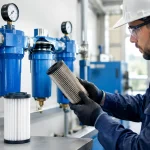
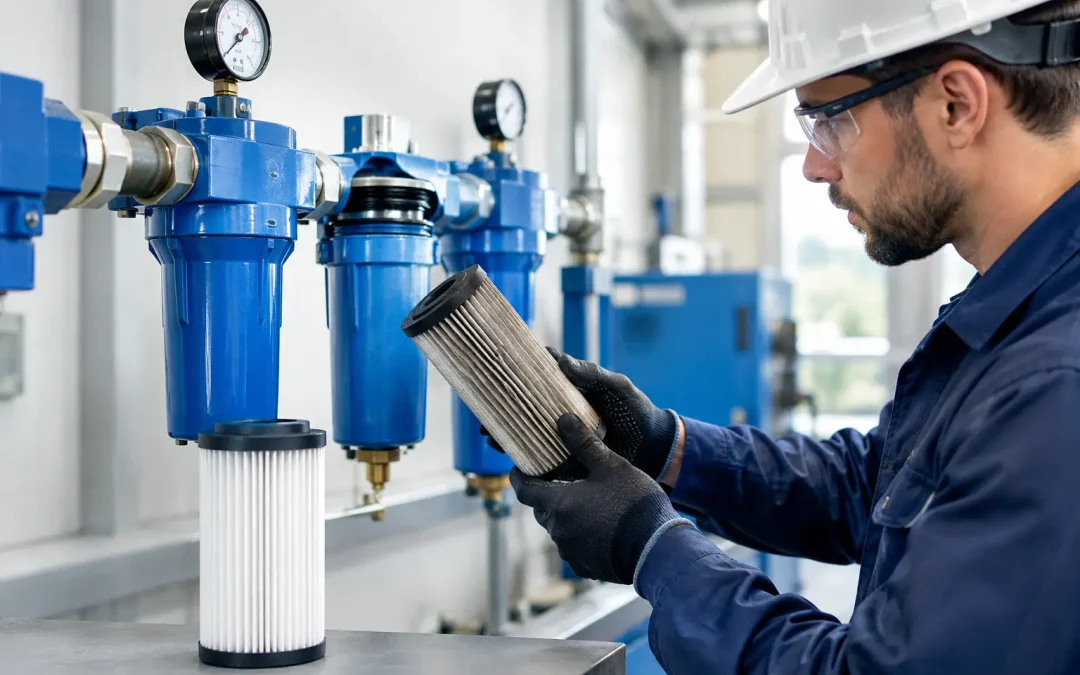
Before opening an air preparation assembly, isolate the air supply and fully depressurize the housing. Follow plant lockout procedures where required. Remove the bowl and element carefully, then inspect O-rings, bowl threads, drain connections, and any internal baffles for wear or damage.
Clean reusable components only with materials compatible with the housing and seals. Do not use shop rags that shed fibers, and do not apply lubricants to filter media unless the manufacturer specifically directs it. Install the correct new element, confirm that seals are seated, restore pressure gradually, and check for leaks.
After service, record the date, differential pressure if available, and any contamination observed. That small amount of documentation turns routine filter replacement into useful reliability data. Over time, it helps maintenance teams predict service needs, identify deteriorating compressor performance, and specify air preparation equipment that matches real plant demand.
Compressed air filters are inexpensive compared with the valves, actuators, controls, and production time they protect. Replace them based on measured restriction and application risk, then use every unexpected change interval as a reason to inspect the air system behind it.