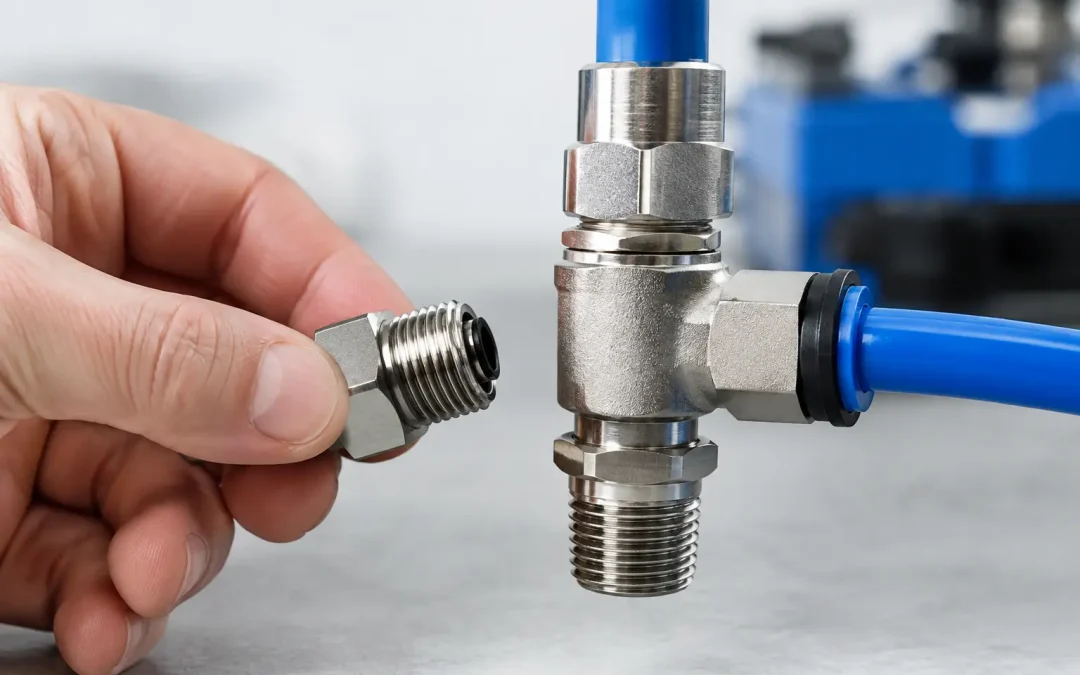
A fitting that starts easily can still be the wrong fitting. That is the costly reality behind pneumatic fitting thread identification in maintenance shops, OEM assembly lines, and field repairs. A near match may hold pressure briefly, then leak under vibration, damage a valve manifold port, or create a failure that appears weeks after startup.
For pneumatic systems, thread identification is not an administrative detail. It is a pressure-containment and uptime decision. Before a technician reaches for thread sealant or applies torque, the port standard, thread form, and sealing method must agree. This guide focuses on the checks that prevent the most common and expensive thread-matching mistakes.
Why pneumatic fitting thread identification fails in the field
The usual problem is not a completely unknown fitting. It is a fitting that looks familiar. NPT, BSPT, BSPP, metric, and SAE-style straight threads can overlap enough in outside diameter or pitch to invite an incorrect connection. A 1/4-inch port designation also does not describe a simple 0.250-inch thread diameter, which adds another layer of confusion when measurements are taken without a reference.
Thread size alone never identifies a fitting. A correct callout needs three answers: Is the thread tapered or parallel? What is the pitch or threads-per-inch count? Where does the connection seal? Those answers matter more than the hex size, tubing size, or nominal port label stamped on a component.
A male tapered pipe thread seals by interference as the threads tighten. A parallel thread commonly seals with an O-ring, bonded seal, face seal, or gasket at a defined surface. Installing a parallel-thread fitting into a tapered port, or the reverse, can produce a connection that feels tight but has no reliable sealing geometry.
Start with the port, not the fitting
When replacing a failed elbow, flow control, regulator connection, or solenoid valve adapter, identify the female port first. The port controls what can safely be installed. Measuring only the removed fitting risks repeating an earlier installation error.
Clean the port carefully before inspection. Old PTFE tape, anaerobic sealant, corrosion, and thread damage can obscure the shape of the first threads. Then use a caliper to measure the major diameter at the opening and, where accessible, farther into the port. On a tapered thread, the diameter changes gradually with depth. On a parallel thread, it remains essentially constant.
Next, use a thread pitch gauge. For inch-series threads, read threads per inch. For metric threads, identify the distance from one thread crest to the next in millimeters. Do not estimate pitch by eye. The difference between common thread families can be small enough to create a misleading partial engagement.
Finally, inspect the sealing surface. Look for a machined flat face, a spotface for an O-ring, a conical seat, or a thread form designed to seal on the flanks. This step often resolves uncertainty faster than diameter measurement alone.
The thread families most often confused
NPT, or National Pipe Taper, is widely used on North American pneumatic equipment. It is tapered and normally relies on thread interference plus an approved sealant. NPT threads have a 60-degree profile and are measured in threads per inch.
NPTF is also tapered and uses the same basic dimensional relationship as NPT, but its dryseal thread form is intended to deform at the thread crest and root under assembly. In practical pneumatic service, sealant may still be specified by the component manufacturer. Do not assume an NPTF connection should be assembled dry simply because its name includes dryseal.
BSPT, often marked R or PT depending on convention, is a tapered pipe thread with a 55-degree Whitworth profile. It is common on equipment built for international markets. It is not interchangeable with NPT, even where the nominal size and apparent diameter look close.
BSPP, commonly identified as G thread, is parallel. It generally requires a seal at the face or under the fitting shoulder, not in the thread itself. A BSPP male fitting may use a bonded seal against a flat female port, while other configurations use an O-ring or a dedicated seat.
Metric parallel threads are frequent on compact valves, cylinders, sensors, and imported automation assemblies. An M10 x 1.0 fitting, for example, identifies a 10 mm major diameter and 1.0 mm pitch. The sealing method still must be confirmed, because a metric thread may use an O-ring, gasket, cone, or face seal.
SAE straight-thread ports are also common in fluid power hardware. SAE O-ring boss connections use straight UN threads and seal with an O-ring in a groove near the male-thread shoulder. The threads provide retention, while the O-ring provides the pressure seal. Adding tape to these threads does not correct a damaged or missing O-ring.
| Thread family | Thread form | Typical sealing method | Common field risk | |—|—|—|—| | NPT | Tapered, 60-degree | Thread interference with sealant | Mistaking it for BSPT | | BSPT/R | Tapered, 55-degree | Thread interference with sealant | Forcing into an NPT port | | BSPP/G | Parallel, 55-degree | Face seal, washer, or O-ring | Expecting threads to seal | | Metric | Usually parallel | O-ring, gasket, cone, or face seal | Confusing pitch with inch TPI | | SAE O-ring boss | Parallel UN thread | O-ring at port face | Using tape instead of an O-ring |
Measure, gauge, and confirm the sealing method
A disciplined identification process takes only a few minutes and prevents an expensive manifold or valve replacement. Use a caliper for diameter, a dedicated thread gauge for pitch, and a thread identification chart or reference sample for comparison. For high-value assemblies, plug gauges and ring gauges provide the strongest confirmation.
Avoid relying on a fitting’s packaging or a previous technician’s label when the connection is critical. Mixed equipment fleets often accumulate adapters over time, and an incorrectly labeled replacement can move from crib stock to a production line without anyone noticing.
If a port is shallow, damaged, or inaccessible, identify the component part number and verify the original manufacturer specification. This is especially useful for compact pneumatic valve islands, air preparation units, and specialty actuators where port geometry may include proprietary sealing details.
A practical bench check before installation
A correctly matched fitting should hand-start smoothly without cross-threading. Tapered threads will become progressively resistant as engagement increases, but they should not bind immediately. Parallel threads should screw in freely until the seal or shoulder approaches its mating surface.
Never use a wrench to make a doubtful thread fit. Wrench force can cut new, incorrect thread paths into softer aluminum valve bodies and regulator housings. The result may be a port that no longer accepts the proper fitting consistently.
After installation, pressure-test the assembly at the application operating pressure. For production equipment, test under realistic conditions: vibration, actuator cycling, temperature changes, and pressure pulses can expose a mismatch that a static soap-bubble check misses. A small leak at a fitting can also become a significant compressed-air energy loss over continuous operation.
Sealant is not a substitute for correct threads
PTFE tape and liquid thread sealants have a defined role on tapered threads, but they cannot compensate for mismatched standards, damaged crests, or an absent face seal. They also require application discipline. Excess tape can shred during assembly and enter solenoids, flow controls, or pilot passages, causing intermittent pneumatic faults that are difficult to trace.
For tapered pneumatic threads, apply the approved sealant sparingly and keep the first thread free of tape or compound where possible. Follow the fitting and component manufacturer’s torque guidance rather than tightening until the fitting points in the desired direction. If directional orientation is required, use a fitting design that supports adjustment or select the correct seal and assembly method for that port.
For BSPP, metric face-seal, and SAE O-ring boss connections, inspect the O-ring or washer condition before installation. Replace flattened, cut, hardened, or chemically swollen seals. A new fitting will not perform as designed if the sealing element is compromised or the port face is scratched.
Build thread control into maintenance and purchasing
The strongest long-term fix is to standardize identification at the point of use. Mark machine documentation with port standards, keep thread gauges in maintenance kits, and separate visually similar fittings in stock locations. Procurement teams should specify thread family, size, material, seal type, and tubing connection style on purchase requests rather than ordering a generic “1/4-inch air fitting.”
For OEMs and integrators, choosing a consistent port strategy across machine platforms simplifies service, reduces adapter count, and limits emergency substitutions. There are valid reasons to support multiple standards – customer requirements, export markets, or legacy equipment – but each added thread family needs clear documentation and controlled inventory.
VidoAir supports pneumatic component selection with catalog-driven specifications and technical support for demanding automation applications. When a port standard is uncertain, supplying measured dimensions, clear photos of the port and fitting, operating pressure, and the sealing arrangement gives the fastest path to an accurate replacement.
A fitting is inexpensive. A damaged manifold, an unplanned air leak, or a delayed production restart is not. Treat thread identification as part of the assembly specification, and every replacement fitting becomes a controlled repair rather than a calculated gamble.