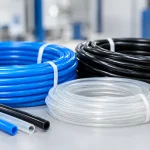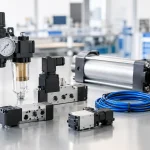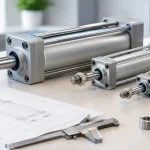
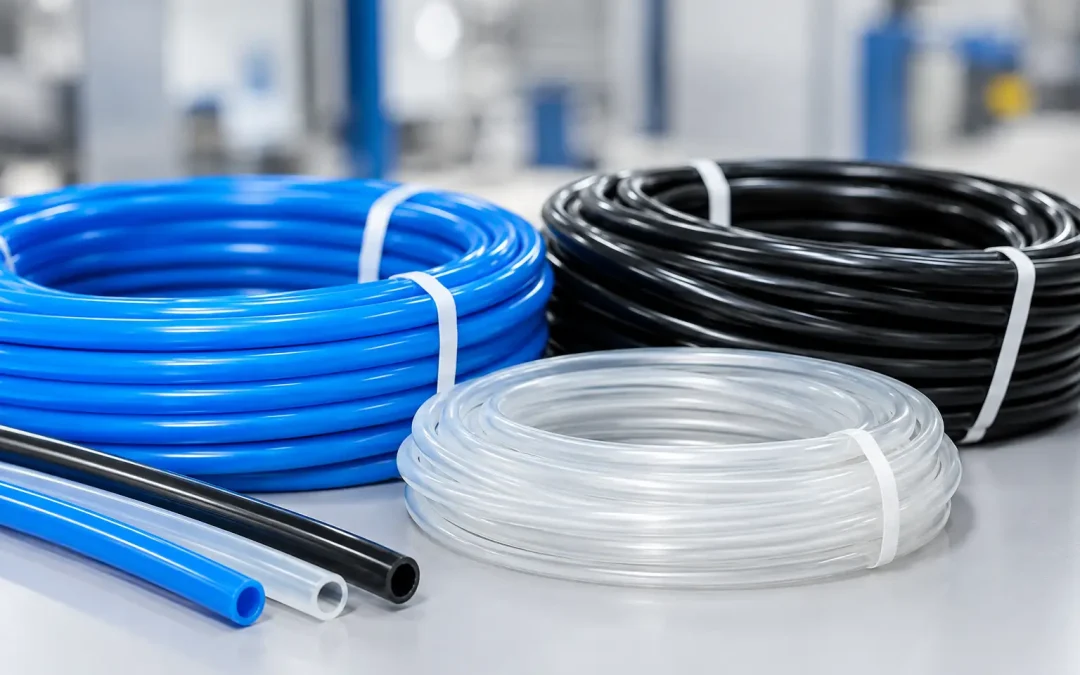
A tubing failure rarely starts at the tubing. It starts with a material selected only by outside diameter, then exposed to heat, oil mist, repeated motion, washdown chemicals, or a fitting that bites too deeply. Selecting the best industrial pneumatic tubing materials means matching the polymer to the real operating environment, not just choosing what is available in the maintenance crib.
For OEMs, automation integrators, and maintenance teams, tubing affects more than air delivery. It influences cycle consistency, leak rates, routing time, machine appearance, service intervals, and the ability to keep replacement parts standardized across a plant. The right choice is usually straightforward once pressure, temperature, movement, media exposure, and fitting style are evaluated together.
Best Industrial Pneumatic Tubing Materials by Application
No single tubing material is best for every pneumatic circuit. Polyurethane, nylon, polyethylene, PTFE, and PVC each solve different problems. The performance gap becomes obvious in demanding equipment, where a low-cost tubing choice can create frequent leaks, restricted flow, or premature failure.
Polyurethane tubing for motion and tight routing
Polyurethane, often called PU tubing, is the standard choice for many automation systems because it combines flexibility with good abrasion resistance. It routes easily through cable carriers, around actuator assemblies, and inside compact machine frames. Its smaller bend radius helps technicians create clean installations without kinking a line or imposing side load on a push-to-connect fitting.
PU performs well on pick-and-place units, robotic end effectors, pneumatic grippers, slide tables, and other applications with repeated movement. It also holds up well against incidental contact with machine surfaces. For equipment that cycles constantly, flex life often matters more than maximum pressure rating, and polyurethane is usually the better starting point.
The trade-off is that PU tubing generally has lower pressure and temperature capability than nylon. It can also be less suitable where aggressive chemicals, high heat, or certain oils are present. Verify compatibility with the actual lubricant, cleaner, coolant, or vapor in the area rather than assuming all polyurethane formulations perform alike.
Nylon tubing for higher pressure and heat
Nylon tubing is firmer than polyurethane and is typically selected where higher working pressure, elevated temperature, and improved resistance to many oils are needed. It is common on heavy equipment, industrial machinery, truck and transportation systems, and pneumatic circuits located near warmer process equipment.
Its stiffness can be an operational advantage. Nylon maintains its shape well on long straight runs and is less likely to sag or rub against surrounding components. That makes it a practical choice for organized panel routing and fixed machine plumbing.
However, nylon requires more attention during installation. It has a larger minimum bend radius than polyurethane and can become more difficult to route in confined spaces. Moisture absorption can also affect dimensional stability and physical properties over time. In a highly dynamic cable-track application, a softer tubing material may deliver longer service life even if nylon offers a stronger pressure rating.
Polyethylene tubing for economical air and fluid lines
Polyethylene, particularly linear low-density polyethylene, is widely used for general-purpose pneumatic and low-pressure fluid handling. It is lightweight, economical, and chemically resistant to many common substances. It works well for static air lines, water circuits, beverage equipment, laboratory setups, and installations where frequent motion is not expected.
Compared with PU, polyethylene is more rigid and less abrasion-resistant. It is not the preferred material for continuous flexing or sharp routing around moving actuators. It also has lower temperature capability than nylon and fluoropolymer materials. Still, for straightforward static connections where cost control matters, polyethylene can be a highly effective option.
PTFE and fluoropolymer tubing for heat and chemical exposure
PTFE tubing is built for the environments that defeat conventional pneumatic tubing. It offers excellent chemical resistance, broad temperature capability, low friction, and very low surface energy. This makes it a strong material choice for chemical processing, analytical equipment, high-temperature zones, semiconductor-related processes, and applications involving aggressive media or cleaning agents.
The same qualities that make PTFE valuable also affect installation. It is relatively stiff, more expensive, and can be harder to seal consistently with fittings designed around softer tubing. Tube support sleeves, carefully matched fittings, and correct insertion depth are especially important. If flexibility is required alongside chemical resistance, FEP or PFA may be evaluated depending on the specific temperature, pressure, and transparency requirements.
For ordinary shop air, PTFE is often more material than the application needs. Its value appears when the cost of a chemical compatibility failure, contamination event, or heat-related shutdown outweighs the higher tubing cost.
PVC tubing for low-pressure utility service
PVC tubing remains useful for selected low-pressure air, water, drain, and general utility applications. It is easy to identify, readily available in many configurations, and can be a practical choice where the environment is controlled. Clear PVC also helps technicians observe fluid movement or contamination in certain noncritical lines.
It should not be treated as a universal pneumatic solution. PVC can stiffen in cold conditions, may not tolerate repeated flexing well, and can have limitations with oils, solvents, and elevated temperatures. For a production machine with fast motion and high uptime requirements, polyurethane or nylon is generally the more dependable choice.
Material Selection Must Start With the Actual Duty Cycle
Pressure rating is essential, but it is only one part of the specification. A line running at 100 psi in a stationary, climate-controlled enclosure has little in common with a 100 psi line flexing thousands of times per shift near a heated washdown process.
Start with the maximum working pressure, including regulator failures, compressor surges, and pressure spikes created by fast valve switching. Then apply the manufacturer’s temperature derating data. Tubing pressure capability drops as temperature rises, and this is a common source of under-specified installations.
Next, consider movement. Repeated bending, twisting, rubbing, and vibration generally favor polyurethane. Fixed high-pressure routing often favors nylon. Chemical exposure and extreme temperature conditions may justify PTFE or another fluoropolymer. Static, economical utility runs may be well served by polyethylene.
The inside diameter also deserves closer attention. Undersized tubing restricts flow, slows actuator response, and can create inconsistent cylinder speed. Increasing supply pressure may appear to solve the problem, but it can raise air consumption and mask the real restriction. On fast-cycling cylinders, valve flow capacity, fitting bore, tubing ID, and run length should be evaluated as one system.
Fittings Can Determine Whether Good Tubing Performs Well
Push-to-connect fittings simplify installation, but they are not universally interchangeable with every tubing material. Tube outside diameter tolerances, hardness, surface finish, and wall thickness all affect grip and sealing performance. A tube that feels secure during installation can leak after vibration, temperature cycling, or repeated side loading.
Use tubing with a clean, square cut. An angled or crushed end can damage the fitting seal or prevent full insertion. Avoid routing that pulls the tubing sideways at the fitting body, especially at moving cylinders and guided actuators. Where movement cannot be avoided, add proper support, provide enough service loop, or use a swivel connection designed for the motion.
For high-pressure nylon and fluoropolymer applications, confirm that the fitting is rated for the tubing material, wall construction, and operating conditions. A fitting rated for general pneumatic service may not be the right answer for high heat, vacuum, chemicals, or specialized process media.
Common Tubing Failures and What They Reveal
A line that repeatedly pops out of a fitting may point to incorrect tubing tolerance, insufficient insertion depth, a damaged collet, or pressure beyond the fitting’s rating. Replacing the same segment with the same material will not correct the root cause.
Cracking near a bend usually indicates that the bend radius is too tight, the tubing is too rigid for the motion, or heat has accelerated material aging. Surface wear and pinholes often show that the line is rubbing against machine guards, structural edges, or moving cable bundles. In those cases, rerouting and clamping are as important as changing tubing material.
A system with slow cylinders and inconsistent end-of-stroke performance may have a flow issue rather than a valve issue. Check for tubing that is too small, runs that are too long, restrictive elbows, or water and oil contamination in the air supply. Proper air preparation protects tubing, seals, valves, and actuators from the inside out.
Specify for Serviceability, Not Just Initial Assembly
The strongest tubing specification is one that maintenance can identify and replace correctly at 2 a.m. Standardize colors by function where practical, document tubing OD and ID, and avoid mixing visually similar materials without clear labeling. A transparent polyethylene line and a clear polyurethane line may look alike, but their pressure, temperature, and flex performance can be very different.
For critical equipment, keep a defined material standard for each duty: flexible motion lines, fixed high-pressure lines, chemical-exposed lines, and low-pressure utility circuits. This approach reduces substitution errors and helps purchasing maintain the right inventory without carrying every tubing type in every size.
VidoAir supports this kind of application-based selection with pneumatic tubing, fittings, air preparation, and motion components that can be matched around the demands of the complete circuit. Specify the material for the environment it will see after installation, and the tubing becomes a reliable part of machine performance rather than the next source of downtime.