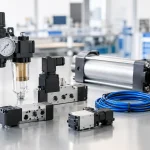
A cylinder that drifts at the end of stroke, a valve bank that runs hot, or a pressure drop that appears only during peak production can stop an otherwise capable machine. Choosing the best electro pneumatic components is not about selecting the highest specification on a catalog page. It is about matching air quality, load, response time, duty cycle, electrical controls, and maintenance access to the actual operating conditions.
For OEMs, integrators, and plant teams, the right component set delivers repeatable motion without adding unnecessary cost or troubleshooting time. The wrong set may function during commissioning, then create slow cycles, inconsistent clamping force, valve failures, and hard-to-find leaks once production demand increases.
What Makes Electro Pneumatic Components the Best Fit?
The best fit depends on the motion and control problem being solved. A high-cycle packaging machine needs fast switching and compact valve manifolds. A washdown food or chemical process area may require stainless steel air preparation equipment and corrosion-resistant fittings. A heavy fixture may need a larger bore actuator, controlled cushioning, and a valve sized for the required flow rather than the port size alone.
Electro-pneumatic systems combine compressed-air power with electrical command and feedback. Their performance is determined by the complete circuit: air preparation, tubing, fittings, valves, actuators, sensors, wiring, and the PLC or other controller. A premium cylinder cannot compensate for undersized tubing, contaminated air, or a restrictive regulator.
When evaluating components, prioritize repeatability under load, cycle-life expectations, available flow, pressure stability, environmental resistance, and replacement availability. Those factors matter more than a low initial unit price when downtime carries a real production cost.
Best Electro Pneumatic Components by System Function
Directional solenoid valves and valve manifolds
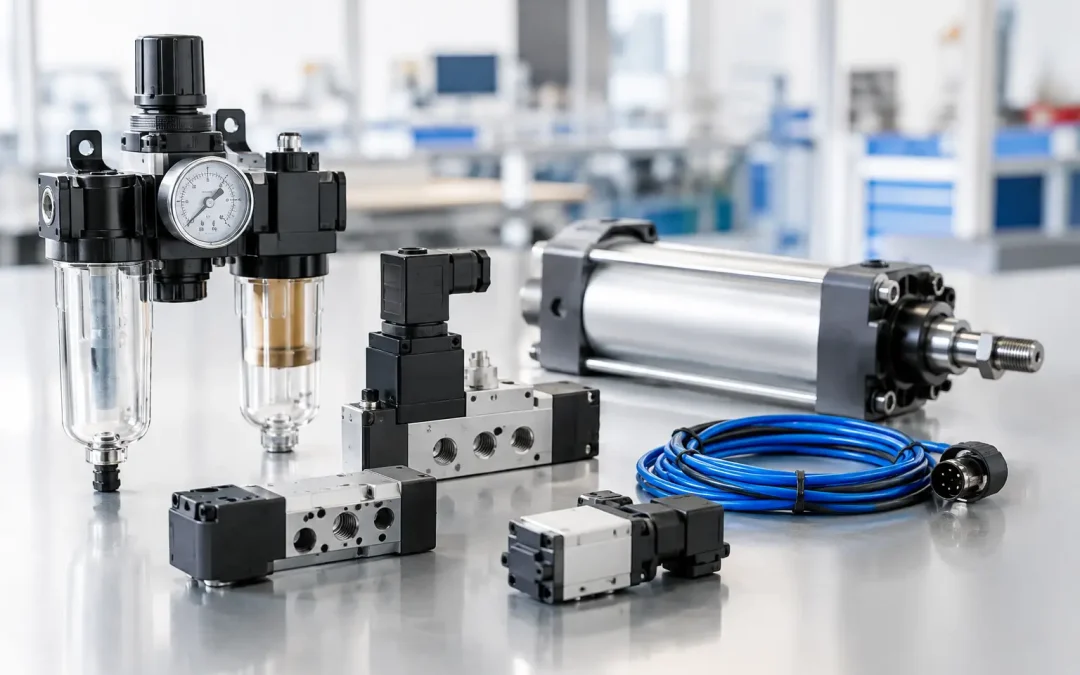
Directional control valves are the switching center of an electro-pneumatic circuit. For double-acting cylinders, 5-port, 2-position and 5-port, 3-position valves are common choices. The center condition on a 3-position valve deserves careful attention. A closed center can hold a cylinder in place under certain conditions, while an exhaust center can remove air pressure for a safer or faster return behavior. Neither option is automatically better.
Valve flow capacity should be matched to the cylinder volume and required stroke time. A valve that is too small creates slow extension and retraction, especially when long tubing runs add restriction. A valve that is excessively large can raise cost and may make motion harder to control without appropriate flow controls.
Manifold-mounted valves are often the better choice for multi-axis equipment because they reduce tubing, simplify electrical connections, and make troubleshooting more organized. For machines with frequent design changes, modular manifolds also support easier expansion. Individual valves can still be practical for isolated functions, remote cylinders, or harsh areas where local replacement access is more important than centralized packaging.
Pneumatic actuators matched to real load conditions
Standard double-acting cylinders remain a dependable choice for linear motion, clamping, part ejection, and gate control. The best actuator selection starts with force calculations, but it should not end there. Engineers should account for friction, side loading, breakaway force, pressure loss during simultaneous movements, and the effects of a changing load.
Rodless cylinders, guided cylinders, slide table actuators, and compact cylinders solve different packaging and support problems. A rodless design can provide a long stroke in a shorter overall machine envelope. A guided or slide table actuator helps when the load must resist moment forces and maintain positional stability. Mounting a side-loaded carriage directly to a basic rod cylinder may appear economical, but it often shortens seal and bearing life.
Cushioning also affects component life. Adjustable pneumatic cushions reduce end-of-stroke impact, while external shock absorbers may be needed for higher speeds, larger masses, or strict cycle-time demands. If a cylinder slams at the end of travel, increasing pressure is rarely the correct fix.
Air preparation units that protect every downstream part
Air contamination is one of the most common reasons valves stick, seals wear early, and proportional control becomes inconsistent. A properly selected filter, regulator, and lubricator arrangement protects the entire pneumatic system, although lubrication should only be used where component specifications call for it. Adding oil to a system built for non-lubricated operation can create its own maintenance complications.
Select filtration based on the contamination risk and application sensitivity. General plant air may need particulate filtration and stable regulation. Instrument-quality or precision-control circuits may require finer filtration and moisture management. Refrigerated or desiccant drying may be necessary when condensation is likely in long lines, outdoor equipment, or temperature-changing environments.
Regulator sizing is frequently overlooked. A regulator that maintains static pressure but cannot supply adequate flow during cylinder movement causes pressure sag. The result is reduced force, changing stroke speed, and inconsistent machine performance. Place gauges where technicians can verify actual downstream pressure rather than assuming the compressor setting reflects conditions at the actuator.
Tubing, fittings, and flow controls
Tubing and fittings are often treated as commodity hardware, yet they directly influence response time and leak rate. Tube material must suit temperature, chemical exposure, flexibility requirements, and routing conditions. Polyurethane tubing is commonly chosen where flexibility is valuable, while nylon can suit applications requiring greater stiffness or higher temperature capability. The correct choice depends on the equipment environment and bend radius, not preference alone.
Use fittings that are compatible with the tubing outside diameter and thread standard, then make installation repeatable. Poorly cut tubing, stressed connections, and over-tightened threaded fittings are recurring sources of compressed-air loss. In a high-cycle machine, short and properly sized air paths improve response more effectively than trying to tune around restrictive plumbing.
Meter-out flow controls are widely used to control cylinder speed because they provide more stable motion with varying loads. Meter-in control can be appropriate in certain cases, but it can allow uncontrolled motion when a load assists the cylinder. Verify the load direction before deciding where to restrict flow.
Position sensing and electrical integration
Reed switches and solid-state cylinder sensors provide the feedback needed for sequence control, fault detection, and safe coordination with conveyors, robots, or other axes. Sensor selection must match the cylinder’s magnetic piston arrangement, mounting geometry, supply voltage, and PLC input type.
For demanding machinery, consider how the sensor and cable will survive vibration, coolant, weld spatter, and repeated flexing. A sensor that is technically compatible but difficult to adjust or poorly protected becomes a recurring service problem. Standardizing connector styles and input logic across a machine family can also reduce commissioning and spare-part complexity.
A Practical Selection Check Before Release
Before approving a bill of materials, review the complete circuit under worst-case conditions. The following checks catch many of the issues that later become startup delays:
- Confirm actuator force at the minimum available pressure, not nominal compressor pressure.
- Size valves, regulators, tubing, and fittings for required flow and acceptable pressure drop.
- Check valve voltage, connector style, PLC output capacity, and suppression requirements.
- Define the air cleanliness and moisture-control level for the operating environment.
- Verify mounting, sensor access, replacement clearance, and expected maintenance intervals.
This review is especially valuable when multiple actuators move at once. A system can appear properly sized when one cylinder cycles independently, then lose force when several stations demand air at the same time.
Common Problems That Point to a Component Mismatch
Slow cylinder motion usually traces back to insufficient flow, a restrictive exhaust path, undersized tubing, or a regulator that cannot hold pressure dynamically. Inconsistent end positions can indicate poor sensing, inadequate mechanical guidance, unstable pressure, or a load that exceeds the cylinder’s usable force margin.
Frequent solenoid failure deserves a closer look than simply replacing the coil. High ambient temperature, incorrect voltage, water ingress, voltage drop, or duty cycle beyond the coil rating can all be involved. Likewise, repeated fitting leaks may point to tubing stress and poor routing rather than a defective fitting design.
The most effective correction is usually system-level. Replace the component that is limiting performance, but also correct the condition that caused it to be overstressed.
Build for Serviceability, Not Just Initial Assembly
The strongest electro-pneumatic designs make routine service fast and predictable. Use valve manifolds with clear station identification, mount regulators where gauges can be read, provide enough tubing slack for maintenance without creating loops that restrict flow, and make sensors accessible for adjustment.
VidoAir supports this approach with factory-direct pneumatic components, electro-pneumatic controls, and configured solutions for equipment builders and industrial operations that need performance without extended sourcing delays. Whether the requirement is a replacement valve or a complete motion-and-air-management package, component compatibility should be evaluated as one circuit.
A well-specified electro-pneumatic system gives technicians clear signals when something changes: pressure readings remain meaningful, motion remains repeatable, and replacement parts fit without improvisation. That is the standard worth designing toward.