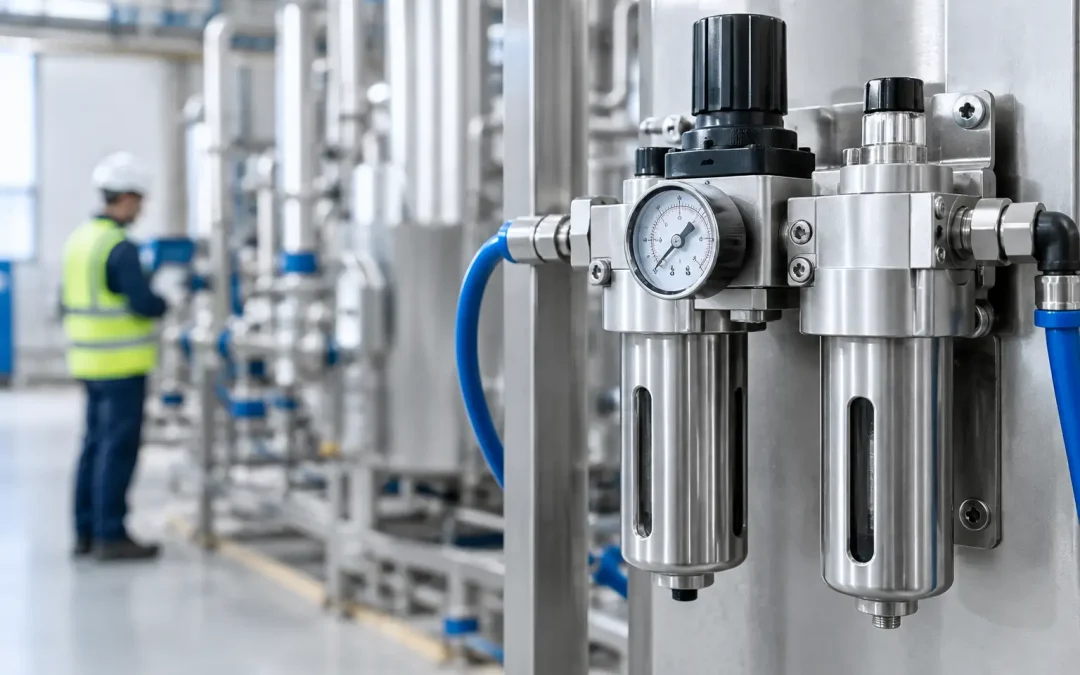
A corroded filter-regulator-lubricator assembly rarely fails at a convenient time. It starts as staining around a drain, a sticking adjustment knob, or a pressure gauge that no longer reads consistently. In wet, washdown, coastal, food, chemical, and outdoor environments, the question is not simply why use stainless steel air prep, but whether a standard zinc or aluminum unit can remain reliable long enough to protect the pneumatic equipment downstream.
Stainless steel air preparation equipment is specified when compressed air quality and component survival must hold up under environmental exposure. The initial purchase price is higher than that of standard FRL hardware, but the right specification can prevent recurring replacements, unstable pressure, contamination concerns, and unplanned downtime.
Why Use Stainless Steel Air Prep for Critical Pneumatic Systems?
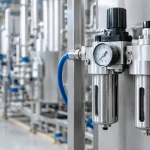
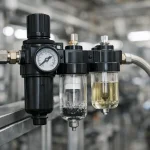
Air prep equipment sits at a vulnerable point in a pneumatic system. Filters remove particulate and liquid water, regulators establish usable downstream pressure, and lubricators supply oil where older or specialized components require it. Because these units are often installed near machinery, they are exposed to the same wash chemicals, humidity, temperature swings, dust, vibration, and operator contact as the rest of the line.
A stainless body helps preserve the integrity of the air-prep station when those conditions would degrade plated steel, painted components, or standard aluminum assemblies. Corrosion is not only cosmetic. Pitting around threaded ports, bowl retainers, drains, and adjustment mechanisms can create leaks, restrict serviceability, and introduce debris into the air stream.
For an OEM, that durability supports a machine that stays presentable and functional after installation. For a maintenance team, it reduces the chance that a simple filter-element change turns into a seized fitting or a damaged manifold connection. Stainless air prep is especially valuable where access is difficult and a small leak can disrupt cycle time or make pressure troubleshooting unnecessarily complicated.
Resistance to washdown and chemical exposure
Frequent washdown is one of the clearest reasons to specify stainless steel. Food packaging, beverage processing, pharmaceutical support equipment, meat processing, and sanitary material handling systems may be cleaned with water, detergents, foaming agents, or disinfectants that attack conventional finishes over time.
The correct stainless grade matters. Type 304 stainless is a strong general-purpose choice for many wet industrial environments. Type 316 stainless provides better resistance where chlorides, saline air, aggressive cleaners, or certain chemical exposures are expected. A 316 body does not make every component chemical-proof – seals, sight glasses, gauge internals, drains, and bowl materials still require review – but it gives the assembly a better foundation in severe service.
The goal is not to overspecify every pneumatic circuit. A dry indoor assembly area with clean compressed air may gain little from stainless air prep. A washdown conveyor zone or outdoor loading system faces a different operating reality.
More stable protection for downstream components
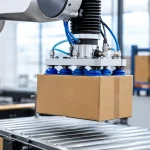
Air cylinders, solenoid valves, vacuum generators, grippers, and position-control devices depend on consistent pressure and cleaner air. When the filter housing, drain, or regulator body deteriorates, the resulting leaks and contamination can show up as sluggish actuators, inconsistent gripping force, short solenoid life, or unexplained pressure loss at the point of use.
Stainless steel air prep does not correct poor compressor sizing or inadequate dryer performance. It does, however, give the local point-of-use treatment station a longer service life in environments that accelerate corrosion. That allows planned maintenance to focus on consumables, such as filter elements and seals, rather than replacing the entire assembly because its exterior and service connections have failed.
Where Stainless Air Prep Earns Its Cost
The best application is one where corrosion resistance protects uptime, product quality, safety, or maintenance access. Stainless air prep is commonly justified on equipment exposed to moisture, frequent cleaning, airborne contaminants, or outdoor weather.
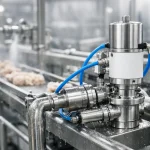
In food and beverage production, a stainless FRL assembly can be installed near packaging, conveying, sorting, and case-handling equipment where routine sanitation is part of normal operations. The specification should still match the cleaning process. High-pressure spray, high-temperature washdown, and chemical sanitation may require protected mounting, compatible accessories, and appropriately rated enclosures for gauges or electrical components nearby.
In chemical processing and wastewater applications, humidity and chemical vapor can corrode standard air-line hardware even when direct washdown is limited. Stainless units help maintain dependable local regulation for valve actuators, dampers, sample systems, and instrument air circuits. Here, engineers should consider 316 stainless when process conditions include chlorides or corrosive chemical exposure.
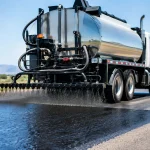
Outdoor machinery presents another practical case. Asphalt equipment, mobile processing equipment, transportation infrastructure, and bulk-material systems may face rain, freeze-thaw cycles, UV exposure, road salt, and airborne dust. Stainless construction reduces one failure mechanism, but it should be paired with proper drainage and mounting orientation. Water that is trapped in a bowl or low point will still create performance problems, regardless of housing material.
Specify the Whole Assembly, Not Just the Body
A stainless label can be misleading if the rest of the assembly is not suitable for the application. Industrial buyers should evaluate every wetted and exposed component, including bowls, guards, drains, seals, gauges, fittings, and mounting brackets.
Polycarbonate bowls offer visibility and are common in general industrial air prep, but they may be incompatible with certain cleaners, oils, solvents, or high-impact environments. Metal bowls or guarded bowl configurations can be the better choice where chemical exposure or physical damage is likely. If visual inspection is necessary, select a design that provides visibility without sacrificing compatibility.
Automatic drains should also be selected carefully. Float drains and electronic drains can reduce manual maintenance, but each has different sensitivity to dirt, flow conditions, and power availability. In dirty or heavily wet systems, upstream water management still matters. An automatic drain cannot compensate for a saturated air dryer or a compressor system that delivers excessive condensate to the point of use.
Pressure range is another frequent oversight. A regulator should operate in the portion of its range where adjustment resolution and flow performance are appropriate for the application. Selecting a 0 to 150 psi regulator for a circuit that must hold 8 to 12 psi precisely may create avoidable control issues. In that case, a low-pressure regulator or a separate precision regulator downstream may be the better engineered solution.
Stainless Steel Air Prep and Compressed Air Quality
Stainless construction improves environmental durability, not filtration performance by itself. Filter grade must be selected based on the air-quality requirement of the equipment being supplied. General pneumatic cylinders may only require particulate and water separation, while sensitive valves, instrumentation, paint processes, vacuum generators, or clean manufacturing operations may need coalescing filtration and lower oil carryover.
Start with the actual contamination source. Compressor oil carryover, pipe scale, rust, water, microbial concerns, and ambient dirt require different treatment approaches. A standard particulate filter captures solids but will not provide the same aerosol removal as a coalescing filter. Likewise, a coalescing filter can become a maintenance burden if it is asked to remove bulk liquid water that should have been handled by upstream separation and drying.
Flow demand must be evaluated at working pressure, not only by the thread size on the unit. A small-port stainless regulator may look adequate on a schematic but create pressure drop when several cylinders cycle at once. Consider peak flow, acceptable pressure loss, line length, valve flow capacity, and the pressure needed at the actuator under load. This is particularly important on high-cycle automation, palletizing equipment, and vacuum pick systems where pressure stability affects repeatability.
Installation Practices That Preserve Performance
Even premium air prep hardware can underperform when installed without attention to condensate flow and service access. Mount filters vertically where the design requires it, keep bowls accessible for inspection, and leave room to remove elements without dismantling nearby tubing. Install a shutoff valve upstream so maintenance can be performed safely and quickly.
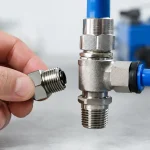
Use compatible stainless fittings where the environment warrants it. Mixing materials is not automatically a problem, but outdoor and wet installations should be reviewed for galvanic corrosion and for the condition of plated adapters, brackets, and fasteners. Apply thread sealant correctly and avoid contaminating the air passage with excess tape or compound.
Set maintenance intervals from actual conditions rather than a calendar assumption. A differential-pressure indicator, drain inspection, pressure-drop trend, and visual checks of seals provide better evidence than replacing elements only because a fixed number of months has passed. Conversely, waiting until a cylinder slows down is too late for equipment that supports production-critical motion.
Make the Specification Match the Environment
Stainless steel air prep is a targeted reliability decision, not a universal upgrade. Standard FRL units remain cost-effective for protected, dry, indoor pneumatic systems with manageable contamination and easy maintenance access. Stainless becomes the better value when corrosion, washdown, chemical exposure, or outdoor service can turn ordinary air prep into a recurring failure point.
For demanding machines, specify the material grade, bowl and seal compatibility, filtration level, drain method, pressure range, and flow capacity as one package. VidoAir can support configured air-prep selections for applications where those details need to work together. The most productive next step is to inspect the current air-prep station after a normal operating cycle: the corrosion, condensate, pressure drop, and service difficulty you find will usually point directly to the right specification.