
A cylinder that begins taking 150 milliseconds longer to extend can be the first warning before a missed pick, a jammed station, or a line stoppage. The most valuable pneumatic predictive maintenance trends focus on catching those small performance changes while there is still time to schedule a repair. For plant teams, the objective is not to add sensors everywhere. It is to identify the pneumatic assets where a developing fault has real consequences for throughput, scrap, safety, energy use, or delivery commitments.
Pneumatic systems have traditionally been maintained through fixed service intervals, technician observation, and corrective repair. That approach remains appropriate for many low-cycle utility circuits. But high-cycle automation equipment, vacuum handling stations, packaging machinery, and remotely located equipment benefit from a more targeted condition-based strategy. The technology is now practical enough to collect meaningful air-system data without turning every machine into a costly data project.
Pneumatic Predictive Maintenance Trends Moving Into Production
The strongest trend is a shift from basic pressure indication to air intelligence. A pressure switch can confirm that supply pressure has reached a setpoint. It cannot explain why a cylinder is slowing down, why air demand is increasing, or why a valve bank is behaving inconsistently during a particular sequence. Modern monitoring combines pressure, flow, temperature, dew point, cycle time, and valve command data to create a clearer operating picture.
This matters because pneumatic faults often develop gradually. Contamination increases friction in a directional control valve. A fitting begins leaking under vibration. A filter element loads up and produces excessive pressure drop at peak demand. Cylinder seals wear, allowing bypass that reduces available force. Each fault can look minor in isolation. Together, they can create intermittent machine behavior that consumes hours of troubleshooting.
Edge Diagnostics Are Replacing Raw Data Collection
Plants do not need a historian filled with millions of unfiltered pressure readings. A growing number of pneumatic monitoring strategies use edge devices, PLC logic, or local controllers to evaluate data near the machine. Instead of transmitting every sample, the system can report an exception: fill time has increased by 12%, average air consumption per cycle has exceeded its baseline, or valve response is outside its normal range.
This approach reduces network load and gives maintenance teams actionable alarms. It also works well for OEMs that want diagnostic capability built into equipment without requiring every customer to adopt a large-scale industrial data platform.
The trade-off is that edge logic depends on a good baseline. A machine running three product sizes, different payloads, or multiple recipes needs operating limits matched to each normal condition. A single universal threshold may create nuisance alarms or conceal a real fault. Engineers should establish baseline data by machine state, product format, and expected production speed.
Flow Monitoring Is Becoming a Practical Leak Tool
Compressed air is expensive, and persistent leakage remains one of the most measurable pneumatic losses. Ultrasonic leak surveys are still valuable, especially for facility-wide audits. Continuous flow monitoring adds a different benefit: it reveals when a specific machine or zone consumes more air than its established pattern.
A rising idle-flow value can indicate a leaking solenoid, damaged tubing, a loose push-to-connect fitting, or an actuator seal that is bypassing internally. Excessive flow during a cycle may point to an incorrectly sized blow-off circuit, a regulator set higher than necessary, or a mechanical condition forcing longer cylinder dwell times.
Flow data is most useful when it is paired with production context. A machine that makes 500 units per hour should not be judged against the air use of a machine making 200. Tracking standard cubic feet per part, or air consumption per completed cycle, produces a more useful maintenance and energy metric.
Cylinder Health Is Measured Through Motion, Not Guesswork
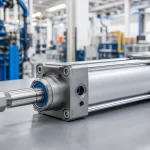
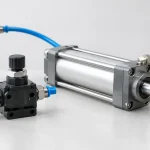
Pneumatic cylinders remain central to predictive maintenance because their behavior is easy to observe and directly tied to machine performance. Position sensing has long been used for end-of-stroke confirmation. The next step is evaluating the time between command, movement, and confirmed position.
A gradual rise in extend or retract time can reveal pressure loss, flow restriction, load changes, guide wear, contamination, or seal degradation. For slide table actuators and guided cylinders, a change in cycle profile may also expose binding or misalignment before it damages bearings and mechanical stops.
Time-based diagnostics should not be treated as a substitute for correct actuator sizing. A cylinder operating near its force limit will naturally be more sensitive to normal supply-pressure variation and load changes. Before setting predictive thresholds, confirm bore size, stroke, cushioning, mounting alignment, tubing diameter, fitting flow capacity, and valve Cv are appropriate for the application.
Valve Signatures Are Gaining Attention
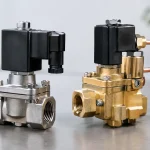
Solenoid valves are increasingly monitored as functional devices rather than simple on-off components. In a well-instrumented circuit, the controller can compare the command signal with pressure response, flow response, or cylinder movement. If the command is present but the expected response is delayed, the fault may be electrical, mechanical, or pneumatic.
A slow response can result from a weak coil, sticky spool, pilot restriction, inadequate pilot pressure, contaminated air, or an exhaust muffler that has become restricted. Monitoring does not eliminate the need for inspection, but it narrows the troubleshooting path. That is valuable on valve manifolds supporting many identical stations, where intermittent faults can otherwise be difficult to isolate.
For safety-related functions, diagnostics must support, not replace, the designed safety architecture. A predictive alert can signal degrading performance, but it should never be assumed to provide the required safety function unless the full system has been engineered and validated for that purpose.
Air Quality Data Is Becoming More Relevant to Reliability
Pressure alone does not define usable compressed air. Water, oil carryover, and particulates shorten the life of valves, cylinders, vacuum generators, and sensitive electro-pneumatic controls. As production lines add smaller passages, high-speed valves, and precision motion, air preparation performance becomes more visible in maintenance data.
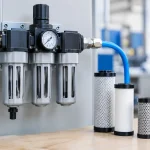
Differential pressure across filters is a practical condition indicator. Rising differential pressure suggests the element is loading and beginning to restrict flow. Dew point monitoring can be justified where moisture causes corrosion, freeze risk, process defects, or contamination concerns. This is especially relevant in refrigeration equipment, outdoor installations, food and packaging environments, and applications with long air distribution runs.
Not every circuit needs continuous dew point measurement. A targeted approach makes more economic sense: monitor the central treatment system, then apply point-of-use filtration and regulation where the application has higher sensitivity. Stainless steel air preparation devices can also be a better fit in washdown or corrosive environments, where housing durability and cleanability affect long-term maintenance requirements.
The Best Programs Start With Failure Modes
Predictive maintenance succeeds when monitoring is tied to known failure modes and clear actions. Adding sensors without a response plan creates more alarms, not more reliability. Start with the stations where an unplanned pneumatic failure stops production, creates quality risk, or requires difficult access.
For each asset, identify what typically fails, what measurable condition changes first, and what a technician should do when the threshold is crossed. A cylinder may be monitored for cycle-time drift. A filter may be monitored for differential pressure. A vacuum pick station may be monitored for evacuation time and achieved vacuum level. A valve manifold may be monitored for command-to-response delay.
Then establish a practical escalation path. A small deviation may trigger a planned inspection during the next maintenance window. A rapid change or an out-of-tolerance process value may require immediate intervention. This prevents teams from treating every alert as an emergency while still protecting critical production assets.
Integration Must Respect the Existing Control System
Many plants already have PLC capacity, spare I/O, and HMI screens that can support condition monitoring. In these cases, adding well-selected pressure, flow, or vacuum sensors may deliver value faster than deploying a separate platform. For more complex equipment, IO-Link devices and networked valve manifolds can add diagnostics while reducing point-to-point wiring.
Compatibility deserves careful review. Confirm sensor output type, pressure range, environmental rating, electrical connector style, response time, and communication protocol before standardizing a component. Also consider replacement availability. A predictive system loses value when a failed sensor requires a long lead time or an extensive redesign to replace.
VidoAir supports this practical approach with pneumatic components, air preparation hardware, solenoids, tubing, fittings, vacuum products, and configured solutions that help engineers address both the monitored symptom and the underlying air-system issue.
The useful future of predictive maintenance is not a dashboard full of colorful trends. It is a maintenance technician receiving a specific, credible signal early enough to correct a restriction, leak, valve problem, or actuator issue before the machine gives production no choice but to stop.