A pneumatic valve that sticks intermittently, a cylinder that slows near the end of stroke, or a solenoid pilot that fails after a washdown shift often points back to air quality. This industrial air filter review focuses on the details that affect those failures: actual flow at pressure, contaminant type, drain performance, pressure drop, and the filter’s fit within the full air preparation assembly.
For industrial buyers, the right filter is not simply the one with the smallest micron rating. A poorly sized fine filter can create damaging pressure loss. An inexpensive bowl material can crack in a chemical environment. And a high-efficiency element without dependable condensate removal will eventually pass water downstream. The correct choice depends on what the equipment is doing, how clean the supply air really is, and what downtime costs the operation.
Industrial Air Filter Review: What Should Be Evaluated?
Start with the compressed-air system rather than the catalog page. The filter’s job is to protect downstream hardware, but its ability to do that depends on installation location, upstream cooling and separation, expected air consumption, and maintenance practices.
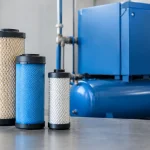
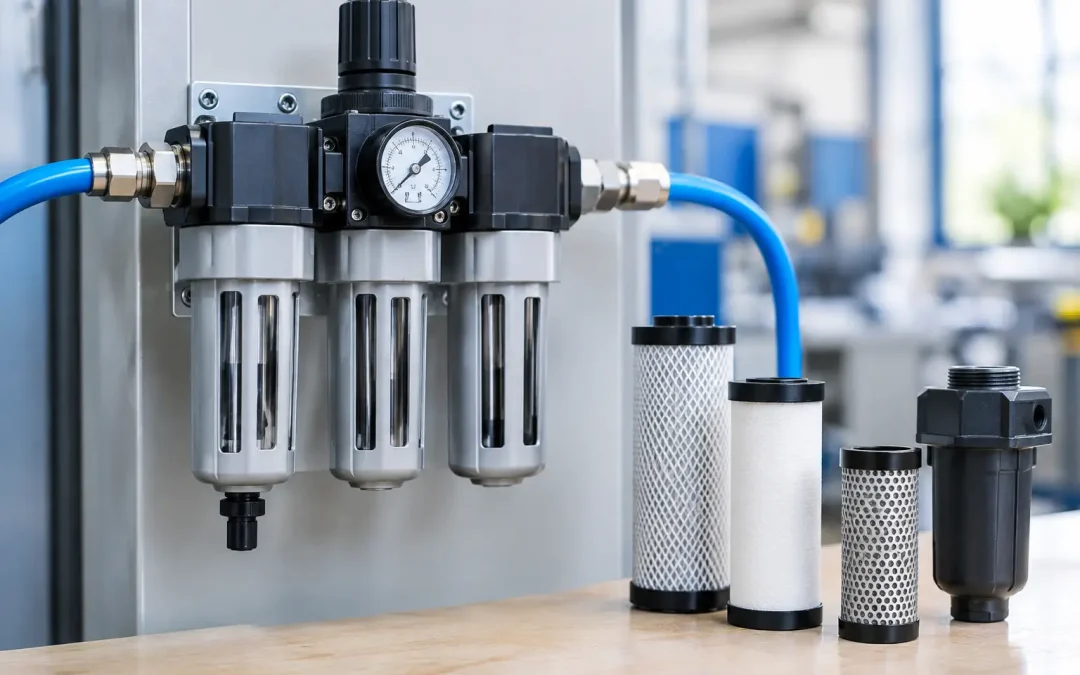
A general particulate filter captures pipe scale, rust, dust, and other solid debris. It is typically the first filtration stage after a mainline separator or at the point of use. Coalescing filters target fine aerosolized oil and water, making them appropriate ahead of sensitive instruments, paint equipment, vacuum generators, and high-cycle pneumatic controls. Activated-carbon elements address oil vapor and odors, but they are a final-polishing component, not a substitute for particulate or coalescing filtration.
The distinction matters. Specifying a coalescing element as the only protection on a wet, dirty main line may overload it quickly. Specifying only a particulate filter for a precision electro-pneumatic regulator may allow fine oil aerosols to affect repeatability. Effective air preparation uses staged protection, with each stage handling the contaminant load it was designed to manage.
Micron Rating Is Only One Part of Performance
Micron ratings are useful, but they do not tell the whole story unless the filtration efficiency and test conditions are also clear. A nominal rating generally means the element captures a stated percentage of particles around that size. An absolute rating indicates much tighter control at the specified particle size. Those terms should not be treated as interchangeable.
For standard pneumatic automation, a filter in the 5-micron to 40-micron range may be sufficient where the primary concern is scale and particulate damage. Applications using proportional valves, compact solenoid valves, precision pressure controls, or pneumatic instrumentation often require finer filtration. The exact requirement should come from the most sensitive downstream component, not from the least expensive filter option.
There is a trade-off. Finer media increases resistance to flow as it loads with contamination. If a machine is already marginal on pressure during peak demand, moving to a finer element without increasing filter capacity can cause slower actuator motion, reduced gripping force, and inconsistent cycle times.
Flow Capacity Must Be Read at Real Operating Conditions
Published flow capacity can be misleading when it is viewed as a single headline number. Airflow ratings depend on inlet pressure, permitted pressure drop, temperature, and whether the stated flow is standard cubic feet per minute or actual flow at line conditions.
Review the flow curve whenever it is available. A filter that appears adequate at a low pressure-drop threshold may become a restriction during a fast cylinder extension, a blowoff pulse, or simultaneous valve actuation across a machine zone. This is especially common on packaging equipment and automated assembly stations, where average air consumption looks modest but instantaneous demand is high.
A practical sizing approach is to calculate peak demand for the section of the system, add reasonable capacity for future additions, and select a filter body that maintains acceptable pressure drop with a partially loaded element. Sizing only for a clean, new element creates a maintenance problem later. The filter will still remove contaminants, but the machine may lose the pressure margin needed for repeatable performance.
Drain Design Separates a Good Filter From a Reliable One
Collected condensate must leave the bowl. If it does not, airflow can re-entrain water and oil into the downstream line, effectively defeating the filter. This is why drain selection deserves the same attention as micron rating.
Manual drains are simple and cost-effective for low-risk applications with disciplined maintenance schedules. They are a poor fit for unattended systems, remote equipment, or operations where technicians cannot reliably inspect every point-of-use assembly. Semi-automatic drains can discharge when pressure is removed, which works well for equipment that is routinely shut down. Automatic drains are typically the better choice for continuously operating production equipment with meaningful moisture loads.
Drain performance also depends on installation. A bowl mounted where access is blocked will not be serviced. A drain line that is kinked, frozen, or routed into an unsuitable collection point can create its own failure mode. In plants with oil-lubricated compressors, condensate handling should follow site environmental procedures rather than being treated as ordinary water.
Housing and Bowl Materials Need to Match the Environment
The filter body and bowl see pressure, vibration, temperature changes, and sometimes chemical exposure. Aluminum housings are widely used for industrial air preparation because they offer a strong balance of weight, durability, and cost. For corrosive, sanitary, outdoor, or washdown environments, stainless steel air preparation components can provide a more durable answer.
Bowl material requires separate consideration. Polycarbonate bowls offer good visibility and are common in general factory service, but certain solvents, cleaning chemicals, and environmental conditions can cause stress cracking or degradation. Metal bowls provide greater impact resistance and are often preferred in demanding applications. Bowl guards can add protection, but they do not make an incompatible material chemically suitable.
Maintenance teams should also consider temperature limits and ultraviolet exposure. A filter mounted near a heat source, in direct sunlight, or on mobile equipment may face conditions very different from a protected indoor assembly line.
Pressure Drop Is a Maintenance Signal, Not Just a Design Figure
Every filter creates some pressure drop, and that drop rises as the element loads. The right response is not to wait until downstream equipment fails. Differential pressure monitoring gives maintenance teams a direct indication that the element is approaching replacement criteria.
Without monitoring, many facilities use time-based replacement schedules. This can work where contamination and runtime are stable, but it can also waste elements or miss unexpected loading caused by compressor failure, deteriorating piping, or a change in production demand. A pressure indicator or differential gauge supports condition-based maintenance and makes root-cause troubleshooting easier.
If filters begin clogging far sooner than expected, replacing elements repeatedly is not the full fix. Inspect compressor intake performance, aftercooler operation, receiver drainage, dryer capacity, and the condition of older distribution piping. Excessive loading often signals an upstream problem that is sending contamination through the system faster than point-of-use filtration can manage.
How to Compare Filter Options for Demanding Equipment
A useful comparison should evaluate the assembly as a system: filtration grade, flow curve, bowl capacity, drain type, pressure rating, port size, environmental compatibility, and serviceability. Element availability matters as well. A filter with excellent specifications but difficult-to-source replacement elements can create avoidable production risk.
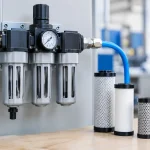
For an OEM, modularity can be equally valuable. Filters that integrate cleanly with regulators, lubricators, soft-start valves, and shutoff components reduce plumbing, leak points, and panel space. For maintenance replacements, matching the established porting, mounting arrangement, and pressure requirements may be more important than adding features that the existing system cannot use.
VidoAir supports this decision process with industrial air preparation options that can be configured around pneumatic demand, contamination exposure, and installation constraints. The goal is not to overspecify filtration. It is to protect valves, actuators, grippers, and controls without sacrificing the flow and pressure stability the machine needs.
Before approving a filter, verify the downstream cleanliness requirement, peak flow, expected moisture load, bowl material compatibility, and element replacement plan. A properly selected filter becomes quiet insurance for pneumatic uptime. A mismatched one becomes another restriction technicians have to diagnose when production is already behind schedule.