A pneumatic line can appear healthy at the compressor and still deliver the contamination that causes a critical valve spool to stick, a cylinder seal to wear early, or a paint finish to fail inspection. Compressor air filters are the first controllable barrier between compressed-air generation and the precision components that depend on it. For production equipment, filtration is not a minor maintenance item. It is part of the system’s uptime strategy.
The challenge is that not every application needs the same filter grade, drain method, or service interval. Over-filtering can add unnecessary pressure drop and operating cost. Under-filtering shifts the cost downstream into failed components, scrap, and unplanned troubleshooting. The right approach begins with identifying what is actually in the air and what the point of use can tolerate.
Start With the Contamination Load
Compressed air commonly carries solid particles, condensed water, oil aerosols, and oil vapor. The makeup changes with compressor type, intake conditions, duty cycle, ambient humidity, receiver capacity, and the condition of piping. A system located near welding, grinding, or bulk-material handling may ingest a far heavier particulate load than one supplied with clean indoor intake air.
Water deserves particular attention because air cools as it travels through the system. A compressor may produce air that looks dry at discharge, while a long run through uninsulated pipe creates condensation before the air reaches a machine. That water can combine with compressor lubricant, scale, and dirt to form a sludge that bypasses poorly maintained drains and collects in valves, regulators, and cylinders.
Before specifying a filter, assess the compressor lubricant, operating pressure, average and peak flow, air temperature, piping layout, and downstream process requirements. Also distinguish between protection for general pneumatic motion and protection for a process. A clamp cylinder can tolerate conditions that would be unacceptable for instrumentation, food packaging, paint spraying, or vacuum generation.
Compressor Air Filters Need Staged Protection
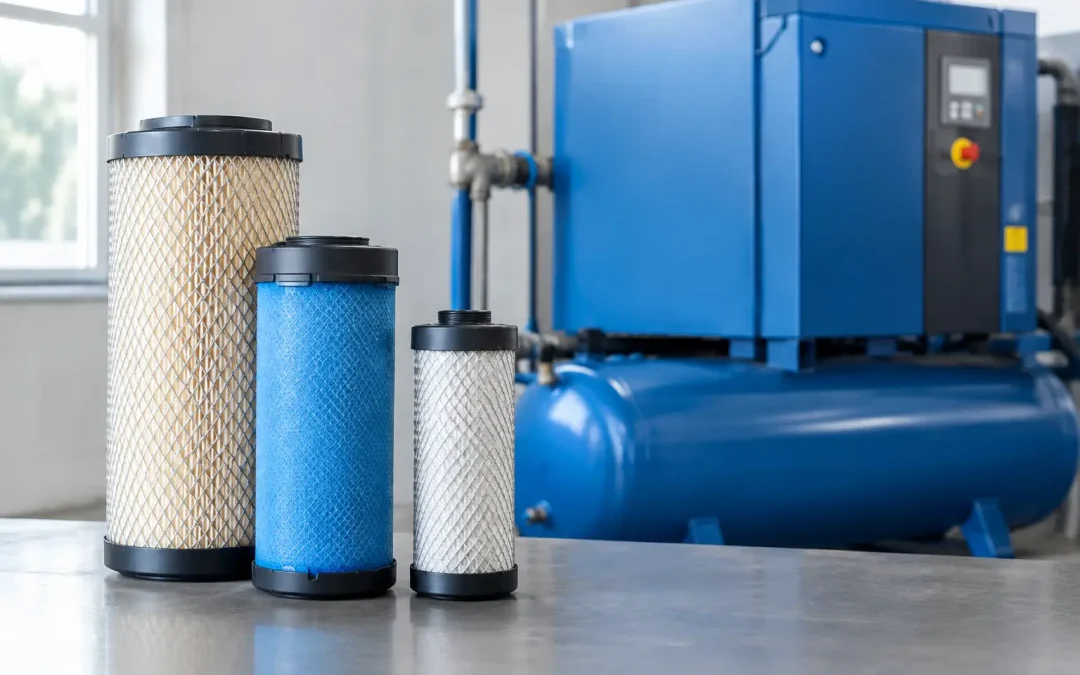
A single filter rarely provides the most efficient solution for demanding systems. Staged filtration places each element where it delivers a clear function while avoiding premature loading of fine media.
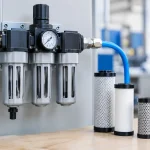
A particulate or general-purpose filter is typically the upstream workhorse. It captures pipe scale, rust, dust, and liquid water droplets before they reach air preparation components. This filter is essential after a receiver or dryer and at branches feeding general machinery, especially in older facilities where internal pipe corrosion is a known concern.
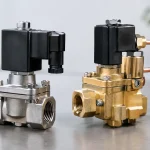
Coalescing filters address fine oil aerosols and smaller liquid droplets. Their media causes fine aerosols to combine into larger droplets that can drain from the bowl. They are often required ahead of sensitive solenoid valves, proportional controls, instrumentation, and processes where oil carryover creates quality or reliability issues.
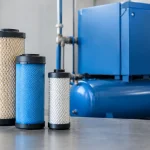
Activated-carbon filtration serves a different purpose. It reduces oil vapor and odors that pass through coalescing media. It is appropriate where air quality directly affects a product or process, but it is not a replacement for particulate and coalescing stages. Carbon elements can be damaged or exhausted quickly when they are asked to handle bulk oil or water.
The practical sequence is bulk contaminant removal first, fine coalescing second, and vapor treatment only when the application requires it. This staged design protects expensive fine elements and provides a more predictable pressure-drop profile over the service life of the system.
Match Filtration Grade to the Downstream Risk
The smallest micron rating is not automatically the best selection. Fine filtration media generally creates more resistance to airflow, and that resistance rises as the element loads. If a high-flow actuator bank only needs protection from pipe debris and liquid water, an ultra-fine element may reduce available cylinder force without adding meaningful value.
On the other hand, a 5-micron particulate filter may not sufficiently protect pilot-operated valves, precision regulators, or pneumatic controls exposed to compressor oil aerosol. Review the component manufacturer’s air-quality requirements, then specify the filter train around the most sensitive equipment on that branch.
This can lead to a smarter system layout: use suitable central treatment for the plant header, then install point-of-use compressor air filters for critical machines. That approach avoids imposing fine-filtration pressure loss across every air consumer while giving high-value processes the protection they need.
Pressure Drop Is a Production Variable
A filter that is too small, incorrectly plumbed, or overdue for replacement becomes a restriction. The effect is often misdiagnosed as an undersized compressor, a failing regulator, or weak cylinder performance. In reality, the pressure at the compressor may be acceptable while the machine sees a substantial loss under flow.
For an actuator, lost pressure translates directly into lost force. A cylinder that must overcome fixture friction, payload variation, or a side load may cycle reliably during low demand but stall when several valves shift at once. This is particularly common in automated cells where air consumption is intermittent and peak flow is much higher than the average compressor demand.
Size filters for actual flow at operating pressure, not simply the nominal pipe size. Check published flow curves and pressure-drop data at the required inlet pressure. Leave capacity for peak demand, element loading, and future machine modifications. A filter that looks generously sized on paper can become restrictive if its rating was based on ideal conditions or a lower flow requirement.
Differential pressure indication is a valuable maintenance tool because it replaces guesswork with a visible condition signal. If a filter has no indicator, record upstream and downstream pressure during a repeatable high-flow machine cycle. A growing difference across the assembly is evidence that the element is loading or the unit is undersized.
Drain Failures Create Problems That Look Like Filter Failures
Many air-quality problems are caused less by the element itself than by a drain that does not evacuate collected liquid. Manual drains are dependable when included in a disciplined maintenance route. In high-duty systems or hard-to-access installations, automatic drains are usually the stronger choice, provided they are compatible with the condensate and the operating environment.
A blocked drain allows water and oil to rise into the filter bowl. During sudden flow demand, turbulence can re-entrain that liquid and carry it downstream. The result may be intermittent valve sticking, inconsistent lubrication, or unexplained water at the point of use even though a filter is installed.
Inspect drain discharge regularly. No discharge is not always good news. It can mean the system is clean, but it can also mean the drain is plugged, isolated, or receiving insufficient pressure to operate. Excessive discharge may point to poor upstream water separation, a saturated dryer, or unusual compressor carryover.
Troubleshoot the System, Not Just the Element
When contamination reaches pneumatic equipment, replacing the filter element is necessary only if it addresses the root cause. A recurring pattern should trigger a wider inspection of the air system.
Start by checking flow direction and bowl orientation. Filter assemblies installed backward may still pass air, but their separation performance can be poor. Confirm that the correct element grade is installed, since replacement cartridges with similar dimensions can have very different filtration characteristics.
Next, inspect the compressor, aftercooler, receiver, dryer, and main-line drainage. A failed refrigerated dryer, undersized moisture separator, or receiver with an inoperative drain can overload every downstream filter. Likewise, degraded compressor oil or a worn air-oil separator can increase aerosol carryover beyond what the existing coalescing stage was designed to handle.
Finally, look at the piping. Corroded black iron pipe, low spots without drains, and dead legs can continuously release contamination into otherwise well-treated air. If debris appears primarily after maintenance work, flushing or purging affected branches may be more effective than repeatedly changing point-of-use elements.
Build Service Intervals Around Conditions
Calendar-based replacement is useful as a starting point, but it should not be the only rule. Filter life depends on air quality, compressor runtime, ambient conditions, and flow demand. A plant operating around the clock in humid conditions will load elements differently than a low-duty assembly operation.
Use a combination of scheduled inspection, differential-pressure monitoring, drain verification, and observed downstream performance. Keep records of element changes and contamination findings. If a coalescing element consistently fails early, the answer may be better upstream separation rather than more frequent purchasing.
For OEMs and integrators, standardizing bowl sizes, thread types, replacement elements, and drain styles across machine platforms also simplifies field service. VidoAir air preparation assemblies can be configured around flow, filtration grade, drainage, and installation requirements, helping engineers protect sensitive pneumatic hardware without adding unnecessary restriction.
Clean air is most valuable when nobody has to think about it. Specify filtration according to the real contamination risk, verify pressure loss under demand, and treat drainage as part of the system. Those steps give valves, actuators, and controls the stable air supply they need to keep production moving.