A tubing failure rarely begins with a dramatic burst. More often, it starts as a small leak at a fitting, a line that kinks after repeated machine movement, or a tube that hardens near a heat source. Selecting the right pneumatic tubing materials is therefore a system reliability decision, not a commodity purchase. The material must perform under the actual pressure, temperature, motion, media exposure, and installation conditions of the machine.
For OEMs, integrators, and maintenance teams, the lowest tubing cost can become expensive quickly when it creates air loss, inconsistent actuator performance, unplanned service calls, or delayed production. A material that fits the application protects both pneumatic efficiency and uptime.
How Pneumatic Tubing Materials Affect System Performance
Pneumatic tube selection affects more than whether air reaches the cylinder. Tube stiffness influences routing and installation time. Outside diameter tolerance affects push-to-connect fitting retention and sealing. Internal surface quality can influence flow restriction, particularly on long runs or high-cycle equipment. Chemical resistance determines whether the tubing remains flexible and intact after exposure to washdown chemicals, oils, coolants, or cleaning agents.
The operating environment matters just as much. A flexible tube that performs well on a stationary assembly fixture may fail rapidly on a cable carrier. A material suitable for dry, filtered compressed air may not tolerate compressor oil carryover. Likewise, a tube rated for room-temperature shop conditions may become too rigid in a refrigerated enclosure or soften near heated tooling.
Pressure ratings should always be read with temperature in mind. As operating temperature rises, the allowable working pressure of many thermoplastic tubes declines. Engineers should specify from the manufacturer’s published pressure-temperature data, then allow a practical margin for pressure spikes, startup conditions, and expected service life.
Polyurethane Tubing for Motion and Tight Routing
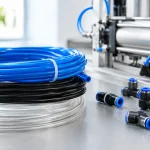
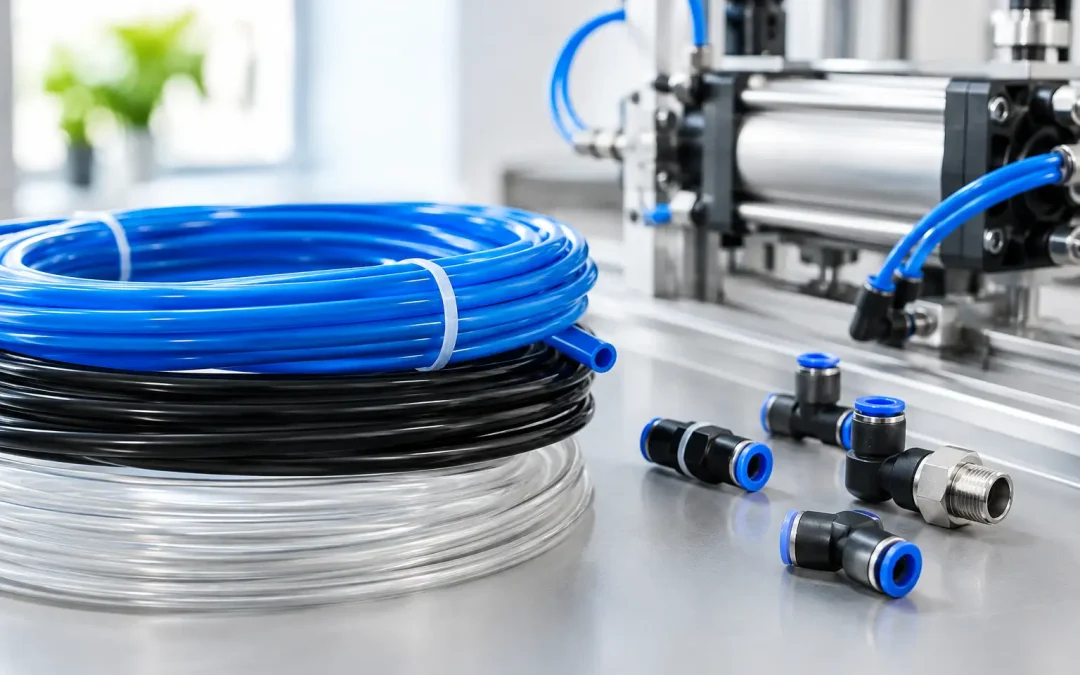
Polyurethane, commonly identified as PU, is a leading choice where flexibility, abrasion resistance, and repeated movement are priorities. It has a relatively tight bend radius and resists kinking better than stiffer alternatives, making it well suited to robotic end effectors, pick-and-place equipment, moving slides, and compact automation cells.
This flexibility comes with trade-offs. Polyurethane generally has lower maximum pressure capability than nylon tubing of the same size, and some grades are less appropriate for elevated-temperature service or certain aggressive chemicals. It may also be more permeable than harder tubing materials, which can matter in systems where air loss must be tightly controlled.
For high-cycle motion, look beyond the material label. Confirm the tube’s bend radius, abrasion resistance, and suitability for cable tracks or continuous flexing. Route the line so it does not rub against sharp sheet-metal edges, actuator hardware, or adjacent tubing. A premium flexible tube cannot compensate for poor routing geometry.
Nylon Tubing for Higher Pressure and Mechanical Strength
Nylon tubing is often selected for pneumatic circuits requiring higher pressure capability, greater mechanical strength, and better resistance to elevated temperatures. Its harder construction makes it useful on stationary machinery, industrial vehicles, heavy equipment, and applications where tubing could be exposed to impact or abrasion.
Compared with polyurethane, nylon is less flexible and requires a larger bend radius. Forcing it into a tight route can place continuous stress at the fitting connection or cause the tube to ovalize, restricting flow. Nylon also absorbs moisture, which can alter dimensions and physical properties depending on the grade and environment. That does not make it unsuitable for humid conditions, but it does mean engineers should select a grade designed for the service environment.
Semi-rigid nylon is commonly a strong option for fixed air distribution lines. When the machine needs a clean, durable installation with moderate routing complexity, nylon can offer a useful balance of pressure performance and service life.
Polyethylene Tubing for Clean, Cost-Conscious Air Lines
Polyethylene, or PE, is a practical choice for many low- to medium-pressure pneumatic applications. It is lightweight, chemically resistant to many common substances, and often more economical than polyurethane or nylon. It is frequently used for stationary air lines, general industrial controls, water-compatible circuits, and applications where flexibility is not the central requirement.
The limitation is its comparatively lower mechanical strength and temperature capability. Polyethylene can be too soft for applications where abrasion, repeated motion, or high pressure are present. It can also become less suitable near heat sources or in installations that require exceptionally tight, kink-resistant bends.
When using PE tubing with push-to-connect fittings, verify the tubing hardness and dimensional tolerance match the fitting design. Poorly controlled outside diameter can reduce gripping performance, even if the nominal size appears correct.
PTFE and Fluoropolymer Tubing for Heat and Chemical Exposure
PTFE tubing is specified when ordinary pneumatic tubing materials cannot handle the environment. It offers exceptional chemical resistance, high-temperature capability, and very low friction. This makes it a fit for chemical processing equipment, specialty manufacturing, laboratory automation, hot-air circuits, and applications involving solvents or corrosive media.
Its performance comes at a higher material cost and with handling considerations. PTFE is less flexible than polyurethane and may need more careful routing. It can also be prone to cold flow under certain fitting and loading conditions, so fitting compatibility is critical. Do not assume a standard push-to-connect fitting that works with nylon or PU will provide the same retention and seal performance with PTFE.
Other fluoropolymer materials, such as FEP and PFA, can provide different combinations of flexibility, clarity, temperature resistance, and chemical compatibility. The correct choice depends on the exact media, operating temperature, and required tube geometry.
Material Selection Must Include the Air System
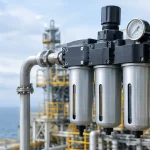
A tube does not operate independently from the rest of the pneumatic circuit. Compressor oil carryover, incomplete filtration, water contamination, and pressure cycling all influence material life. Before replacing a failed line with a different tubing type, identify what caused the failure.
If tubing becomes swollen, soft, or brittle, inspect the air preparation system and confirm whether the line is exposed to oils, cleaners, or process chemicals. If cracks appear close to fittings, check for side loading, undersized bend radius, excessive insertion force, or incompatible fitting teeth. If a line blows out of a fitting, verify the outside diameter, tube hardness, cut quality, and fitting type before blaming the tubing material.
A clean, square tube cut is essential. Angled cuts, crushed ends, and scratches at the sealing area can create slow leaks that are difficult to diagnose. For critical circuits, use a purpose-built tubing cutter rather than side cutters or a utility blade.
Specify the Tube by Application, Not Color
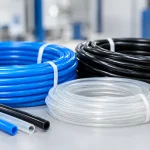
Color coding is valuable for installation, troubleshooting, and maintenance, but it is not a material specification. Two blue tubes can have entirely different pressure ratings, temperature limits, hardness, and chemical resistance. Procurement teams should avoid substitutions based only on size and color, especially when a tube is used on safety-related equipment, high-cycle machinery, or high-temperature process equipment.
A complete tubing specification should document the material, outside diameter, inside diameter or wall thickness, working pressure at operating temperature, service media, color, required certifications, and fitting compatibility. For moving applications, add minimum bend radius and flex-cycle expectations. This gives maintenance teams a repeatable replacement standard and prevents unapproved material changes during a rush repair.
Matching Material to Common Industrial Applications
Polyurethane is typically the better choice for robotic tooling, moving actuators, compact automation, and equipment with frequent motion. Nylon is often better for higher-pressure stationary lines, mobile equipment, and mechanically demanding installations. Polyethylene fits general-purpose, lower-pressure routing where chemical resistance and cost efficiency matter. PTFE or related fluoropolymers belong in high-temperature, chemically aggressive, or specialty process environments.
These are starting points, not universal rules. A food-processing line may need tubing that also meets washdown, temperature, and regulatory requirements. A refrigeration application may require a material that remains dependable at low temperatures. An automated welding cell may need abrasion resistance and heat tolerance in the same route. The best selection reflects the complete operating envelope.
Build Reliability Into the First Installation
Tubing is one of the most visible parts of a pneumatic system, yet it is often specified last. That approach creates avoidable restrictions, leaks, and service problems. Select material early, match it to the fitting and air preparation strategy, and validate the routing before the machine reaches production.
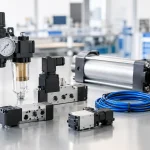
For demanding installations, VidoAir can support material and component selection across pneumatic tubing, fittings, air preparation, valves, and motion hardware. The most useful tubing is not simply the one that fits the port today. It is the one that keeps fitting correctly after thousands of cycles, changing temperatures, and the real conditions of the plant floor.