A vacuum generator that picks a sealed carton flawlessly can fail immediately when the same end effector handles a corrugated blank, a perforated part, or a slightly warped metal panel. That is why the best industrial vacuum generators are not simply the units with the deepest stated vacuum rating. They are the generators that match the part leakage, cycle rate, available compressed air, mounting location, and control strategy of the machine.
For OEMs, integrators, and maintenance teams, the correct choice protects more than grip force. It affects compressed-air demand, recovery time after a missed pick, noise exposure, downtime, and the stability of the entire handling process. A small ejector may be the right answer for a fast, localized robotic pick. A multistage generator with vacuum sensing may be the better investment for a high-leakage packaging station running three shifts.
What Separates the Best Industrial Vacuum Generators
Industrial vacuum generators create vacuum through the Venturi principle. Compressed air accelerates through a nozzle, creating a low-pressure zone that draws air from the suction side. The design is simple, with no moving mechanical pump components, but application results depend heavily on how that air flow is managed.
The strongest selections balance two measurements that are often confused: vacuum level and suction flow. Vacuum level, typically stated in inches of mercury or kilopascals, indicates how much pressure differential the generator can develop. Suction flow indicates how quickly the generator can evacuate a volume of air and compensate for leakage.
A high vacuum level is valuable when lifting smooth, nonporous parts with limited cup area. Glass, sealed plastic trays, machined metal, and smooth sheet goods often benefit from a high vacuum level because the cup can maintain a tight seal. However, high vacuum alone does not solve a leaking application. Porous cartons, rough lumber, textile layers, foam, and uneven surfaces continuously admit air. These jobs require enough suction flow to maintain usable vacuum under leakage.
This distinction is where many specifications go wrong. A buyer may select a compact high-vacuum ejector based on its maximum rating, then find that it cannot hold a porous box. The problem is not necessarily inadequate pressure. It is insufficient flow capacity for the real leak rate.
Choose the Generator Type Before Comparing Ratings
Single-stage ejectors are compact, economical, and effective for many point-of-use tasks. They fit well on robotic end effectors, small pick-and-place assemblies, and individual suction cups where fast local response matters. Their trade-off is compressed-air consumption, particularly if they run continuously to compensate for leakage.
Multistage vacuum generators use several nozzles to increase suction flow. They are often a stronger fit for porous materials, larger vacuum pads, multiple cups, and central manifolds serving a handling fixture. They can move more air, but they require careful sizing of the air supply, exhaust path, and noise control.
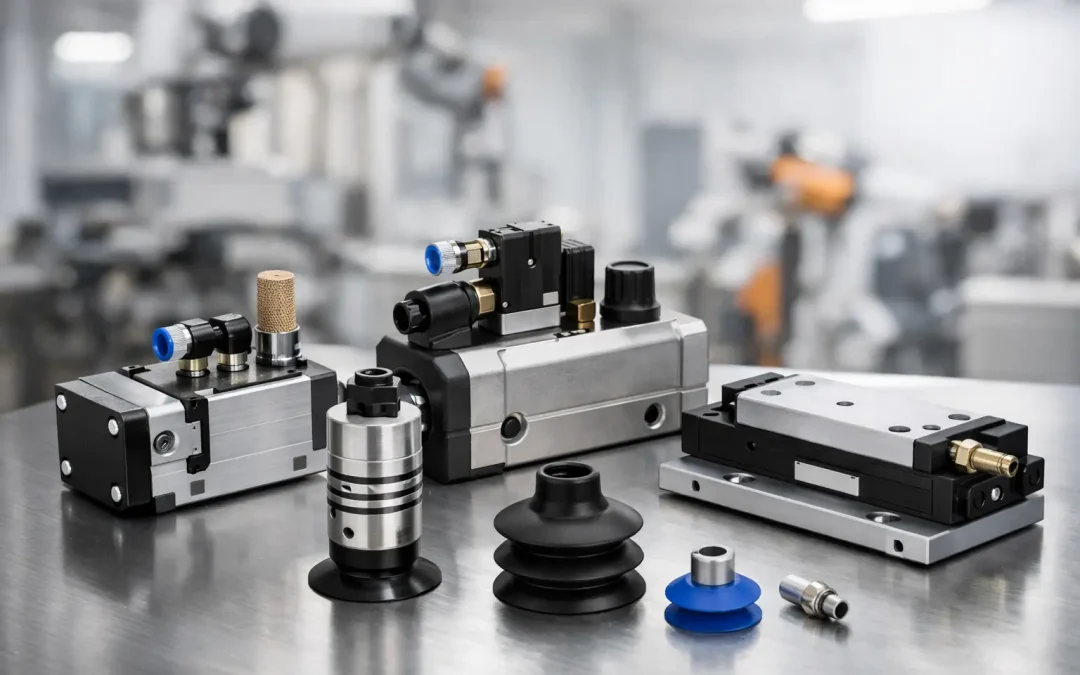
Integrated vacuum generators combine the ejector with useful control functions such as a solenoid valve, blow-off valve, vacuum switch, check valve, and energy-saving logic. These units reduce tubing runs and simplify installation. They are especially practical where machine builders need a compact, repeatable vacuum module rather than a collection of separately plumbed components.
A centralized vacuum arrangement can make sense when many cups operate together and the generator can be mounted away from contamination, impact, or heat. Decentralized generators, mounted close to the cups, generally improve response time and reduce the internal volume that must be evacuated. Neither layout wins in every case. Long vacuum lines may slow pick response, while placing many ejectors on a moving robot can add weight and increase utility connections.
Size Industrial Vacuum Generators for the Actual Load
Start with the required holding force, then add a realistic safety factor. The basic relationship is straightforward: holding force equals vacuum pressure differential multiplied by effective cup area. The difficult part is defining effective area. A cup rarely delivers its theoretical area when the surface is curved, textured, dusty, wet, or misaligned.
For vertical lifting, account for part weight, acceleration, deceleration, vibration, and any side load caused by motion. For horizontal transfer, friction, cup orientation, and machine acceleration still matter. A light package can require more capacity than a heavier rigid part if it leaks badly or moves rapidly through a robot path.
A practical sizing process should confirm these operating conditions:
- Material and surface condition, including porosity, roughness, oil, dust, and perforations.
- Part weight, orientation, acceleration, and the consequences of a dropped part.
- Number, type, and diameter of suction cups or grippers.
- Required pull-down time from atmospheric pressure to the minimum usable vacuum.
- Available supply pressure at the generator during peak machine demand.
- Vacuum line length, tubing diameter, fittings, filters, and valves that add flow restriction.
Do not size from nominal compressor pressure alone. Measure pressure near the vacuum generator while nearby cylinders, blow-offs, and other pneumatic devices are operating. A generator tested at 80 psi may behave very differently if the machine’s pressure falls to 60 psi during a high-demand motion sequence.
For applications with multiple cups, divide the fixture into zones whenever possible. A check valve or individual vacuum control for each cup can prevent one uncovered cup from draining vacuum from the entire system. This is particularly useful in case packing, mixed-size product handling, and sheet handling where part coverage changes from cycle to cycle.
Air Consumption Is a Production Cost, Not a Footnote
Vacuum generators are dependable and fast, but compressed air is one of the more expensive utilities in a plant. A generator that is oversized or left energized unnecessarily can add significant operating cost over thousands of cycles.
The most effective improvement is often vacuum sensing with automatic air-saving control. The generator pulls vacuum until it reaches a set point, then reduces or stops air consumption while a check valve maintains vacuum at the cup. If the vacuum falls because of normal leakage, the unit reactivates. This approach is highly effective on sealed or moderately leaking loads.
Air-saving control has limits. On heavily porous products, the generator may need to run nearly continuously because the leak rate exceeds what the system can hold. In that case, a higher-flow multistage unit, a larger cup contact area, a foam sealing pad, or a different gripper design may deliver better results than simply increasing supply pressure.
Blow-off also deserves attention. A short pulse of positive pressure can release parts quickly, improving cycle time and reducing the chance of a product sticking to the cup. Too much blow-off pressure or duration can shift lightweight parts, scatter debris, and waste air. Tune it at the end effector, not just at the valve manifold.
Controls and Feedback Prevent Missed Picks
A vacuum switch turns a passive holding system into a verified process. Rather than assuming a part is present, the PLC can confirm that vacuum reached the required threshold before allowing a robot or actuator to move. This is a direct way to prevent missed picks, double picks, and collisions caused by an empty gripper.
Use two thresholds when the controls platform permits it. A higher threshold can confirm the initial pick, while a lower threshold can trigger a warning or stop if vacuum falls during transport. The correct thresholds depend on the material and normal leakage rate. Setting them too close to the maximum possible vacuum creates nuisance alarms; setting them too low can validate an unreliable grip.
For critical handling, combine vacuum feedback with part-presence sensing. A vacuum signal can confirm cup contact, but it cannot always distinguish between the intended product and a flat obstruction. Redundant confirmation is justified when a dropped part could damage tooling, interrupt a production cell, or create a safety concern.
Common Vacuum Generator Problems and Their Likely Causes
Slow pull-down is frequently blamed on the generator, but restrictions are often the real issue. Undersized tubing, long hose runs, clogged filters, restrictive fittings, and large dead volumes delay evacuation. Mounting the generator closer to the cup and using correctly sized vacuum tubing can improve response without increasing generator capacity.
Vacuum that falls after a successful pick usually indicates leakage. Inspect cup lips for wear, hardening, cuts, contamination, and incorrect material selection. Then check tubing connections, manifold seals, check valves, and the part surface. On corrugated or textured materials, a cup with a softer lip or a larger sealing area may solve the problem more effectively than a higher vacuum rating.
Poor release often points to inadequate or mistimed blow-off, but it can also be caused by a cup that remains mechanically adhered to a smooth surface. Review cup geometry and release motion along with the pneumatic settings.
Excessive exhaust noise is a common concern with high-flow ejectors. Use correctly sized silencers, but maintain them as service items. A contaminated silencer can create backpressure that reduces performance. In dusty environments, protect both the vacuum side and exhaust path according to the generator design and application conditions.
Specify for the Environment, Not Only the Cycle Time
Standard aluminum-body generators suit many automation cells, but washdown, food-adjacent, corrosive, high-temperature, and dirty environments may require different materials and filtration strategies. Stainless steel air-management components, compatible seals, and accessible filters can reduce maintenance exposure where moisture or aggressive cleaning chemicals are present.
Likewise, do not overlook service access. A high-performance vacuum generator becomes a poor choice if technicians cannot reach the filter, silencer, adjustment point, or electrical connector without dismantling guarding or tooling. For production equipment, maintainability is part of the specification.
VidoAir supports vacuum components and pneumatic controls for applications where performance, replacement availability, and configured solutions all matter. The right selection starts with the operating conditions, not the catalog’s highest number.
Before approving a generator, test it with actual parts at production speed and with normal supply-pressure variation. The best result is not the deepest vacuum on a bench. It is a stable grip, verified pick signal, controlled air use, and a machine that keeps running when real production conditions arrive.