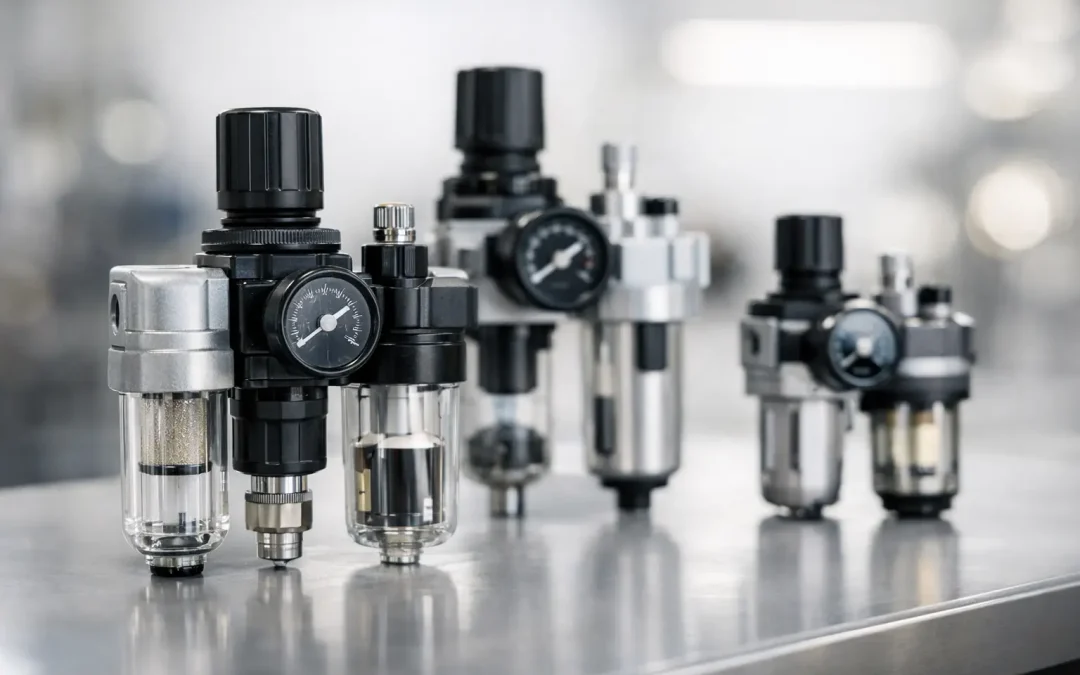
A cylinder that sticks at mid-stroke or a valve island that starts seeing moisture is rarely an actuator problem first. In many plants, the real issue sits upstream in the air prep package. That is why choosing from the top air filter regulator combinations matters more than many teams expect. The right unit protects downstream components, stabilizes pressure, and cuts the kind of nuisance failures that quietly eat production time.
For most industrial buyers, this is not about finding a generic FR unit that matches the port size and calling it done. It is about matching filtration level, regulator stability, bowl construction, drain type, and flow capacity to the actual machine duty. A combination that performs well on a light assembly cell may be the wrong choice for a high-cycle packaging line, a washdown area, or a dusty fabrication environment.
What separates the top air filter regulator combinations
The best-performing combinations are not always the most expensive. They are the ones that stay stable under changing flow demand, handle contamination without constant intervention, and fit the maintenance reality of the site.
Pressure control is usually the first differentiator. Some regulators hold setpoint well at steady demand but show noticeable droop when a bank of valves shifts at once. Others recover quickly and keep downstream pressure tighter through cycling. If your process depends on repeatable clamp force, actuator speed, or air blow-off performance, that difference shows up in quality and scrap rates.
Filtration is the second split. A standard particulate filter is enough for many general pneumatic circuits, but it may not be enough for precision regulators, proportional devices, air bearings, or instrumentation. Finer filtration improves air quality, but it also increases pressure drop and can raise maintenance frequency if the environment is dirty. That trade-off matters.
Then there is construction. Polycarbonate bowls help with visibility and cost, but they are not ideal in every industrial setting. Metal bowls and guards are often the safer call where there is chemical exposure, impact risk, heat, or aggressive cleaning. In a controlled electronics assembly area, the lighter option may be perfectly reasonable. On a heavy equipment line, it often is not.
The 7 most useful filter regulator configurations
Rather than pretending there is one best unit for every machine, it is more useful to look at the top air filter regulator combinations by application type.
1. General-purpose particulate filter plus relieving regulator
This is the standard workhorse for OEM machinery and plant air drops. It typically uses moderate filtration and a relieving regulator that can vent excess downstream pressure when the setpoint is reduced.
It is a strong fit for valve manifolds, cylinders, grippers, and everyday pneumatic circuits where air quality is decent and cost control matters. The advantage is broad compatibility and simple maintenance. The limitation is that it may not give enough protection for very sensitive downstream components or contaminated air systems.
2. Fine filter plus precision regulator
When pressure stability matters more than raw economy, this combination moves to the front of the list. It is common on test fixtures, dosing equipment, light force control, and automation stations where repeatability matters.
The regulator design is the key value here. A precision regulator generally offers tighter control, lower hysteresis, and better response to small demand changes. The downside is that these combinations are less forgiving of poor upstream air quality. If you choose this route, proper pre-filtration and maintenance discipline matter.
3. High-flow filter regulator for fast-cycle equipment
Packaging lines, pick-and-place systems, and multi-actuator assemblies can pull hard on the air system in short bursts. A compact FR unit that looks fine on paper can become a restriction point once the machine reaches full cycle rate.
A high-flow filter regulator solves that by prioritizing Cv, internal passage size, and regulator recovery under dynamic demand. This is one of the most practical combinations for OEMs trying to avoid actuator lag and pressure collapse during simultaneous events. The trade-off is size and cost. You may need a larger body than the port thread alone suggests.
4. Coalescing filter plus regulator for cleaner air demand
If your downstream devices are vulnerable to oil aerosol or very fine contamination, a coalescing stage paired with regulation is often the better answer. This setup is common before instrumentation, electro-pneumatic controls, and sensitive valve assemblies.
It improves air cleanliness significantly, but it is not the right answer everywhere. Coalescing elements add pressure drop and require close attention to saturation and drainage. In a dirty compressed air system, they can become a maintenance burden if used as the only filtration stage.
5. Filter regulator with automatic drain
Manual drains sound acceptable until the plant gets busy and nobody services them on schedule. In wet systems or facilities with fluctuating compressor loading, accumulated condensate can quickly become a reliability problem.
An automatic drain combination reduces that risk and is often the smarter choice for remote installations, continuous-duty equipment, and plants trying to standardize maintenance. It is especially useful where multiple FR units are spread across a line. The caveat is that drain style matters. Some automatic drains are better suited to steady condensate loads than others, and low-pressure operation can affect performance.
6. Stainless steel filter regulator for corrosive or washdown areas
Food-adjacent environments, harsh cleaning protocols, and corrosive atmospheres change the selection criteria immediately. In these conditions, the right combination is less about lowest upfront cost and more about service life, contamination resistance, and inspection confidence.
A stainless steel filter regulator combination is often the correct fit where plated bodies and standard bowls degrade too quickly. This applies in certain chemical processes, washdown zones, marine-adjacent sites, and outdoor exposure points. The trade-off is clear: higher purchase cost in exchange for longer life and fewer replacement cycles.
7. Modular filter regulator with scalable accessories
For machine builders and integrators, modularity can be the deciding factor. A filter regulator that accepts add-on soft-start valves, shutoff valves, pressure switches, brackets, and lubricators offers more flexibility than a fixed standalone unit.
This style works well when machine options vary by customer or when a platform design must support several air prep configurations without redesigning the entire panel. It also simplifies future upgrades. The compromise is that modular systems need careful part matching, and not every modular family maintains the same performance across all body sizes.
How to narrow the choice quickly
Start with actual flow demand, not just connection size. A 1/4-inch port does not automatically mean a small FR is adequate. If several actuators fire together or a blow-off circuit creates sharp peaks, the unit must handle that transient demand without excessive droop.
Next, look honestly at air quality. If the compressor room sends wet, dirty air through long piping runs, selecting a fine element alone will not fix the problem. In that case, staged air preparation may make more sense than asking a single compact filter regulator to do everything.
Material selection should follow the environment, not preference. Transparent bowls help technicians inspect condensate quickly, but exposed impact zones, solvent contact, and elevated temperatures can push the decision toward metal construction. The same logic applies to drain style, seal material, and adjustment hardware.
Maintenance access matters more than many specs sheets suggest. If the bowl is hard to remove, the gauge cannot be read in place, or the drain is awkward to service, maintenance gets deferred. The best combination on paper can turn into a weak point in production if routine service is inconvenient.
Common buying mistakes that cause downstream problems
One of the most common mistakes is undersizing by thread size alone. Another is over-specifying filtration and creating avoidable pressure loss. Buyers also run into trouble when they choose bowl materials without considering cleaners, UV exposure, or mechanical abuse.
There is also a tendency to treat all regulators as equal once the pressure range matches. They are not. Response characteristics, relieving behavior, gauge placement, and repeatability under fluctuating demand can vary enough to affect machine performance.
For OEMs and plant teams trying to standardize parts, it helps to think in families rather than single SKUs. A consistent platform with multiple body sizes and accessory options usually supports purchasing, spare parts planning, and future machine revisions more effectively than a patchwork of unrelated units. That is where a factory-direct supplier with broad air prep coverage and technical support can save real time, especially when standard and configured-to-order options need to coexist.
The best filter regulator choice is rarely the one with the lowest line-item price. It is the one that protects the equipment, holds pressure where it needs to, and fits the environment without becoming a maintenance headache. If you choose with actual operating conditions in mind, the air prep package stops being an afterthought and starts doing what it should – keeping the rest of the system out of trouble.