A PLC that looks economical on a prototype can become an expensive decision after a machine enters production. The best PLC options for OEMs are not defined by processor speed alone. They are the controllers that match the machine’s I/O, motion, communications, safety, commissioning, and long-term service requirements without adding unnecessary cost or integration burden.
For an OEM, the selection decision affects far more than the controls enclosure. It affects panel space, wiring labor, program reuse, spare-parts strategy, field diagnostics, and the ability to deliver machines on schedule. A practical choice begins with the machine architecture, then works backward to the controller platform.
Best PLC Options for OEMs: Start With Machine Complexity
PLC families are often presented as a simple ladder from small to large. In actual equipment design, the better question is whether the PLC architecture fits the work the machine must perform. A packaging station with a few pneumatic cylinders and photoeyes needs a different control approach than a multi-axis assembly cell with vacuum handling, recipe control, traceability, and remote service requirements.
Compact PLCs for focused machine control
Compact or fixed-I/O PLCs are often the right choice for self-contained machines with limited field devices. They work well for applications such as pneumatic press stations, simple conveyor modules, refrigeration skids, small material-handling equipment, and fixture automation.
Their advantage is straightforward: fewer parts, less panel space, faster wiring, and lower initial cost. For a machine with a stable I/O count, integrated digital I/O and a modest number of analog channels can eliminate the need for a separate rack and expansion system.
The trade-off is capacity. A compact PLC can become restrictive when a customer requests additional sensors, valve banks, analog pressure feedback, remote operator stations, or added safety functions. OEMs should avoid sizing a compact controller to the exact number of points on the current electrical drawing. Leave room for reasonable expansion, especially when the machine will be offered in multiple configurations.
Modular PLCs for configurable equipment platforms
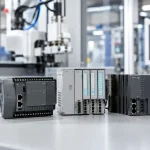
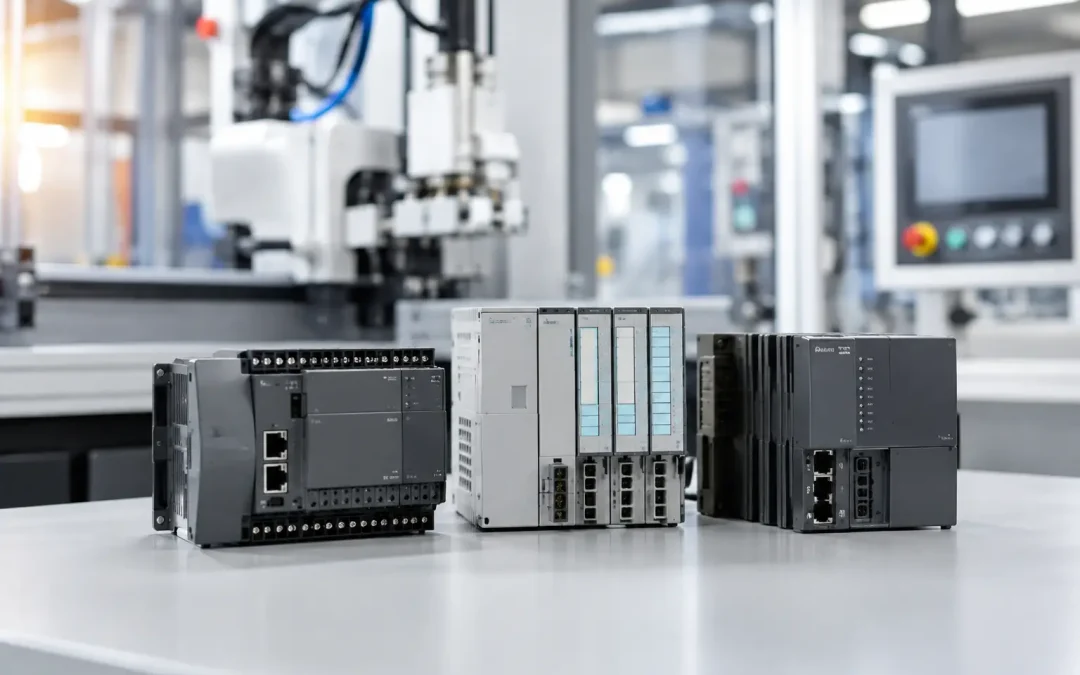
Modular PLCs are usually the stronger fit when an OEM sells a base machine with several options. Separate CPU, power, I/O, communications, and specialty modules allow the controls package to scale without redesigning the complete platform.
This architecture is well suited to machines that combine discrete control with analog process signals, pneumatic valve manifolds, vacuum generators, servo drives, vision systems, barcode readers, or multiple operator interfaces. It also simplifies variant management. One controller family can support a basic model, a high-speed model, and a customer-specific configuration by changing the I/O layout rather than rewriting the machine standard.
Modularity adds cost and design discipline. Each module needs a defined function, wiring plan, spare-parts policy, and documented addressing scheme. But for OEMs building repeatable equipment families, that discipline pays back through faster engineering changes and more consistent field service.
Distributed I/O systems for large or spread-out machines
When sensors and actuators are located across long frames, multiple stations, or separate machine zones, distributed I/O can reduce wiring complexity substantially. Instead of running every field wire back to one central enclosure, remote I/O blocks sit near valve manifolds, sensors, and local devices, connected through an industrial network.
This is particularly valuable on conveyor systems, automated assembly lines, large test fixtures, and machines with multiple pneumatic workstations. Shorter field runs reduce cable cost, improve installation clarity, and make troubleshooting more localized. A technician can identify a failed input or output close to the device rather than tracing conductors across the machine.
The trade-off is network design. Distributed I/O depends on proper cable routing, shielding, grounding, connector selection, and diagnostics. If the network is treated as an afterthought, a wiring reduction can turn into intermittent communication faults. Specify industrial-rated components and document node locations, addresses, and replacement procedures from the first build.
Match PLC Performance to the Actual Control Task
A fast scan time is useful only when the application needs it. For standard pneumatic sequencing, cylinder confirmation, part detection, and conveyor logic, predictable performance and clear diagnostics usually matter more than extreme processing power.
High-speed processing becomes more relevant when the machine includes coordinated motion, registration control, high-speed counting, precision dispensing, complex data handling, or multiple communications tasks running at once. In those cases, verify more than the published scan time. Review available memory, task scheduling, motion capability, network update behavior, and the controller’s ability to maintain deterministic operation while handling HMI, drive, and data traffic.
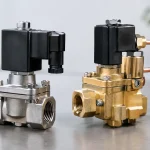
Pneumatic equipment can also shape PLC requirements. A standard solenoid valve output may only need conventional discrete control, while proportional pressure regulation, vacuum monitoring, or closed-loop force control may require analog outputs, analog inputs, and faster update rates. The controller should support the actual resolution and signal types needed by the application, rather than forcing signal converters and workarounds into the panel.
Communications Should Simplify Integration, Not Add Risk
Machine builders increasingly need controllers that communicate with drives, smart sensors, remote I/O, barcode systems, safety devices, and plant-level systems. The best network choice depends on the customer environment and the device ecosystem already selected for the machine.
For many OEM platforms, an Ethernet-based industrial network provides the right balance of speed, diagnostics, and device availability. The key is to select a PLC with the ports and protocol support required by the machine design. A controller with only one available network interface can create avoidable complications if the same port must support programming, an HMI, remote I/O, and a plant connection.
Plan for segregation where appropriate. Machine control traffic should not be exposed unnecessarily to customer enterprise traffic. Consider how an integrator or maintenance team will connect for commissioning, how the OEM will support the machine remotely if permitted, and how the control system will recover after a network device is replaced.
Do Not Treat Serviceability as a Secondary Feature
An OEM machine is judged in the field, often by the speed at which a maintenance technician can diagnose a stopped cycle. PLC selection should therefore include the quality of fault reporting, online monitoring, I/O indication, program structure, and replacement process.
A technically capable PLC becomes harder to support when the program is poorly organized or the electrical design provides no practical access to diagnostics. Use clear tag names tied to the machine function, alarm messages that point to the failed condition, and panel layouts that make I/O modules and network devices accessible. For pneumatic systems, alarms should distinguish between a command to extend, a missing cylinder sensor signal, low supply pressure, and a valve output fault. Those conditions require different corrective actions.
Standardization matters as well. Reducing the number of PLC platforms used across a product line can lower training requirements, simplify spare inventory, and speed commissioning. That does not mean forcing every machine into one controller family. It means choosing a sensible set of platforms that covers the company’s core equipment range.
Build Lifecycle Risk Into the Purchase Decision
A low controller price does not compensate for uncertain availability, limited technical support, or a short product lifecycle. OEMs should evaluate whether the chosen PLC family has stable supply, documented migration paths, and compatible replacement hardware.
This is especially important when machine production will continue for years. The PLC must be available not only for the next build, but also for service replacements and customer expansions. Confirm lead times for CPUs, I/O modules, power supplies, and communication accessories. Select a platform with enough market adoption that technicians and integrators can support it without specialized, hard-to-find expertise.
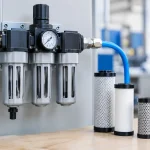
Factory-direct component sourcing can help control the broader automation bill of materials. When PLCs, pneumatic actuators, solenoids, air preparation equipment, tubing, fittings, and vacuum components are selected as a coordinated package, OEMs can reduce supplier handoffs and improve consistency from the controls cabinet to the end effector.
A Practical Selection Standard for OEM Teams
Before releasing a PLC specification, document the machine’s required I/O count with growth capacity, analog and specialty signals, network devices, motion and safety needs, expected cycle times, panel constraints, and service plan. Then test the design against the most demanding machine variant, not only the base model.
A useful specification also identifies what is intentionally excluded. If remote access, servo motion, or plant-level data collection is not part of the current machine, state that clearly while leaving a reasonable path to add it later. This prevents overbuilding every unit while protecting the platform from predictable change requests.
The right controller is the one that gives the machine builder control over cost, delivery, configuration, and field support. Choose a PLC platform that fits the machine you are building now, then make sure its I/O, communications, and service model will still fit when the customer asks for the next capability.